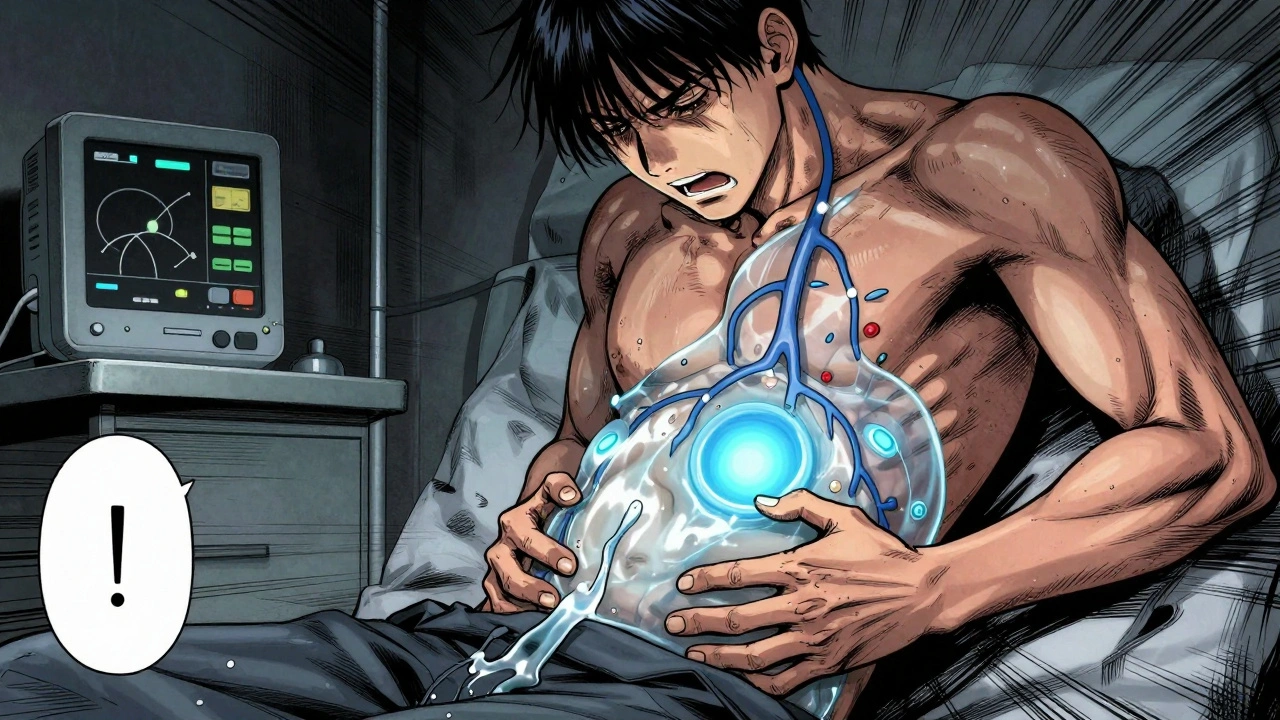
When your liver is damaged, especially from cirrhosis, blood can't flow through it the way it should. This forces blood to find other paths-often through fragile veins in your esophagus or stomach. These veins swell into varices, and if they burst, you could bleed out internally. At the same time, fluid leaks into your belly, creating ascites, making it hard to breathe or eat. This isn’t just a liver problem-it’s a full-body crisis. Portal hypertension is the hidden driver behind these terrifying complications, and without proper management, it kills.
What Exactly Is Portal Hypertension?
Portal hypertension means the pressure in the portal vein-your liver’s main blood supply-is too high. Normal pressure is between 5 and 10 mmHg. Once it hits 10 mmHg or higher, or if the hepatic venous pressure gradient (HVPG) exceeds 5 mmHg, you’re in dangerous territory. This isn’t a standalone disease. It’s almost always a result of cirrhosis, which accounts for 90% of cases. The other 10% come from non-cirrhotic causes like blood clots in the portal vein or rare conditions like schistosomiasis.
The problem starts when scar tissue from chronic liver damage blocks blood flow. Your liver becomes stiff, like a clogged pipe. But here’s the twist: your body tries to compensate by widening blood vessels in your intestines. This increases blood flow to the liver, making the pressure even worse. It’s a vicious cycle. The higher the pressure, the more your veins bulge, the more fluid leaks, and the more your organs suffer.
Varices: The Silent Time Bomb
About half of all people with cirrhosis will develop varices within 10 years. These aren’t just swollen veins-they’re fragile, stretched-out blood vessels that can rupture without warning. The risk of bleeding is 5% to 15% per year if they’re medium or large. And once they bleed, the death rate in the first six weeks is 15% to 20%.
Doctors don’t wait for bleeding to happen. They screen with upper endoscopy. If varices are found, treatment starts immediately. The gold standard? Endoscopic band ligation. It’s simple: tiny rubber bands are placed around the varices during an endoscopy, cutting off blood flow. After 50 supervised procedures, a gastroenterologist can achieve a 90% success rate. Compared to older methods like sclerotherapy (injecting chemicals), band ligation cuts rebleeding rates from 60% down to 25%.
But banding alone isn’t enough. Non-selective beta-blockers like propranolol or nadolol are given to lower portal pressure. The goal? Reduce your resting heart rate by 25% or reach a daily dose of 160 mg. Studies show this cuts the chance of first-time bleeding by 45%. Some patients feel tired or dizzy on these drugs, and 65% report brain fog-a side effect that makes daily life harder. But the trade-off is survival.
Ascites: When Your Belly Swells Beyond Recognition
Ascites develops in 60% of cirrhotic patients within a decade. It’s not just bloating. It’s fluid building up because your liver can’t make enough albumin, and your kidneys start holding onto salt and water. Your belly gets hard, tight, and heavy. You can’t lie flat. Breathing becomes shallow. Many patients quit jobs because standing for more than 20 minutes is unbearable.
First-line treatment is simple but strict: no more than 2,000 mg of sodium per day. That means no canned food, no soy sauce, no processed snacks. Then come diuretics-spironolactone (100 mg/day) and furosemide (40 mg/day). Together, they work in 95% of cases. But if that fails, you need paracentesis: a needle inserted into your abdomen to drain 4 to 6 liters of fluid at a time. And every liter removed? You need 8 grams of albumin infused to prevent kidney failure.
Some patients need this every few weeks. One Reddit user described it as “having a tire iron in your abdomen.” The physical toll is real. But when diuretics and paracentesis aren’t enough, the next step is TIPS-a procedure where a stent is placed between the portal vein and a liver vein, creating a shortcut to reduce pressure. It works in 90% of cases. But here’s the catch: 20% to 30% of patients develop hepatic encephalopathy afterward. Their brain gets foggy, confused, even comatose because toxins from the gut bypass the liver and flood the bloodstream.

Other Deadly Complications You Can’t Ignore
Portal hypertension doesn’t stop at varices and ascites. It triggers a cascade.
- Hepatic encephalopathy affects up to 45% of cirrhotic patients. It’s caused by ammonia buildup. Treatment? Lactulose to flush out toxins, and rifaximin to kill gut bacteria that produce them.
- Hepatorenal syndrome hits 18% of hospitalized patients with ascites. Your kidneys shut down-not because they’re damaged, but because blood flow gets redirected away from them. It’s often fatal without a transplant.
- Spontaneous bacterial peritonitis is a life-threatening infection of ascitic fluid. Antibiotics like ceftriaxone are given immediately if you have fever, abdominal pain, or confusion.
These aren’t rare side effects-they’re expected outcomes if portal hypertension isn’t aggressively managed. And the numbers don’t lie: 60% of patients who survive a variceal bleed will rebleed within a year without proper secondary prevention.
What’s New in 2025? Breakthroughs That Could Change Everything
The field is finally moving beyond just managing symptoms. In September 2023, the European Medicines Agency approved the Hepatica SmartBand-a wearable device that estimates portal pressure using bioimpedance, without needing a needle in your neck. It’s 82% accurate compared to HVPG. That means fewer invasive tests.
In October 2023, the FDA gave breakthrough status to simtuzumab, a drug that targets liver scarring at the molecular level. In trials, it reduced HVPG by 35% in non-cirrhotic patients. If it works in cirrhosis, it could be the first true disease-modifying therapy for portal hypertension.
AI is also stepping in. Mayo Clinic’s algorithm predicts variceal bleeding with 92% accuracy by analyzing liver stiffness, platelet count, and spleen size. That’s better than most doctors’ gut calls. And new drugs are in phase 2 trials that lower portal pressure without dropping blood pressure too much-a long-standing problem with beta-blockers.

Why So Many Patients Still Die
Despite decades of research, mortality from variceal bleeding hasn’t dropped enough. Why? Three big reasons:
- Many patients aren’t screened early enough. Endoscopy should happen at diagnosis of cirrhosis-but in the U.S., only 45% of centers routinely measure HVPG.
- Patients stop taking beta-blockers because of side effects. They feel fine, so they quit. Then they bleed.
- Transplant waiting lists are too long. In the U.S., the median wait is 14 months. Many patients die before they get to the top.
Non-cirrhotic portal hypertension is often missed entirely. If you have a portal vein clot, you need anticoagulants-not beta-blockers. Misdiagnosis kills.
What You Can Do Right Now
If you or someone you know has cirrhosis:
- Get an endoscopy now, even if you feel fine.
- Take your beta-blockers every day. Don’t skip doses because you feel tired.
- Stick to a low-sodium diet. Read labels. Cook at home.
- Watch for signs of infection: fever, belly pain, confusion. Call your doctor immediately.
- Ask about HVPG testing. If your center doesn’t offer it, ask for a referral.
- Consider a liver transplant evaluation if you’re not already on a list.
Portal hypertension isn’t a death sentence. But it demands constant attention. The tools to survive are here. The question is: are you using them?
Can portal hypertension be cured?
No, portal hypertension itself cannot be cured unless the underlying liver damage is reversed-which usually only happens with a liver transplant. Current treatments focus on lowering pressure, preventing bleeding, and managing fluid buildup. Medications, endoscopic procedures, and TIPS can control complications for years, but they don’t fix the scarred liver. The only true cure is transplantation.
How often should I get screened for varices if I have cirrhosis?
If you’ve just been diagnosed with cirrhosis, you should get an upper endoscopy right away. If no varices are found, repeat every 2 years. If small varices are present, repeat every 1 to 2 years. If you’ve had a variceal bleed, you’ll need endoscopy every 3 to 6 months after banding until the varices are gone, then annually. Don’t wait for symptoms-bleeding can happen without warning.
Are beta-blockers safe for everyone with portal hypertension?
Not always. If you have asthma, severe heart failure, or very low blood pressure, beta-blockers can be dangerous. Some patients with small varices and low risk of bleeding may not need them. Your doctor should assess your HVPG, heart function, and overall health before prescribing. If you can’t tolerate beta-blockers, endoscopic banding becomes even more critical.
Can I drink alcohol if I have portal hypertension?
Absolutely not. Any amount of alcohol worsens liver scarring and increases portal pressure. Even small amounts can trigger bleeding or accelerate liver failure. Complete abstinence is non-negotiable. This isn’t a suggestion-it’s a life-or-death requirement.
What’s the difference between ascites and regular bloating?
Regular bloating from gas or food is temporary and moves around. Ascites is persistent fluid buildup that makes your belly feel tight, heavy, and distended. It causes shortness of breath, reduced appetite, and swelling in your ankles. If you press on your belly and it leaves a dent (pitting edema), or if your waist size increases rapidly over days, it’s likely ascites. Get it checked immediately.
Is TIPS a good option for everyone with ascites?
No. TIPS is usually reserved for patients with refractory ascites-meaning diuretics and paracentesis aren’t working. It’s also risky for people with severe liver failure, heart problems, or existing hepatic encephalopathy. The procedure can make brain fog worse. Your doctor will weigh your risk of bleeding, kidney function, and cognitive status before recommending it.
How do I know if I’m a candidate for a liver transplant?
If you’ve had recurrent variceal bleeding, refractory ascites, or hepatorenal syndrome, you’re likely eligible. Your doctor will calculate your MELD score (Model for End-Stage Liver Disease), which uses bilirubin, creatinine, and INR to predict survival. A score above 15 usually qualifies you for the list. The higher your score, the higher your priority. Don’t wait until you’re critically ill-get evaluated early.
What Comes Next?
If you’re managing portal hypertension, your next steps are clear: stay on your meds, follow your diet, keep your endoscopy appointments, and talk to your doctor about HVPG testing. If you’re not getting the care you need, ask for a referral to a liver specialist or transplant center. The tools to survive are available. The biggest barrier isn’t science-it’s awareness. Don’t wait for a bleed to realize how serious this is.
Jaswinder Singh
December 2, 2025 AT 04:30Bro this post is a godsend. I’ve been telling my uncle for months to get that endoscopy-he’s been ‘feeling fine’ and now his belly’s swollen like a water balloon. No more waiting. Get screened. Period.
Conor Forde
December 2, 2025 AT 11:26So let me get this straight-your liver’s a clogged pipe, your veins are party balloons waiting to pop, and the ‘cure’ is either a stent, a needle in your belly, or a whole new liver? Sounds like a sci-fi horror movie written by a drunk hepatologist 😅
Eric Vlach
December 3, 2025 AT 00:35beta blockers make me feel like a zombie but I take em anyway. My cousin died at 48 from a bleed. He skipped his meds because he 'felt fine'. Don't be him.
Also low sodium? Try living on rice and boiled chicken for life. It's not a diet it's a punishment
patrick sui
December 4, 2025 AT 17:23Interesting breakdown-especially the Hepatica SmartBand. Bioimpedance for HVPG estimation? That’s a game-changer if validated. Still, the real bottleneck remains access: rural patients, uninsured folks, and those without hepatology referrals get left behind. We need policy intervention, not just tech. Also, non-cirrhotic portal HTN is criminally underdiagnosed-especially in young adults with portal vein thrombosis. Anticoagulation > beta-blockers here. This deserves more awareness.
Bee Floyd
December 4, 2025 AT 21:38I’ve watched my dad go through this. The ascites drainage? It’s like watching someone deflate. He’d cry after every paracentesis-not from pain, but because he felt like a balloon with a hole. I wish people understood it’s not just ‘bloating’. It’s your body screaming for help.
Souvik Datta
December 4, 2025 AT 21:39Man, I’ve been a nurse for 18 years and this is the most accurate summary I’ve ever seen. TIPS is a double-edged sword-saves lives but turns your brain to mush in 20% of cases. And yeah, lactulose tastes like rotten eggs but it’s the only thing keeping my patient alive.
Bottom line: if you’re on beta-blockers, don’t quit because you’re tired. You’re not just managing symptoms-you’re buying time. And time is everything.
Priyam Tomar
December 6, 2025 AT 11:12Everyone’s talking about TIPS and banding like it’s magic. But have you checked the mortality stats after TIPS? 30% encephalopathy? That’s not a treatment, that’s trading one hell for another. And why’s no one talking about the fact that 60% of patients die within 2 years of first variceal bleed? This isn’t medicine-it’s damage control. We’re just delaying the inevitable. Transplant is the only real answer, and the waitlist is a death sentence for most.
Declan O Reilly
December 7, 2025 AT 10:39It’s wild how we treat the symptoms like they’re the enemy, but the real villain is the silence-patients not getting screened, doctors not ordering HVPG, families not knowing the difference between bloating and ascites.
Portal hypertension doesn’t shout. It whispers. Until it doesn’t.
And when it doesn’t? It’s too late.
We need to normalize the conversation. Talk about it at dinner. Tell your cousin who drinks. Tell your boss you need time off for a scan.
Because the liver doesn’t care if you’re busy. It just stops working.
Jeremy Butler
December 7, 2025 AT 16:21It is imperative to underscore the fact that the current therapeutic paradigm remains palliative in nature, and the absence of a definitive pharmacological intervention capable of reversing hepatic fibrosis constitutes a critical gap in the clinical armamentarium. The advent of simtuzumab, while promising, remains investigational, and its long-term efficacy and safety profile have yet to be established in a prospective, multicenter, randomized controlled trial. Until such data are available, adherence to evidence-based guidelines-including endoscopic surveillance and non-selective beta-blocker therapy-remains the cornerstone of clinical management.