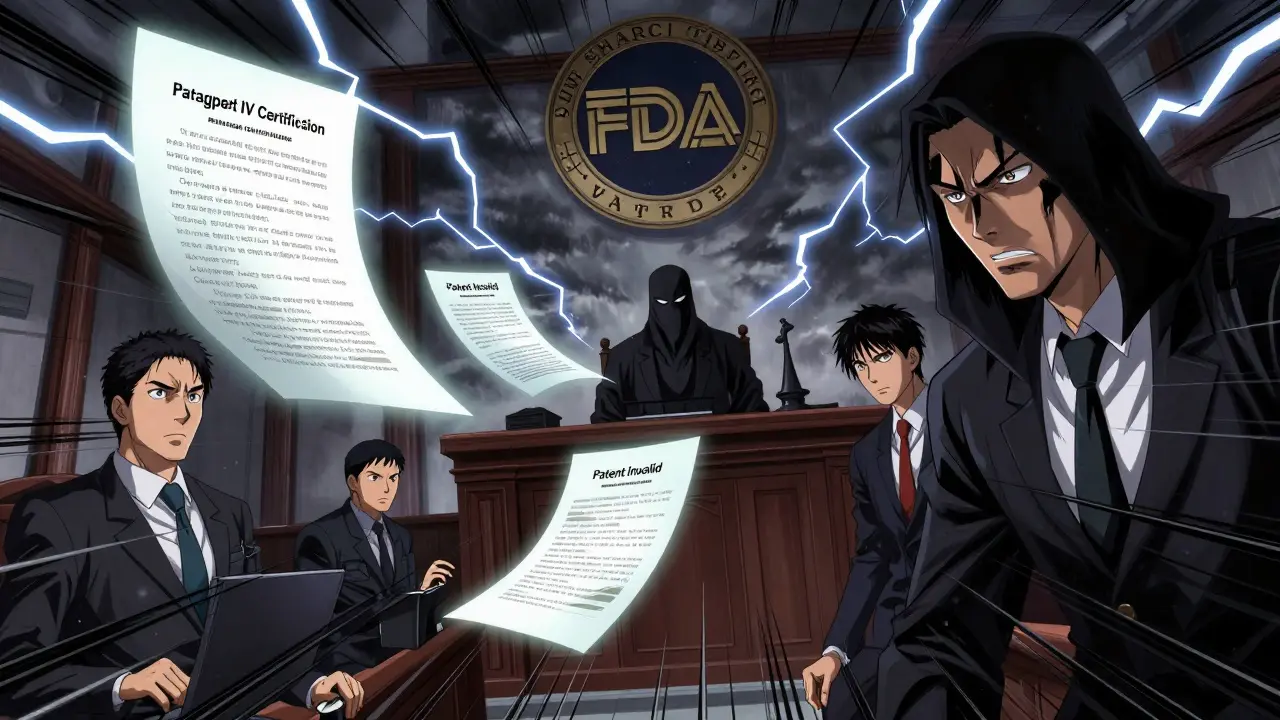
When a brand-name drug company spends billions developing a new medicine, they get a patent to protect their investment. That patent usually lasts 20 years. But here’s the twist: Paragraph IV certification lets generic drug makers challenge that patent before the drug even hits the market. It’s not a loophole. It’s a legal tool built into U.S. law - the Hatch-Waxman Act of 1984 - to speed up cheaper generic drugs without letting big pharma lock up the market forever.
What Exactly Is a Paragraph IV Certification?
A Paragraph IV certification is a formal statement filed by a generic drug company when they submit an Abbreviated New Drug Application (ANDA) to the FDA. In this statement, they say: "One or more of your patents are invalid, not infringed by our drug, or unenforceable." This isn’t just a claim. It’s a legal trigger.
Under normal patent law, you can’t sue someone until they actually make or sell your product. But in pharma, the law says: "Filing this ANDA with a Paragraph IV notice counts as patent infringement." That’s the legal fiction that makes the whole system work. It lets the brand-name company sue immediately - before a single pill is made - instead of waiting for the generic to flood the market and cause damage.
That’s why this system exists. Without it, generics would have to wait until the patent expired to launch - sometimes years after the drug became profitable. Or worse, they’d risk launching early and get crushed in court with massive damages. Paragraph IV creates a clear, timed path for both sides to fight it out in court - on paper - before anyone sells a drug.
The 20-Day Notice and the 45-Day Clock
Once the FDA accepts the ANDA, the generic company has exactly 20 days to send a legal notice to the brand-name drugmaker and the patent holder. This isn’t a friendly heads-up. It’s a formal letter laying out the legal and scientific reasons why their product doesn’t infringe - or why the patent is flawed.
Then the clock starts for the brand company. They have 45 days to file a patent infringement lawsuit. If they do, the FDA immediately puts a 30-month stay on approving the generic. That means no generic can hit the market for at least two and a half years - even if the patent is weak.
But here’s the catch: that 30 months isn’t fixed. If the court rules in favor of the generic before then, the stay ends early. If the brand company delays filing motions or misses deadlines, the stay can be extended. In 2023, the average stay lasted 36.2 months - nearly a year longer than the law intended.
The $500 Million Prize: 180 Days of Exclusivity
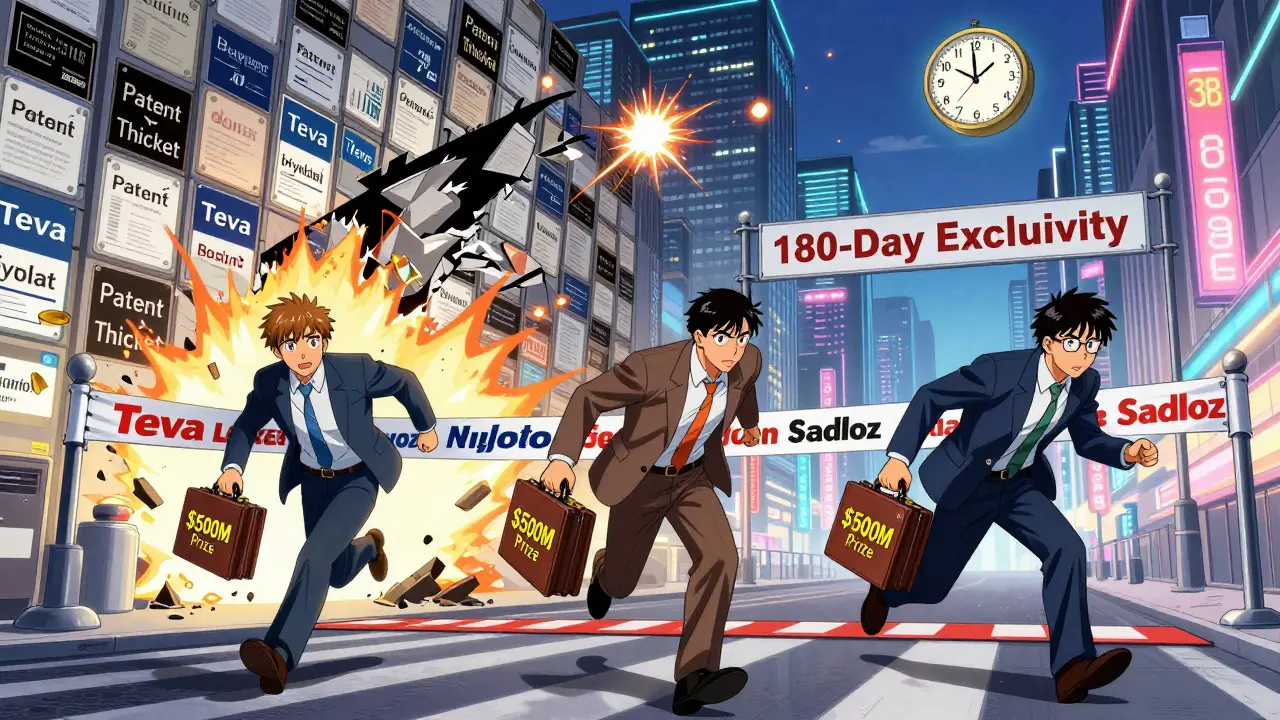
Why would any generic company risk spending $12 million in legal fees and years of waiting? Because the first one to file a successful Paragraph IV challenge gets 180 days of market exclusivity.
During that time, no other generic can sell the same drug. That means they’re the only low-cost option. For a blockbuster drug like Humira, which sold $20 billion a year, 180 days of exclusivity can mean over $500 million in pure profit. In 2023, first-filers earned $4.7 billion total from this rule alone.
That’s why companies like Teva, Mylan, and Sandoz spend millions on patent analysis teams. They don’t just look at patents - they hunt for the weakest ones. A patent on a minor formulation change? A patent that was filed late? A patent that doesn’t actually cover the generic’s version? That’s the goldmine.
How Brands Fight Back: Patent Thickets and Pay-for-Delay
Brand-name companies didn’t sit back and let this system destroy their profits. They adapted.
In 2005, the average drug had 7.2 patents listed in the FDA’s Orange Book. By 2024, that number jumped to 17.3. That’s not innovation. That’s a patent thicket - a wall of overlapping patents, some strong, many weak, all meant to slow down generics.
When a generic files a Paragraph IV challenge, the brand often sues on all 10-15 patents at once. Even if the generic wins on one, they still have to fight the rest. That costs time, money, and patience.
Then there’s pay-for-delay. In 68% of Paragraph IV cases, the brand and generic settle - but not before the brand pays the generic to delay launch. In 2024, these settlements averaged $187 million each. The FTC sued 17 of these deals in 2023-2024, calling them anti-competitive. But they’re still happening. Why? Because it’s cheaper than losing the whole patent battle.
Carve-Outs and Skinny Labels: The Quiet Hack
Not every generic needs to take on the whole patent. Some use a trick called a Section viii carve-out.
Imagine a drug approved for three uses: high blood pressure, heart failure, and migraines. The brand holds a patent only on the migraine use. The generic can file an ANDA that says: "We’re only making this for high blood pressure and heart failure." They remove the migraine indication from their label - a "skinny label" - and launch without touching the patent.
This works in about 37% of Paragraph IV filings. It’s not a direct challenge. It’s a workaround. And it’s growing. Companies use it to get to market faster, avoid litigation, and still capture a big chunk of sales.
Who’s Winning? The Numbers Don’t Lie
Since 2020, generic companies have been winning more often. From 2003 to 2019, they succeeded in about 41% of patent challenges. From 2020 to 2025, that number jumped to 58%. Why? Supreme Court rulings have made it harder to patent vague or obvious inventions - like a new crystal form of a drug that’s been around for decades.
Tea Pharmaceutical led the pack in 2024 with 147 Paragraph IV filings. Mylan and Sandoz weren’t far behind. Meanwhile, the most targeted brand drugs were Humira (28 challenges), Trulicity (24), and Eliquis (21). These are billion-dollar drugs. The generics aren’t just competing - they’re targeting the biggest profits.
And it’s working. In 2024, generic drugs saved U.S. consumers $192 billion. Since 1984, that total is $2.2 trillion. Paragraph IV challenges account for 45% of all generic drug entries. That’s not a footnote - it’s the engine of affordable medicine.
The Future: Tighter Rules and New Battles
The FDA updated its rules in October 2022 to close loopholes. Now, if a generic changes their drug’s crystal structure or strength after filing, they can’t just tweak their Paragraph IV certification. They have to refile properly. That stops companies from "litigation shopping" - filing weak challenges early, then changing their product later to avoid losing.
In 2026, the FDA plans to require brand companies to justify every patent they list in the Orange Book. If they can’t prove it’s relevant to the drug’s use, the patent gets removed. Analysts predict this could cut patent thickets by 30-40%.
The FTC is also stepping up. They’re targeting pay-for-delay deals harder than ever. If those settlements drop, generics could enter the market 4-6 months earlier on average. That’s billions more in savings for patients.
One thing won’t change: the system is still unfair. In every other industry, the patent holder must prove infringement after the fact. In pharma, the generic has to prove they’re not infringing - before they even make the product. But despite that imbalance, it’s the only system we have that gets life-saving generics to patients faster.
Why This Matters to You
If you or someone you know takes a prescription drug, you’ve probably benefited from Paragraph IV. That $5 co-pay instead of $500? That’s not luck. That’s a generic company spending years in court, risking millions, just to get you a cheaper pill.
It’s messy. It’s expensive. It’s full of legal tricks and corporate games. But it works. Without Paragraph IV certifications, most brand-name drugs would stay expensive for years longer. Patients would wait. Insurance premiums would climb. And the cost of care would keep rising.
This isn’t just about patents. It’s about access. And for now, this broken, brilliant system is still the best tool we have to fix it.
Pavan Vora
January 6, 2026 AT 15:42Also, 'skinny labels'? That's wild. Like, you're selling a drug but pretending it doesn't do one thing it totally does... legal loophole art, I guess.
Joann Absi
January 8, 2026 AT 05:12Jeane Hendrix
January 8, 2026 AT 18:04Rachel Wermager
January 9, 2026 AT 02:53Leonard Shit
January 10, 2026 AT 05:26Brian Anaz
January 12, 2026 AT 03:46Venkataramanan Viswanathan
January 13, 2026 AT 09:02Vinayak Naik
January 15, 2026 AT 08:21Kiran Plaha
January 16, 2026 AT 20:12Matt Beck
January 18, 2026 AT 09:04Kelly Beck
January 18, 2026 AT 20:20Molly McLane
January 19, 2026 AT 23:55Beth Templeton
January 21, 2026 AT 07:48Ryan Barr
January 22, 2026 AT 06:08Dana Termini
January 23, 2026 AT 19:21