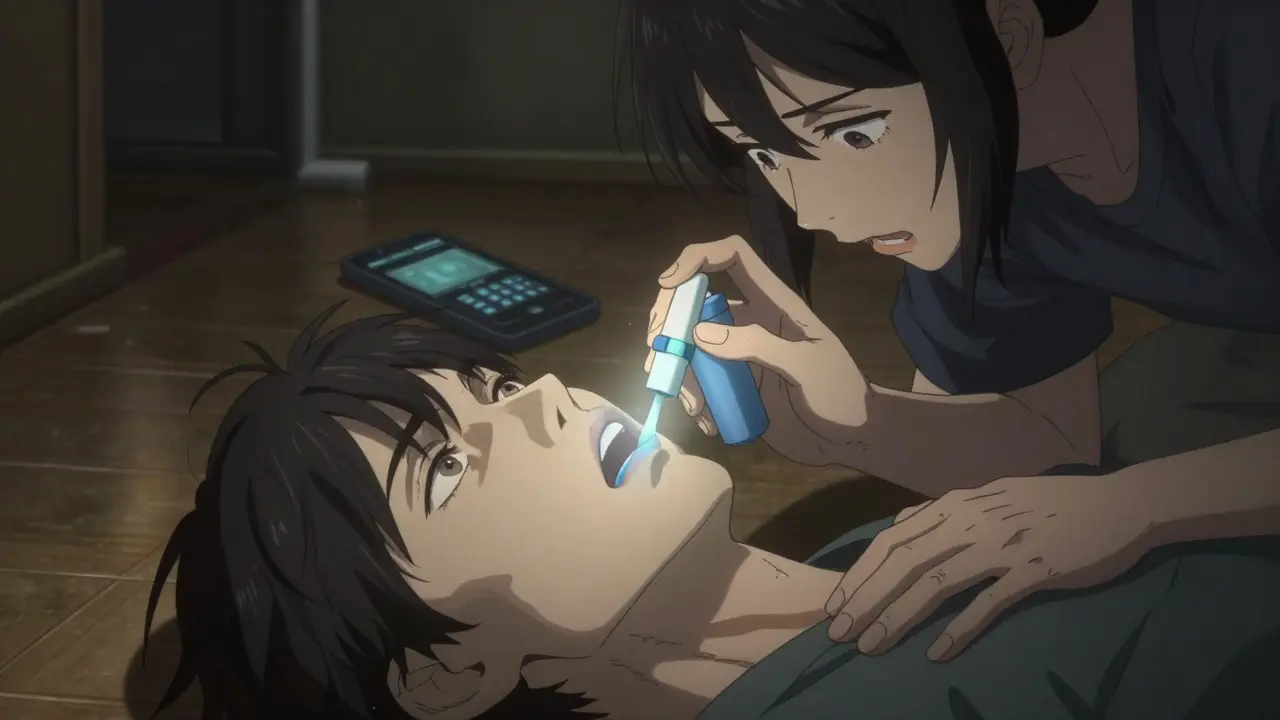
Every minute counts when someone is overdosing on opioids. Breathing slows. Skin turns blue. The person doesn’t wake up-not even when you shake them hard or shout their name. This isn’t just drug use gone wrong. It’s a medical emergency that can kill in minutes. But here’s the truth: naloxone can bring someone back. And you don’t need to be a doctor to use it.
What Happens During an Opioid Overdose
Opioids-like heroin, fentanyl, oxycodone, or morphine-bind to receptors in the brain that control breathing. When too much enters the system, those receptors get overloaded. The brain stops telling the lungs to breathe. Oxygen levels drop. Brain damage starts after just four minutes without air. Without help, death follows quickly.Fentanyl is the biggest threat today. It’s 50 to 100 times stronger than morphine. Most illicit pills and powders now contain fentanyl, often without the user’s knowledge. In overdose cases, fentanyl is involved in nearly 9 out of 10 deaths. Even a tiny amount-less than a grain of salt-can be deadly.
Signs of an Opioid Overdose
You don’t need to be an expert to spot an overdose. Look for these five clear signs:- Unresponsive: The person can’t be woken up, no matter how much you shake or shout.
- Slow or stopped breathing: Fewer than 2 breaths every 15 seconds. Breathing may be shallow, irregular, or sound like gurgling.
- Pinpoint pupils: The black center of the eye shrinks to tiny dots.
- Cyanosis: Lips, fingernails, or skin turn blue, purple, or gray. On darker skin tones, it may look ashen or gray instead of blue.
- Cold, clammy skin: The body feels cold to the touch, even if the room is warm.
Don’t confuse this with stimulant overdoses (like cocaine or meth). Those cause fast breathing, high body temperature, and agitation. Opioid overdoses are the opposite: slow, silent, and deadly.
How Naloxone Works
Naloxone is a life-saving drug that reverses opioid overdoses. It works by kicking opioids off the brain’s receptors and replacing them with itself. Think of it like a key that fits the lock better than the original. Within 2 to 5 minutes, breathing usually starts again.Naloxone has no effect on alcohol, benzodiazepines, cocaine, or meth. That means if you’re unsure whether opioids are involved, giving naloxone won’t hurt. It’s safe. It’s simple. And it’s the only thing that can reverse this kind of overdose.
There are three main forms:
- Intranasal spray (Narcan, Kloxxado): One spray into each nostril. No needles. Easy to use.
- Auto-injector (Evzio): A device that talks you through the process. Injects into the thigh.
- Intramuscular injection: A syringe injected into the upper arm or thigh. Used mostly by medics.
Most people now use the nasal spray. It’s available without a prescription in all 50 U.S. states. Prices range from $25 to $130 per kit. Generic versions have cut costs by 40% since 2022.
How to Administer Naloxone
Follow these four steps exactly. Every second matters.- Recognize the signs: Look for unresponsiveness, slow breathing, blue skin, and pinpoint pupils.
- Call 911 immediately: Even if you give naloxone, emergency help is still needed. Tell them it’s a suspected opioid overdose.
- Give naloxone: For nasal spray: Tilt the head back, insert the nozzle into one nostril, and press the plunger firmly. Use the second spray in the other nostril if the first doesn’t work after 2-3 minutes.
- Do rescue breathing and wait: If the person isn’t breathing, give 1 breath every 5 seconds. Keep doing this until they start breathing on their own or help arrives.
Don’t stop after one dose. Fentanyl and other long-acting opioids can outlast naloxone. If the person doesn’t wake up or start breathing after 2-3 minutes, give a second dose. Some people need three or more doses.
What to Do After Giving Naloxone
Many people think once the person wakes up, they’re fine. That’s dangerously wrong.Naloxone wears off in 30 to 90 minutes. Fentanyl can stay in the body for 3 to 6 hours. That means the person can stop breathing again-this time without any naloxone left in their system. This is called rebound overdose.
That’s why you must:
- Stay with the person until EMS arrives.
- Place them on their side in the recovery position
- Keep monitoring their breathing.
- Don’t let them go to sleep or walk around.
Never put someone in a bathtub, give them coffee, or try to make them vomit. These myths can kill. The only thing that works is naloxone and medical care.
Who Should Have Naloxone
You don’t have to be a person who uses drugs to need naloxone. If you know someone who:- Takes prescription opioids (especially over 50 morphine milligram equivalents per day)
- Uses heroin or street drugs
- Has a history of overdose or substance use disorder
- Is recovering from addiction and may have lower tolerance
- Uses opioids with alcohol or benzodiazepines
-then you should have naloxone on hand. The American Medical Association now recommends doctors prescribe naloxone to anyone getting high-dose opioids. That’s because these patients are nearly 9 times more likely to die from an overdose than the general population.
Barriers and Real-World Challenges
Naloxone saves lives-but many people still don’t have access. Cost is one issue. Even at $25, some can’t afford to buy a second kit after using one. Others fear legal trouble. In some places, people avoid calling 911 because they’re on parole, undocumented, or afraid of police.Good Samaritan laws protect people who call for help during an overdose in 47 U.S. states and all Canadian provinces. These laws shield you from drug possession charges if you’re seeking help. But awareness is low. Many still hesitate.
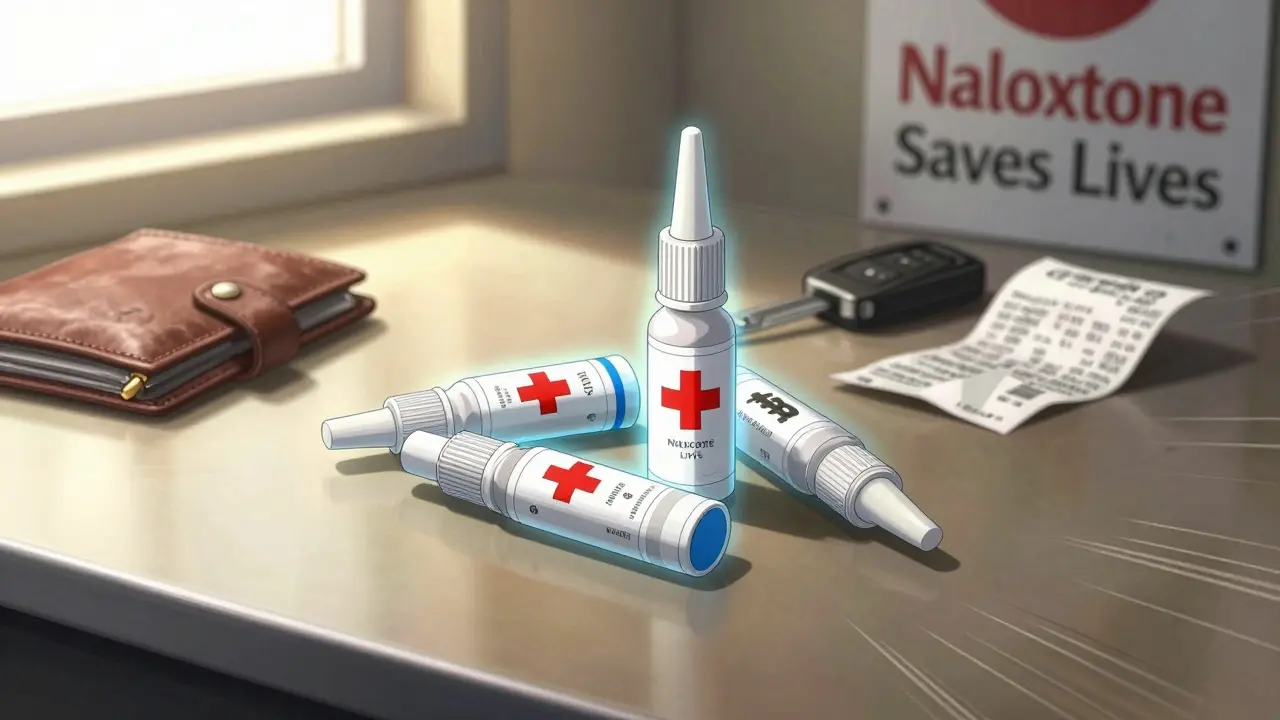
Storage matters too. Naloxone degrades above 104°F (40°C). Don’t leave it in a hot car or direct sunlight. Keep it in a cool, dry place-like your wallet, purse, or glove compartment.
Training and Real Stories
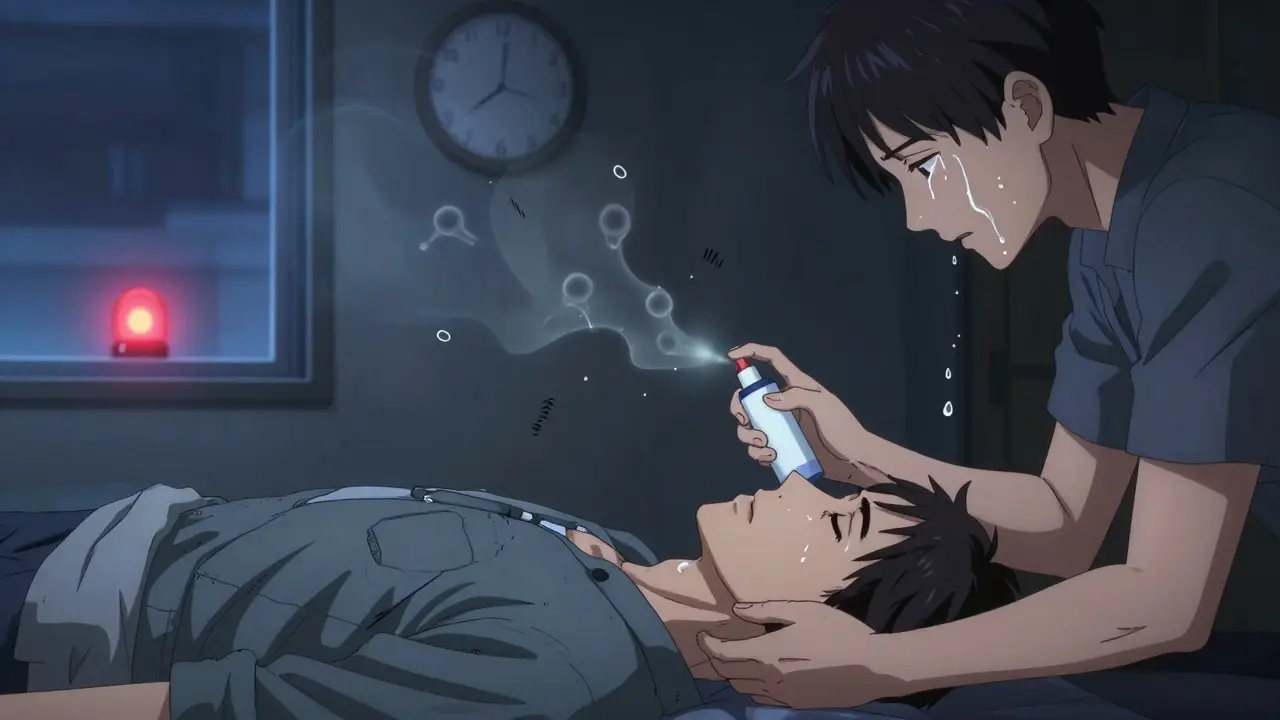
You don’t need a medical degree to use naloxone. Community training programs take 20 to 30 minutes. Most people remember the steps six months later.One Reddit user in Massachusetts saved three people in 2022 using Narcan. The first time, it took 4 minutes after the spray for breathing to return. The second time, they needed two doses because the drug was laced with fentanyl.
In Texas, a woman used Narcan on her brother after he stopped breathing. He woke up coughing 90 seconds later. The EMTs told her if she’d waited two more minutes, he wouldn’t have made it.
These aren’t rare cases. Studies show bystander naloxone use reduces overdose deaths by 35% to 50%. Since 2019, it’s prevented an estimated 27,000 deaths in the U.S. alone.
What Comes After Reversal
Naloxone doesn’t treat addiction. It only buys time. That’s why experts say it’s not enough on its own.After an overdose, the person needs medical care to check for lung damage, fluid in the lungs, or other complications. They also need access to treatment-medication-assisted therapy like methadone, buprenorphine, or counseling.
Dr. Nora Volkow, director of the National Institute on Drug Abuse, says: “Naloxone alone cannot address the opioid crisis.”
The real solution is combining reversal with long-term care. But until that system works better for everyone, naloxone remains the most powerful tool we have to keep people alive right now.
Where to Get Naloxone
You can get naloxone:- At any pharmacy without a prescription
- Through community harm reduction programs
- From local health departments
- Online from organizations like Next Distro or GetNaloxoneNow
Many public libraries, shelters, and public restrooms in cities like Philadelphia and Vancouver now have naloxone kits available for free. Check your local health department website for free distribution sites near you.
Final Thoughts
Opioid overdoses are preventable. You don’t need to be a hero to save a life. You just need to know what to look for-and how to act.Keep naloxone where you can find it fast. Practice with a trainer spray (they’re free online). Talk to your friends and family about what to do if someone stops breathing.
Because the next time someone overdoses-it might be someone you love. And you’ll be the one who knows what to do.
Can naloxone hurt someone if they didn’t take opioids?
No. Naloxone only works on opioid receptors. If someone didn’t take opioids, it has no effect. It won’t cause harm, trigger withdrawal, or make them sick. Giving naloxone when you’re unsure is the safest choice.
How long does naloxone last, and why do I need more than one dose?
Naloxone lasts 30 to 90 minutes. Many opioids, especially fentanyl, last much longer-up to 6 hours. That means the person can stop breathing again after naloxone wears off. Always be ready to give a second dose if breathing doesn’t improve within 2-3 minutes, or if the person relapses into unconsciousness.
Can I use expired naloxone?
Yes, if it’s only slightly past the expiration date. Expired naloxone may be less effective, but it’s still better than nothing. The FDA has confirmed that naloxone can remain effective for years past its printed date if stored properly. Never throw away an expired kit unless it’s discolored or has particles in it.
What if the person vomits after naloxone?
Turn them onto their side immediately. This is called the recovery position. It keeps their airway open and prevents choking. Don’t try to wipe their mouth or force them to sit up. Keep monitoring breathing until help arrives.
Is it illegal to give naloxone to someone else?
No. All 50 U.S. states allow naloxone to be given by bystanders. Many have laws protecting people who administer it in good faith. You cannot be charged with drug possession or distribution for helping someone during an overdose.
Where can I get free naloxone?
Many health departments, community clinics, syringe exchange programs, and nonprofits give naloxone for free. Check your local health department website or visit GetNaloxoneNow.org. Libraries in some cities also have free kits available at the front desk.
Can I carry naloxone in my car or pocket?
Yes. Keep it in your wallet, purse, glove compartment, or backpack. Avoid extreme heat (like a dashboard in summer). Naloxone is designed to be carried anywhere. The faster you can reach it, the better the chance of saving a life.
Do I need training to use naloxone?
No. The nasal spray is designed to be used by anyone. Instructions are printed on the box. But training helps. Free 20-minute videos from Next Distro or the CDC show exactly how to use it. Practice with a trainer kit (no medicine) to build confidence.
Celia McTighe
December 28, 2025 AT 02:59Just carried my first Narcan kit to the grocery store today 🙌 My roommate uses opioids for chronic pain and I was terrified of not knowing what to do. Now I feel like I can actually help if something happens. Thank you for this guide-it’s life-saving info made simple.
sonam gupta
December 28, 2025 AT 05:09Julius Hader
December 29, 2025 AT 07:12Look I get the good intentions but we’re enabling a crisis by handing out free narcan like candy. People need to take responsibility for their choices. This isn’t a public health issue-it’s a moral one.
Vu L
December 29, 2025 AT 19:54Yeah right and I’m sure the guy who overdosed in my neighborhood last week was just trying to be a martyr. Real talk-naloxone is a bandaid. The real problem is the government letting fentanyl flood the streets while pretending it’s all about ‘personal choice.’
Sydney Lee
December 30, 2025 AT 01:55It is both profoundly tragic and statistically indefensible that society has reduced the intervention for opioid overdose to a pharmacological afterthought rather than addressing the root causes: the commodification of mental anguish, the collapse of community care structures, and the institutional failure of psychiatric infrastructure. Naloxone is not a solution-it is a symptom of systemic neglect.
Moreover, the casual normalization of its distribution betrays a disturbing cultural desensitization to death as an inevitable consequence of poor decision-making. One must ask: if we are to pharmacologically reverse every instance of self-harm, what incentive remains for rehabilitation, accountability, or existential growth?
The fact that libraries now stock Narcan is not progress. It is surrender.
oluwarotimi w alaka
December 31, 2025 AT 01:07They say fentanyl is in everything now but who really controls the supply? I heard it’s all part of some secret program to depopulate the poor. Why else would they make it so cheap and easy to get? And now they give out narcan like free candy? Nah… they want us distracted while they take our rights. Look at the stats-they always lie.
Debra Cagwin
December 31, 2025 AT 23:32If you know someone at risk, please get a naloxone kit. It’s not about judgment-it’s about love. I’ve trained over 200 people in my community, and every single one of them said they never thought they’d need it… until they did. You don’t have to be a hero. Just be prepared. And if you’re scared to ask for one? Walk into any pharmacy. Say ‘I want to save a life.’ They’ll hand it to you without a second thought.
Hakim Bachiri
January 1, 2026 AT 13:42Okay so… naloxone is free? At libraries? In my city? I just spent $87 on one because I didn’t know. And now I’m mad. Also-why do they call it Narcan? That’s just a brand name. It’s like saying Kleenex when you mean tissue. And why is the packaging so confusing? The instructions are in tiny font. And who designed the box? It looks like a drug dealer’s business card.
Also, can we talk about how nobody teaches this in school? Like, we learn about the French Revolution but not how to save someone’s life? That’s messed up.
Ryan Touhill
January 2, 2026 AT 03:08While the utility of naloxone as an emergency pharmacological agent is undeniable, one must interrogate the broader epistemological framework underpinning its proliferation. The normalization of bystander administration reflects a troubling epistemic shift: the abdication of medical authority to laypersons, predicated not on clinical competence but on emotional urgency. This is not empowerment-it is procedural nihilism disguised as compassion.
Furthermore, the conflation of harm reduction with moral absolution is dangerously reductive. To administer naloxone without addressing the sociopolitical architecture of addiction-poverty, trauma, pharmaceutical malfeasance-is to treat the symptom while ignoring the disease. One cannot reverse death with a nasal spray and call it justice.
Teresa Marzo Lostalé
January 3, 2026 AT 21:49I used to think this stuff was for ‘other people.’ Then my cousin OD’d in my living room. I didn’t know what to do. I screamed. I shook him. I cried. Then I found the Narcan kit in his backpack-left there by his counselor. One spray. Two minutes. He coughed. He sat up. He didn’t say thank you. He just stared at the wall.
Now I carry two. One in my bag. One in my car. I don’t care who uses them. I just don’t want to be the person who watched someone die because they didn’t know how to act.
Also… the guy who made this guide? You’re a real one.
ANA MARIE VALENZUELA
January 4, 2026 AT 21:00Let’s be real-90% of these overdoses are people who chose to be addicts. They knew the risks. Now we’re supposed to be their babysitters? And why are we giving this stuff out like it’s a free coupon? Next thing you know, they’ll hand out defibrillators to people who binge drink. This isn’t compassion-it’s enabling wrapped in a rainbow sticker.
Bradly Draper
January 5, 2026 AT 01:13I work at a shelter. We keep naloxone behind the front desk. Last week, a guy came in shaking, couldn’t breathe. We gave him a spray. He woke up and said ‘I didn’t even know I had it.’ We didn’t judge. We just helped. That’s all.
Gran Badshah
January 5, 2026 AT 15:43Why do they make it so expensive? I saw a guy in Delhi buy it for $3. Here it’s $130. Something’s wrong. Also, I tried to use one once but I was scared I’d do it wrong. Maybe they should make a video you can watch on your phone before you use it?
Ellen-Cathryn Nash
January 6, 2026 AT 00:51People say ‘just stop using’ like it’s that easy. But what if you’re in pain? What if you’re lonely? What if your brain tells you this is the only thing that makes the noise stop? Naloxone doesn’t fix that. But at least it gives you another chance to figure it out. That’s worth something.
Also-why do we treat addicts like criminals? I’ve seen nurses cry when they have to wake someone up after a reversal. They know the cycle. They know it’s not about willpower.
Samantha Hobbs
January 7, 2026 AT 18:59Just got my free naloxone from the library today. The lady behind the desk said ‘You never know when you’ll need it.’ I told her I’m not a user-I’m just a person who knows people who are. She hugged me. I cried. That’s the kind of care we need more of.