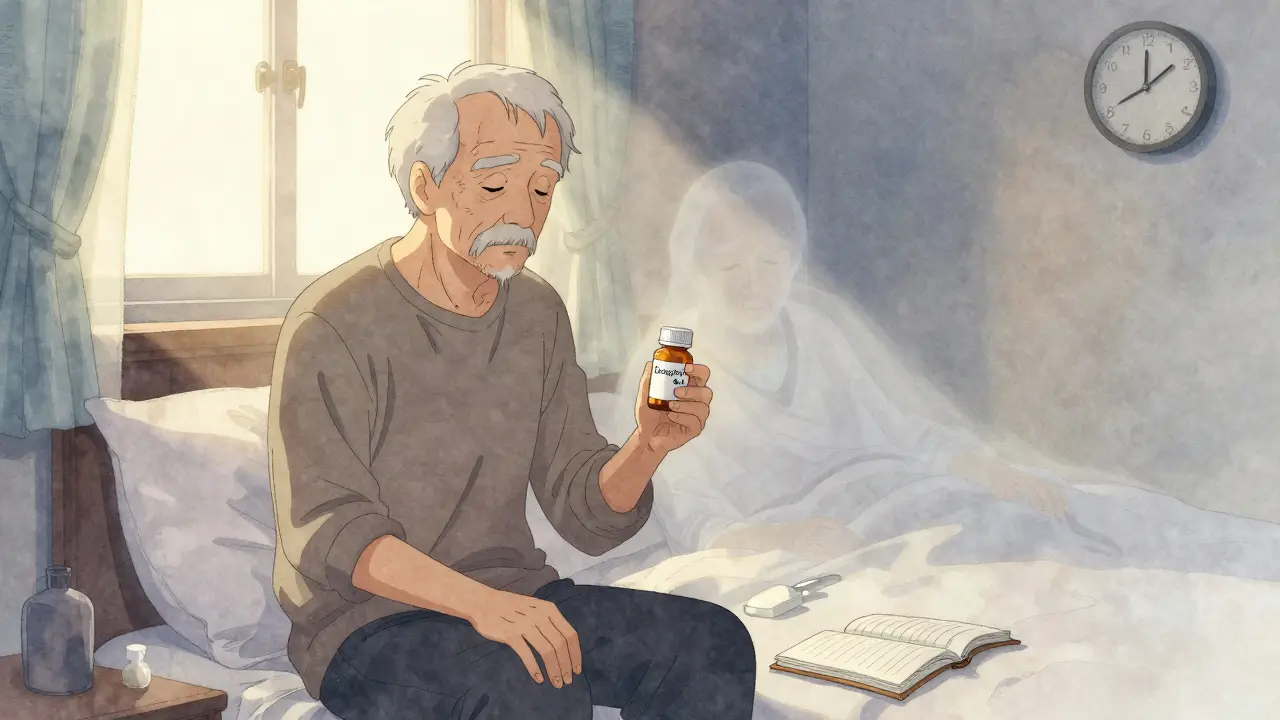
More than one in three adults over 65 struggle with insomnia. It’s not just about tossing and turning-it’s about waking up exhausted, forgetting names, stumbling on the stairs, or feeling like the day is already over before it begins. For years, doctors reached for benzodiazepines or z-drugs like Ambien, thinking they were quick fixes. But those pills come with hidden dangers: falls, confusion, memory loss, and even a higher chance of ending up in the hospital. The truth? There are safer ways to help older adults sleep without putting their health at risk.
Why Older Adults Need Different Sleep Medications
As we age, our bodies change. The liver and kidneys don’t clear drugs as quickly. Medications stick around longer, increasing side effects. Many older adults take five or more prescriptions a day, and mixing sleep pills with blood pressure meds, painkillers, or antidepressants can be dangerous. A 2018 study in the Journal of the American Geriatrics Society found that combining sleep meds with other central nervous system depressants-like opioids or anti-anxiety drugs-raises the risk of falls by 70%.Insomnia isn’t just a nuisance. It’s linked to faster decline in mobility, worse memory, and even higher rates of disability. One 2025 study showed that each extra insomnia symptom increased disability risk by 15%. If you’re already taking a sleep pill, that risk jumps another 27%.
What Medications to Avoid
The American Geriatrics Society’s Beers Criteria has been clear since 2012: benzodiazepines like lorazepam (Ativan), diazepam (Valium), and triazolam (Halcion) should not be used as first-line treatment for older adults. Why? They increase fall risk by 50%, raise the chance of hip fractures, and can cause sudden confusion that looks like dementia.Z-drugs like zolpidem (Ambien), eszopiclone (Lunesta), and zaleplon (Sonata) are often prescribed instead. But they’re not much safer. Zolpidem, in particular, has been linked to sleepwalking, nighttime eating, and even driving while asleep. A Drugs.com review of over 1,200 users found 34% of zolpidem users reported next-day drowsiness, and 8% experienced strange sleep behaviors.
Even though these drugs are still prescribed to millions of older adults-7.2 million Medicare beneficiaries got benzodiazepines in 2023 alone-they’re no longer the answer. The risks outweigh the benefits.
The Safest Options Available Today
The goal isn’t to sleep for eight hours straight. It’s to get restful, safe sleep without grogginess, confusion, or danger. Here are the medications with the best safety profiles for older adults:- Low-dose doxepin (3-6 mg): Originally an antidepressant, this tiny dose works as a selective histamine blocker to help you stay asleep. A 2024 meta-analysis found it improved sleep efficiency by over 6%-better than most alternatives. Users report minimal next-day drowsiness. At 3 mg, it’s cheap-often under $15 a month-and covered by most insurance. One Reddit user wrote, “Doxepin 3mg gave me 5 extra hours of solid sleep without the hangover I got from Ambien.”
- Ramelteon (8 mg): This mimics melatonin and helps reset your body clock. It’s not strong, but it’s very safe. It doesn’t cause dependence, doesn’t impair balance, and has almost no next-day effects. It’s ideal if you struggle to fall asleep but don’t wake up often. Studies show it reduces sleep onset time by nearly 10 minutes.
- Lemborexant (5-10 mg): Approved in 2019, this is one of the newest options. It works by blocking orexin, a brain chemical that keeps you awake. In trials with adults over 65, it increased total sleep time by over 40 minutes and cut nighttime waking by 21 minutes. Users say it feels “natural,” not chemical. The downside? Cost. Without insurance, it can run $750 a month. But for those who can afford it, it’s one of the most effective and safest options.
- Controlled-release melatonin (2 mg): Not a drug, but an over-the-counter supplement. It’s not a miracle cure, but it’s safe. It helps with sleep timing, especially if your rhythm is off due to shift work or lack of daylight. A 2023 review found it modestly improved sleep onset without increasing fall risk.

What Works Best for Different Problems
Not all insomnia is the same. The right medicine depends on your biggest issue:- Can’t fall asleep? Try ramelteon or melatonin. They help your body know it’s time to sleep.
- Wake up in the middle of the night and can’t get back to sleep? Low-dose doxepin is the best evidence-backed choice. It keeps you asleep longer.
- Wake up too early and feel tired all day? Lemborexant helps extend sleep and improves morning alertness better than other options.
There’s no one-size-fits-all. But the safest options all share one thing: they don’t knock you out. They help you sleep more naturally.
Non-Medication Options Are Still First-Line
The American Academy of Sleep Medicine says the best treatment for insomnia in older adults isn’t a pill-it’s Cognitive Behavioral Therapy for Insomnia (CBT-I). It’s not magic. It’s structured: you track your sleep, learn to associate bed with sleep only, challenge anxious thoughts about sleep, and adjust your routine.Studies show CBT-I improves sleep as well as-or better than-medication, without any side effects. And the benefits last long after therapy ends. Yet, a 2024 national poll found 63% of older adults prescribed sleep meds were never told about CBT-I.
Why? Access. CBT-I isn’t always covered by insurance, and there aren’t enough trained therapists. But digital versions-like the FDA-cleared reSET-O app-are becoming more available. Some Medicare Advantage plans now cover online CBT-I programs. If you’re on a fixed income, ask your doctor about free or low-cost programs through local senior centers or universities.
How to Talk to Your Doctor About Safer Sleep
If you’re on a sleep medication now, don’t stop cold turkey. Talk to your doctor about a plan. Here’s what to ask:- “Is this medication still necessary, or can we try something safer?”
- “Can we reduce the dose slowly?”
- “Have you considered CBT-I or low-dose doxepin?”
- “What are the risks of staying on this pill long-term?”
Many doctors still prescribe benzodiazepines out of habit. A 2023 study found primary care doctors needed over three hours of training to reliably follow safe prescribing guidelines. Don’t assume your doctor knows the latest data. Bring it up. Bring a printout of the Beers Criteria if needed.
What to Watch For
Even with safer meds, side effects can happen. Monitor for:- Dizziness or unsteadiness when standing
- Confusion or memory lapses
- Feeling groggy past noon
- Unusual behaviors during sleep
Use the Epworth Sleepiness Scale to track daytime sleepiness. A score above 10 means you’re too drowsy during the day-time to adjust your treatment.
Also, get a simple fall risk check: the Timed Up and Go test. Time how long it takes you to stand from a chair, walk 10 feet, turn, walk back, and sit down. If it takes more than 12 seconds, your fall risk is higher. Tell your doctor.
Cost and Access Challenges
The best options aren’t always the cheapest. Lemborexant is effective but expensive. Doxepin is cheap but often overlooked. Ramelteon is affordable and safe but not always covered. Insurance companies often block access to newer drugs unless you’ve tried and failed on older ones-even if those older ones are risky.Ask your pharmacist if there’s a generic version. Ask about patient assistance programs. Some drugmakers offer discounts for seniors. And if cost is a barrier, CBT-I remains the most cost-effective long-term solution.
The Future of Sleep Treatment for Seniors
New drugs are coming. Danavorexton, an orexin agonist, is in late-stage trials and may offer even better safety for older adults. But the real shift isn’t in pills-it’s in thinking. Health systems are starting to penalize hospitals and clinics that overprescribe benzodiazepines. Medicare is beginning to reward providers who prioritize non-drug treatments.The message is clear: better sleep for older adults doesn’t mean stronger drugs. It means smarter choices. Safer choices. Choices that protect your balance, your memory, and your independence.
Are benzodiazepines ever safe for older adults with insomnia?
Benzodiazepines are not recommended as a first-line treatment for older adults due to high risks of falls, confusion, and dependence. The American Geriatrics Society’s Beers Criteria advises avoiding them entirely in this age group. In rare cases-like severe anxiety with insomnia and no other options-they may be used short-term under close supervision, but even then, alternatives like low-dose doxepin or CBT-I are preferred.
Can melatonin help older adults sleep better?
Yes, but not as a strong sleep aid. Controlled-release melatonin (2 mg) can help reset your internal clock if you’re waking too early or have trouble falling asleep due to a disrupted circadian rhythm. It’s safe, non-addictive, and has minimal side effects. However, it won’t fix insomnia caused by pain, anxiety, or poor sleep habits. It works best as part of a broader sleep hygiene plan.
Why is low-dose doxepin preferred over other antidepressants for sleep?
At 3-6 mg, doxepin acts almost exclusively on histamine H1 receptors, which promotes sleep without affecting mood or causing the side effects seen at higher antidepressant doses (25-150 mg). Unlike other sedating antidepressants like amitriptyline, it doesn’t cause dry mouth, urinary retention, or heart rhythm changes-common problems in older adults. Studies show it’s one of the most effective and safest options for sleep maintenance.
How long should older adults take sleep medications?
Most sleep medications should be used for no longer than 4-5 weeks. Long-term use increases dependence and side effect risks. Low-dose doxepin is an exception-it can be used safely for months or even years under supervision, especially if non-drug treatments aren’t available. Always have a plan to taper off, and combine medication with CBT-I to build lasting sleep habits.
Is CBT-I really effective for older adults?
Yes. Multiple studies show CBT-I improves sleep quality and duration as well as or better than medication-and the results last. Older adults respond just as well as younger people. The biggest barrier is access. Look for programs through local universities, VA hospitals, or online platforms like CBT-i Coach (free from the U.S. Department of Veterans Affairs). Many Medicare Advantage plans now cover it.
If you or a loved one is struggling with sleep, remember: better rest doesn’t mean stronger pills. It means choosing wisely. Start with safety. Explore CBT-I. Ask about doxepin or ramelteon. And never accept a prescription without asking, “Is this the safest option for me?”
Dave Old-Wolf
January 9, 2026 AT 04:56I never realized how many older folks are on these sleep meds until I saw my dad take Ambien for years. He’d stumble in the morning like he’d been hit by a truck. We switched him to 3mg doxepin last year and he’s been sleeping like a baby without the fog. No more falls, no more confusion. Why isn’t this the first thing doctors suggest?
christy lianto
January 11, 2026 AT 02:57CBT-I is the real MVP. My mom did a 6-week online program through her Medicare Advantage plan and now she doesn’t need anything. Not even melatonin. She sleeps better than I do. If your doctor doesn’t mention it, ask for it. It’s free or cheap and it actually works.
swati Thounaojam
January 11, 2026 AT 23:48doxepin 3mg works. i tried it. no hangover. my grandma is on it now. she says she feels like herself again.
Annette Robinson
January 12, 2026 AT 04:08It’s heartbreaking how many seniors are still being prescribed benzodiazepines. I’m a nurse, and I’ve seen the fallout-falls, ER visits, families broken by confusion that looks like dementia. The science is clear. We need better education for providers and more access to CBT-I. It’s not just about pills-it’s about dignity.
Manish Kumar
January 12, 2026 AT 12:39Let’s be real here. We live in a culture that wants quick fixes. Sleep? Take a pill. Anxiety? Take a pill. Loneliness? Maybe take a pill tomorrow. But the real issue isn’t insomnia-it’s the erosion of natural rhythms. We don’t go to bed when the sun sets anymore. We stare at screens. We eat at midnight. We live in artificial light. The body isn’t broken. The environment is. Medications are just bandaids on a civilization that forgot how to rest. Doxepin helps? Sure. But the real cure is silence, darkness, and routine. Not a prescription.
Prakash Sharma
January 13, 2026 AT 16:33Why are we letting American drug companies dictate how Indians sleep? We used to have natural remedies-warm milk, ashwagandha, yoga. Now we’re copying their dangerous pills. Doxepin? Ramelteon? Who even are these people? Stick to what works for our bodies, not their profit margins.
Donny Airlangga
January 15, 2026 AT 15:04My uncle took zolpidem for 8 years. One night he drove to the gas station at 3 a.m. and tried to pay for gas with a credit card he didn’t own. He didn’t remember any of it. That’s not sleep-that’s a chemical coma. I’m so glad this article exists. My mom’s on doxepin now. She’s actually smiling in the mornings.
Kristina Felixita
January 17, 2026 AT 07:37Just want to say… CBT-I changed my life. I was skeptical. Thought it was just “sleep hygiene” nonsense. But the structured stuff-sleep restriction, stimulus control, cognitive reframing-it actually rewired my brain. I’m 71. I didn’t sleep through the night for 15 years. Now I do. And no pills. My sister’s doing it too. Check out CBT-i Coach-it’s free from the VA. Seriously. Try it before you take another pill.
Evan Smith
January 18, 2026 AT 09:48So… lemborexant costs $750 a month? But doxepin is $15? So the “newest, safest” option is basically a luxury item for rich seniors? That’s not progress. That’s capitalism with a side of insomnia. Meanwhile, my grandma’s on a $5 generic that works fine. Maybe the real problem isn’t the meds-it’s the pricing.
Lois Li
January 19, 2026 AT 10:13I’ve been helping my neighbor, Ruth, navigate this. She was on Ativan for 12 years. Her doctor said it was fine. We got her on doxepin, started CBT-I through the local senior center, and now she’s off everything. She says she feels like she’s 50 again. It’s not magic. It’s just… better care. Why isn’t this standard? Why does it take a family member to fight for it?
Ken Porter
January 19, 2026 AT 20:58Why are we even talking about this? Just give them Ambien. They’re old. They’re not gonna be driving anyway. Let them sleep. It’s not like they’re gonna live forever.
Luke Crump
January 20, 2026 AT 11:03What if the real problem isn’t insomnia… but the fact that we’ve turned aging into a disease? We’re medicating the natural process of sleep fragmentation because we’re terrified of death. We want our grandparents to be “productive” even at 80. But maybe they’re just… tired. Maybe rest isn’t a problem to be solved. Maybe it’s a gift. Maybe the pills are the real insult to dignity.
Aubrey Mallory
January 20, 2026 AT 11:46My mom’s on doxepin now. She’s been sleeping 7 hours straight for the first time in 10 years. I’m so glad we found this. But I’m mad that no one told us about it earlier. Doctors need to stop acting like they know everything. We have to be our own advocates. If you’re on a sleep med, ask about alternatives. Don’t wait for a fall. Don’t wait for confusion. Ask now.