
When a patient walks up to the counter and sees their usual brand-name pill replaced with a different color or shape, they don’t just see a change in appearance-they see uncertainty. Generic medications are just as effective as their brand-name counterparts, but if you don’t explain why, patients will assume something’s wrong. And that assumption can cost them their health.
Here’s the reality: 90% of prescriptions filled in the U.S. are generics. They save patients an average of $300 a month and the entire healthcare system over $370 billion every year. Yet, nearly one in three patients still worry they’re getting an inferior drug. That’s not because the science says otherwise-it’s because no one took the time to talk to them about it.
Why Patients Doubt Generics (Even When They Shouldn’t)
Patients aren’t being irrational. They’re reacting to what they see and feel. A blue pill they’ve taken for years suddenly becomes a white oval. The packaging looks cheaper. The price dropped by 80%. Their first thought isn’t "This is FDA-approved"-it’s "Why did they switch this?"
Studies show that 28% of patients worry about switching from brand to generic. For some, it’s about appearance. For others, it’s a memory-"The last generic I tried gave me stomach pain." Or worse: "My friend took this and it didn’t work."
The truth? Those differences are almost always in inactive ingredients-fillers, dyes, coatings. These don’t affect how the medicine works. But they can change how the pill looks, tastes, or even how fast it dissolves slightly. For most drugs, that’s irrelevant. For drugs with a narrow therapeutic index-like warfarin or levothyroxine-doctors may prefer to keep patients on the same generic manufacturer. But even then, the FDA requires all approved generics to meet the same strict bioequivalence standards: the drug must deliver the same amount of active ingredient into the bloodstream within 80-125% of the brand-name version. That’s not a guess. That’s science.
What Makes a Generic Really the Same
Let’s cut through the noise. A generic drug must have:
- The same active ingredient (exact chemical compound)
- The same strength and dosage form (tablet, capsule, injection, etc.)
- The same route of administration (oral, topical, inhaled)
- The same labeling for uses, warnings, and side effects
- The same manufacturing quality standards as the brand
The FDA inspects every generic manufacturing plant-same as brand-name facilities. No exceptions. The only difference? No trademarked name. No fancy marketing. No $2.6 billion in clinical trials. Generics use the existing safety data. That’s why they cost 80-85% less.
And here’s what most patients don’t know: the same company that makes the brand-name drug often makes the generic too. About 37% of top-selling brand-name drugs have an "authorized generic"-same factory, same formula, just a different label. If you’re switching from Crestor to rosuvastatin, you might be getting the exact same pill with a different color.
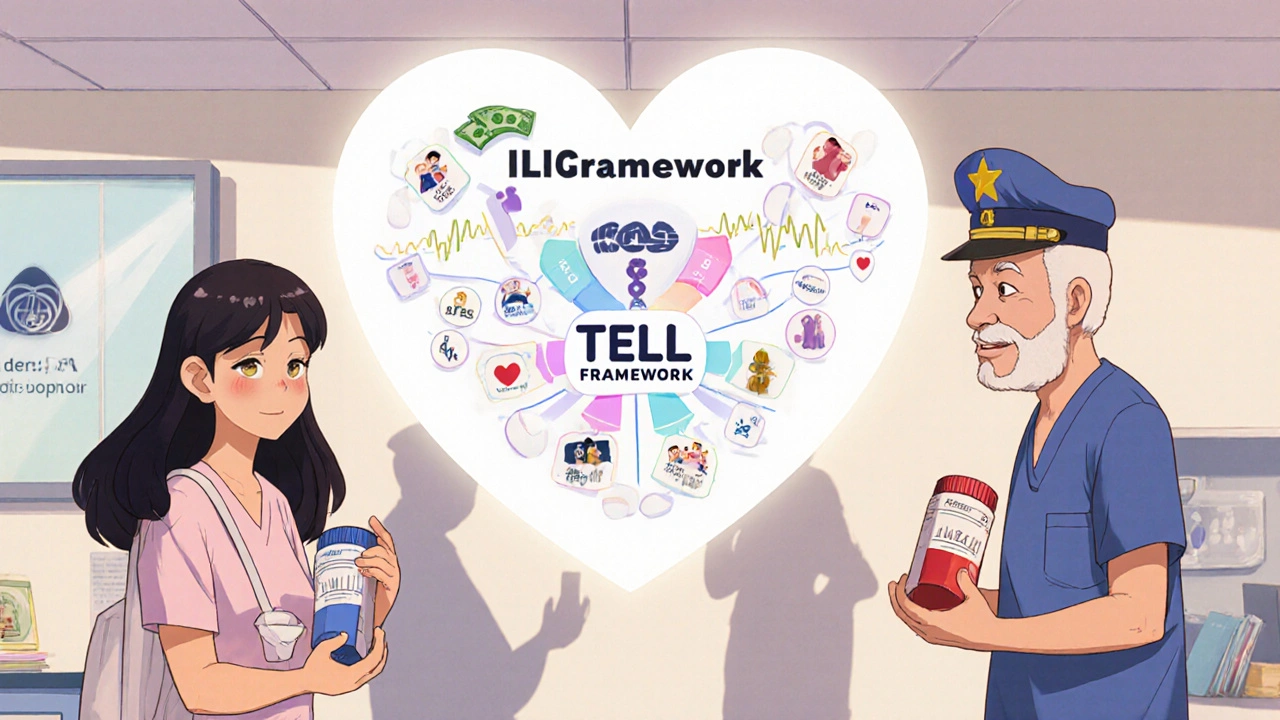
The TELL Framework: A Simple Way to Talk About Generics
There’s no script that works for every patient. But there is a proven structure: TELL.
- Tell them the generic has the same active ingredient. Don’t say "it’s the same." Say: "This pill contains the exact same medicine as your brand. It’s not a copy-it’s the same drug, just without the brand name."
- Explain why it looks different. "Trademark laws require generics to look different. That’s why the color, shape, or size changed. But the medicine inside? Identical."
- Listen without interrupting. Let them say: "I don’t trust it." Or: "I felt worse on the last one." Don’t dismiss it. Ask: "What exactly changed for you?" Sometimes it’s a side effect. Sometimes it’s a coincidence. But you need to know.
- Link it to their goals. "You’re trying to lower your cholesterol so you can keep playing with your grandkids. This generic saves you $250 a month. That’s $3,000 a year you can put toward groceries, gas, or a vacation. And it works just as well."
This isn’t just nice advice. It works. Patients who get this kind of counseling are 22% more likely to stick with their medication six months later.

What to Do When Patients Say No
Some will still refuse. That’s okay. But don’t just accept it. Dig deeper.
Ask: "What would make you feel more comfortable?"
They might say: "I need the brand."
Then ask: "Is it the cost? Or the fear it won’t work?"
If it’s cost, offer alternatives: generic alternatives, mail-order options, manufacturer coupons. If it’s fear, suggest a trial. "Let’s try it for two weeks. If you notice anything different, we’ll switch back. I’ll monitor your labs."
For patients on critical drugs like levothyroxine, it’s okay to recommend staying on the same generic manufacturer. But don’t assume they know that. Say: "For your thyroid medicine, we usually stick with one brand of generic because even tiny changes can affect your levels. Let’s keep you on this one unless you have a reason to change."
What Not to Say (And What to Say Instead)
Here are common missteps-and better ways to respond:
- Bad: "It’s just as good." → Good: "It’s the same medicine. The FDA requires it to work exactly the same way."
- Bad: "It’s cheaper." → Good: "This saves you $200 a month. That’s $2,400 a year you can use for other things you care about."
- Bad: "Everyone takes generics." → Good: "Most people do because they work just as well and cost far less. But your comfort matters. Let’s talk about what’s worrying you."
Don’t assume they know what "bioequivalent" means. Don’t use jargon. Don’t rush. A 3-5 minute conversation can change adherence forever.
Use the Teach-Back Method
After you explain, ask: "Can you tell me in your own words what you’ll be taking and why?"
This isn’t a test. It’s a tool. If they say, "It’s the same as the blue pill but cheaper," you know they got it. If they say, "I don’t know, I just hope it works," you’ve got more work to do.
Studies show this method improves retention by 40%. And when patients can explain their own meds, they’re far less likely to stop taking them.
Document the Conversation
Write down what was said. Note the patient’s concerns. Note how you addressed them. This isn’t bureaucracy-it’s protection. For them. And for you.
If they later say, "No one told me this was a generic," your notes prove you did. If they have a side effect, you’ve already documented their history with generics. This builds trust over time.
What’s Changing Right Now
The FDA just launched a $5 million campaign in 2023 to improve patient education on generics. They’re testing video explainers combined with counseling. Early results show a 31% increase in patient acceptance.
Biosimilars-complex generics for biologic drugs like insulin or rheumatoid arthritis treatments-are now entering the market. These aren’t simple pills. They’re intricate proteins. The same principles apply: same active component, same effect, lower cost. But the conversation needs to be even more thoughtful. Patients need to understand that "similar" doesn’t mean "inferior."
And while "pay-for-delay" deals still slow down some generics, the trend is clear: generics are the future. More insurers are requiring them. More formularies put them in the lowest cost tier. More patients are saving money.
Final Thought: It’s Not About the Pill. It’s About the Person.
Generic medications aren’t a cost-cutting trick. They’re a lifeline for people who can’t afford their prescriptions. A single mother choosing between insulin and groceries. A veteran on fixed income. A retiree skipping meals to pay for blood pressure meds.
When you take five minutes to explain what a generic is-and why it’s safe-you’re not just filling a prescription. You’re helping someone stay healthy. You’re removing fear. You’re giving them back control.
That’s not pharmacy work. That’s care.
gerardo beaudoin
November 30, 2025 AT 06:07Just had a patient ask me why her blood pressure pill changed color. Took 3 minutes to explain the TELL framework and she cried. Said she was skipping doses because she thought the generic was "fake." Now she’s refill-ready. This stuff matters.
LINDA PUSPITASARI
December 1, 2025 AT 11:27OMG YES THIS. I’m a nurse and patients always freak out when the pill looks different 😭 I use the "same medicine, different outfit" analogy and it works like magic 🤗 Also, the teach-back method? Game changer. I’ve seen so many people actually remember what they’re taking now. No more "I forgot the name" 😅
Mary Kate Powers
December 1, 2025 AT 18:06My grandma switched to generic levothyroxine last year. She was terrified. We sat down, I showed her the FDA bioequivalence chart, and we called the pharmacy to confirm it was the same manufacturer as her brand. She’s been stable for 14 months. It’s not magic-it’s communication.
Andrew Keh
December 2, 2025 AT 21:58It’s funny how a simple conversation can undo years of misinformation. I’ve been using the TELL method since last spring. Patients don’t just accept generics-they thank me for explaining. That’s the real win.
Sara Shumaker
December 3, 2025 AT 21:12What’s interesting is how the fear of generics mirrors deeper anxieties about being treated as disposable. The pill isn’t the issue-it’s the feeling that the system is cutting corners on *them*. When we frame generics as empowerment-not compromise-we’re not just educating. We’re restoring dignity.
Peter Lubem Ause
December 5, 2025 AT 10:08As a pharmacist in Lagos, I’ve seen this exact dynamic play out-patients refusing generics because they believe cheaper means weaker. I explain that the active ingredient is identical, and I show them the WHO and FDA guidelines. Many come back weeks later to thank me. The key is patience and clarity. No jargon. Just truth, delivered kindly.
tushar makwana
December 6, 2025 AT 00:17in india too people think generic = bad. i had a patient who refused his generic statin because "it looked like a candy pill" 😅 i told him "the sugar is the same, just no logo" and he laughed. now he takes it every day. small wins, man.
Richard Thomas
December 7, 2025 AT 16:27While the empirical data supporting bioequivalence is robust, the psychological resistance to generics remains underexamined in the medical literature. The phenomenon reflects a conflation of aesthetic cues with therapeutic efficacy-a cognitive bias well-documented in behavioral economics. A formalized, evidence-based communication protocol is not merely advisable-it is ethically imperative.
Bernie Terrien
December 9, 2025 AT 06:07Brand-name pharma is a scam. They spend billions on ads to make you think your pill is special. Meanwhile, your grandma’s blood pressure med costs $4 because it’s the same damn chemical. Stop being manipulated. Generics aren’t "good enough"-they’re the standard.
Joy Aniekwe
December 9, 2025 AT 11:43Oh wow, another feel-good piece about how doctors are saints for explaining pills. Meanwhile, the system still makes patients wait 3 weeks for prior auths, and then acts shocked they’re confused about generics. Thanks for the TED Talk, but fix the damn system first.
Steven Howell
December 11, 2025 AT 05:18At the VA, we’ve implemented the TELL framework across all clinics. Compliance rates for generics rose from 62% to 84% in 18 months. The data doesn’t lie. This isn’t theory. It’s practice. And it saves lives.
jamie sigler
December 12, 2025 AT 04:52Same pill. Different color. Big deal. People are so dramatic.
Scott Collard
December 12, 2025 AT 12:04Wait-so you’re saying the company that makes Crestor also makes rosuvastatin? That’s wild. So the whole "generic" thing is just a label swap? Why don’t they just sell it under both names? This whole system is a joke.