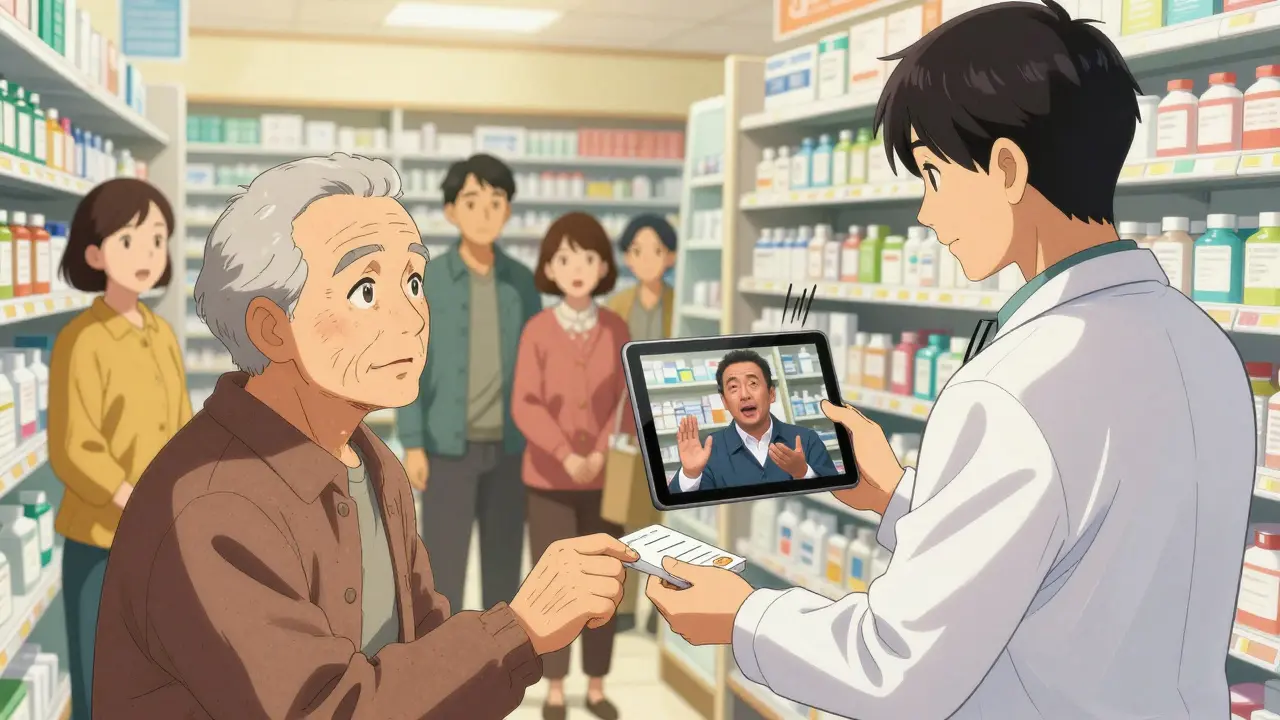
When you’re prescribed a new medication, understanding how to take it isn’t optional-it’s life or death. But if English isn’t your first language, the instructions on the bottle might as well be written in code. That’s where professional translator services for medication counseling come in. By law, pharmacies in the U.S. must provide these services at no cost to you. Yet many patients don’t know how to ask for them-or worse, they’re told to use a family member instead. This isn’t just inconvenient. It’s dangerous.
Why You Need a Professional Interpreter, Not a Family Member
Using your child, spouse, or neighbor as an interpreter might seem practical, but it’s risky. A 2021 study in JAMA Pediatrics found that relying on untrained bilingual staff or family members increases the chance of serious medication errors by 49%. Why? Medical terms like "take on an empty stomach," "avoid alcohol," or "do not crush tablets" don’t translate easily. Even if someone speaks both languages, they might not know what "QT prolongation" or "hepatic metabolism" means in their native tongue.Professional medical interpreters aren’t just bilingual-they’re trained in pharmacology, side effects, drug interactions, and patient safety protocols. They follow strict confidentiality rules under Section 1557 of the Affordable Care Act. They don’t guess. They don’t summarize. They translate accurately, word for word.
What the Law Says About Language Access in Pharmacies
Federal law doesn’t leave this up to chance. Title VI of the Civil Rights Act of 1964 and Section 1557 of the Affordable Care Act require any pharmacy that receives federal funding-meaning nearly every chain and many independent ones-to provide free language assistance. This includes oral interpretation during counseling and written translations of prescription labels and warnings.California’s SafeRx program sets the gold standard: pharmacists must use an interpreter-either in person, by phone, or video-whenever counseling a patient who doesn’t speak English well. And they can’t charge you a cent. Other states like New York, Texas, and Illinois have similar rules. As of 2023, 48 states have formal requirements for medication counseling translation, according to the National Health Law Program.
Enforcement is tightening. The Office for Civil Rights (OCR) has settled 47 language access cases since 2016. In 2022, a national pharmacy chain paid $1.2 million for failing to provide interpreters during prescription counseling. If a pharmacy ignores your request, you can file a complaint with HHS.gov. You’re not asking for a favor-you’re exercising your legal right.
How to Ask for an Interpreter-The Right Way
Don’t wait until the pharmacist starts reading the label. As soon as you hand over your prescription, say clearly:- "I need a professional interpreter to help me understand my medication instructions."
- "I don’t want my child or a staff member to interpret. I need a trained medical interpreter."
- "This is required by federal law. Please connect me with one now."
Pharmacists are trained to handle this. Most have access to phone, video, or on-site interpreters. If they hesitate, ask for the manager. No pharmacy can legally refuse. You’re not being difficult-you’re protecting your health.
Types of Interpreter Services Available
There are three main ways pharmacies provide interpreters. Each has pros and cons:- Phone interpreting: Fast and cheap-usually connects in under 30 seconds. Costs about $2.50-$3.50 per minute. Best for quick questions, but can be confusing for elderly patients or complex instructions. A 2019 study found 32% of older adults struggled with phone-only interpretation.
- Video interpreting: Now used by 65% of healthcare facilities. You see the interpreter, which helps with nonverbal cues. Costs $3-$5 per minute. Works well for counseling sessions where you need to show where a patch goes or how to use an inhaler. But 28% of attempts fail due to tech issues like poor internet or outdated tablets.
- On-site interpreters: The most effective option. Pharmacists report 78% better patient understanding when an interpreter is physically present. But they’re only available in larger urban pharmacies. Most rural or small-town locations don’t have them on staff.
For complex medications-like blood thinners, insulin, or chemotherapy-always ask for video or in-person. For simple antibiotics or painkillers, phone might be enough. But never accept a staff member who says, "I speak a little Spanish."
What’s Included in Medication Counseling Translation
A full translation service isn’t just about the conversation. It includes:- Verbal explanation of dosage: "Take one tablet by mouth every 12 hours."
- Translation of warning labels: "May cause drowsiness. Do not operate machinery."
- Instructions on food interactions: "Avoid grapefruit juice."
- Side effect warnings: "If you develop swelling in your face or throat, seek emergency care."
- Follow-up guidance: "Call us if you feel nauseous after three days."
Some pharmacies use pre-translated labels from services like RxTran, which offers FDA-compliant translations in Spanish, Chinese, Korean, Russian, and Vietnamese. But even these aren’t perfect. A 2022 California survey found that 38% of Russian-speaking patients found dosage instructions confusing because the grammar didn’t match how medical terms are structured in Russian.
That’s why live interpretation is still best. A human can adjust for dialect, cultural context, and patient confusion in real time.
What to Do If the Pharmacy Refuses
If you’re told, "We don’t have an interpreter," or "We can’t call one right now," here’s what to do:- Ask for the pharmacy’s compliance officer or manager. They’re required to know the law.
- Request a written explanation of why they can’t provide services.
- Call the pharmacy’s corporate headquarters. Most chains have a patient advocacy line.
- File a complaint with the U.S. Department of Health and Human Services at hhs.gov/ocr. You don’t need a lawyer.
Don’t leave without your medication. If they won’t provide an interpreter, ask them to call you back later when one is available-or take your prescription to another pharmacy. You have options.
How Pharmacies Are Improving (And Where They’re Falling Short)
Big pharmacy chains like CVS and Walgreens are slowly improving. Many now have video interpreter tablets at the counter. RxTran’s on-demand phone service connects in under 30 seconds 92% of the time, according to one pharmacist’s internal logs. But problems remain.A 2023 Kaiser Health News report showed that 67% of pharmacy techs try to handle LEP patients without interpreters when they’re busy. That leads to 23% of LEP patients saying they didn’t understand critical warnings.
And here’s the hidden gap: only 41% of pharmacy staff who claim to be "bilingual" pass a basic medical terminology test. That means even well-intentioned employees might be giving you wrong information.
California is leading the way by adding translations for Tagalog and Arabic in 2024. But nationwide, only 54% of community pharmacies have a structured system to request interpreters, according to the American Medical Association.
What’s Changing in 2025
New rules took effect January 1, 2025. AI translation tools like Google Translate or DeepL are now banned for use on prescription labels and medication counseling materials unless a human reviews them first. The FDA and CMS made this clear: machines can’t replace trained interpreters when safety is on the line.Also, reimbursement rates for interpreter services under CHIPRA have jumped from 50% to 75% for children in non-English households. This means more pharmacies will be financially able to afford on-site or video interpreters.
By 2026, experts predict 70% of small translation service providers will be bought by major healthcare tech companies. That could mean better tech, faster connections, and more languages-but also more corporate control over how services are delivered.
Final Advice: Know Your Rights, Speak Up
You’re not asking for special treatment. You’re asking for the same care everyone else gets. If you don’t understand your medication, you’re at risk of overdose, missed doses, or dangerous interactions.Next time you pick up a prescription:
- State your language need clearly.
- Refuse untrained interpreters.
- Ask for video or in-person if the instructions are complex.
- Document what was said-if you’re unsure, ask for a printed translated sheet.
- If you’re ignored, file a complaint. It helps others too.
Medication errors kill over 250,000 Americans every year. A third of those involve language barriers. You have the power to change that-for yourself and for others.
Matt Davies
December 20, 2025 AT 09:47Man, this post is a godsend. I’ve seen grandparents fumble with pill bottles because their kid translated ‘take twice daily’ as ‘take two times when you remember’-and yeah, that’s how people end up in the ER. Pharmacies treating language access like a luxury instead of a legal duty? That’s not just negligence, it’s a death sentence waiting to happen. Time to stop being polite and start being loud.
bhushan telavane
December 22, 2025 AT 01:25In India we don’t have this problem because doctors explain everything in person, and if you don’t understand, you ask again till you do. But I get it-US pharmacies are rushed, understaffed, and overworked. Still, using family as interpreters? Big mistake. My cousin’s aunt took the wrong dose because ‘dilute’ got translated as ‘mix with water’-but she mixed it with milk instead. No one told her milk ruins antibiotics.
Mahammad Muradov
December 23, 2025 AT 19:54Let’s be real. The law is clear, but people are lazy. If you can’t speak English well enough to read a prescription label, maybe you shouldn’t be taking Western medicine at all. Why not just go to a clinic that speaks your language? This isn’t about rights-it’s about personal responsibility. And no, your kid shouldn’t be your interpreter, but neither should the pharmacy be forced to hire interpreters for every single language under the sun. Prioritize. Simplify.
holly Sinclair
December 23, 2025 AT 20:54I’ve been thinking about this deeply. Language isn’t just about vocabulary-it’s about epistemology. When a term like ‘hepatic metabolism’ is rendered into a language without a direct equivalent for ‘metabolism,’ the entire conceptual framework of pharmacology gets distorted. The interpreter isn’t just translating words-they’re reconstructing a medical worldview. And when that reconstruction is done by someone who doesn’t understand pharmacokinetics, the patient isn’t just misinformed-they’re living inside a linguistic illusion. We’re not just failing patients linguistically; we’re failing them ontologically. The fact that AI translation is now banned unless human-reviewed? That’s not regulation. That’s a last-ditch effort to preserve human dignity in a system that treats bodies like data points.
Emily P
December 24, 2025 AT 09:04My abuela was told to ‘take one pill every day’ and she took three because the pharmacist said ‘una cada día’ and she thought ‘cada’ meant ‘all.’ I didn’t know until she got sick. I wish I’d known this back then.
Jedidiah Massey
December 25, 2025 AT 05:02OMG this is so basic. If you’re LEP, you’re essentially a liability to the healthcare system. Why are we wasting $$$ on interpreters when we could just… I dunno… teach people English? Like, come on. This isn’t 1950. We have Duolingo. We have Google Translate. If you can’t speak the lingua franca of modern medicine, maybe you shouldn’t be in the US. #JustSayNoToTranslationCultures
Alex Curran
December 25, 2025 AT 11:10Phone interpreters are a joke. I worked in a pharmacy in rural Oregon. We had a tablet with video interpreters but the internet was so bad the interpreter kept freezing mid-sentence. One guy thought ‘take with food’ meant ‘eat the pill with a burger’ and ended up in the ER. On-site interpreters are ideal but we need more funding. Also, don’t trust bilingual techs. One guy thought ‘QT prolongation’ meant ‘take it slow’
Lynsey Tyson
December 26, 2025 AT 01:13I really appreciate how this post lays out the legal stuff. I used to work in a clinic and I saw so many patients nodding along just to be polite. They didn’t understand a word. I always felt terrible. But I never knew I could push back like this. I’m going to start saying, ‘I need a trained interpreter’ every time now. It’s not rude-it’s necessary. And honestly? It feels good to stand up for something that matters.
Edington Renwick
December 26, 2025 AT 18:59Let me tell you about the time a pharmacy in Arizona refused my mother a Spanish interpreter because ‘she looked fine.’ She had a stroke three days later from mixing blood thinners with grapefruit juice. The pharmacist said, ‘I thought she understood.’ That’s not incompetence. That’s criminal negligence. And no, I’m not over it. I still cry every time I see a pill bottle.
Allison Pannabekcer
December 28, 2025 AT 07:58This is one of those posts that makes you feel less alone. I’m a nurse and I’ve seen this over and over-patients too scared to ask for help, too proud to admit they don’t understand, too tired to fight. But you’re right: asking for an interpreter isn’t asking for special treatment. It’s asking for basic human decency. I’ve started handing out little cards in Spanish, Vietnamese, and Arabic that say ‘I need a trained medical interpreter. This is my right.’ I keep them in my scrubs. If you’re reading this and you’ve ever been ignored-please know you’re not crazy. You’re not overreacting. You’re just trying to survive.
Sarah McQuillan
December 29, 2025 AT 23:36Okay but isn’t this just another way for big pharma to push more bureaucracy? We already have enough paperwork. Why not just use Google Translate? It’s free, it’s fast, and it works for 90% of cases. Also, why are we giving money to interpreters instead of fixing the real problem-why are so many people here who don’t speak English? Maybe we should focus on immigration reform instead of hiring translators. Just saying.