Finding a pill that looks wrong - maybe the color is off, the packaging feels cheap, or the tablet doesn’t dissolve like it should - isn’t just unsettling. It’s dangerous. Counterfeit or tampered medications are a growing global threat, with the World Health Organization estimating that 1 in 10 medical products in low- and middle-income countries are fake or substandard. Even in places like the U.S. and Australia, online scams and supply chain gaps make it possible for dangerous imitations to slip through. The good news? You don’t have to sit back and hope it’s a one-time mistake. Reporting a suspicious medication can stop others from being harmed - and it’s easier than you think.
What Counts as Counterfeit or Tampered?
A counterfeit medication is intentionally designed to look like the real thing but contains the wrong ingredients, wrong dose, or no active drug at all. Tampered meds might be real products that have been opened, altered, or repackaged - maybe with expired pills swapped in, or foreign substances added. Both are life-threatening.
Common signs include:
- Spelling errors on the label or packaging
- Missing or mismatched batch numbers, expiration dates, or manufacturer details
- Packaging that looks cheaper than usual - flimsy cardboard, blurry printing, or mismatched seals
- Pills that are oddly shaped, discolored, or crumble easily
- Unusual smell, taste, or lack of expected effect (e.g., insulin that doesn’t lower blood sugar)
- Buying from websites that don’t require a prescription or offer prices far below retail
Don’t assume it’s a manufacturing glitch. If something feels off, treat it like a red flag - because it is.
What to Do Immediately After Finding a Suspicious Medication
Don’t throw it away. Don’t take it. Don’t flush it. Your next steps matter.
- Keep the medication and all packaging. This includes the bottle, box, inserts, receipt, and even the plastic seal. These are critical evidence.
- Don’t handle it more than necessary. Wash your hands after touching it. If it’s a liquid or injectable, leave it sealed.
- Take a photo. Get clear, well-lit shots of the front and back of the packaging, the label, the pills themselves, and any batch or serial numbers. Zoom in on tiny text - manufacturers often embed hidden codes.
- Write down where and when you bought it. Name of the pharmacy, website URL, date of purchase, and even the name of the person who sold it to you. If it was bought online, save the order confirmation email.
These details aren’t just helpful - they’re essential. Experts say reports with batch numbers and photos are 68% more likely to lead to a successful investigation.
How to Report in the United States
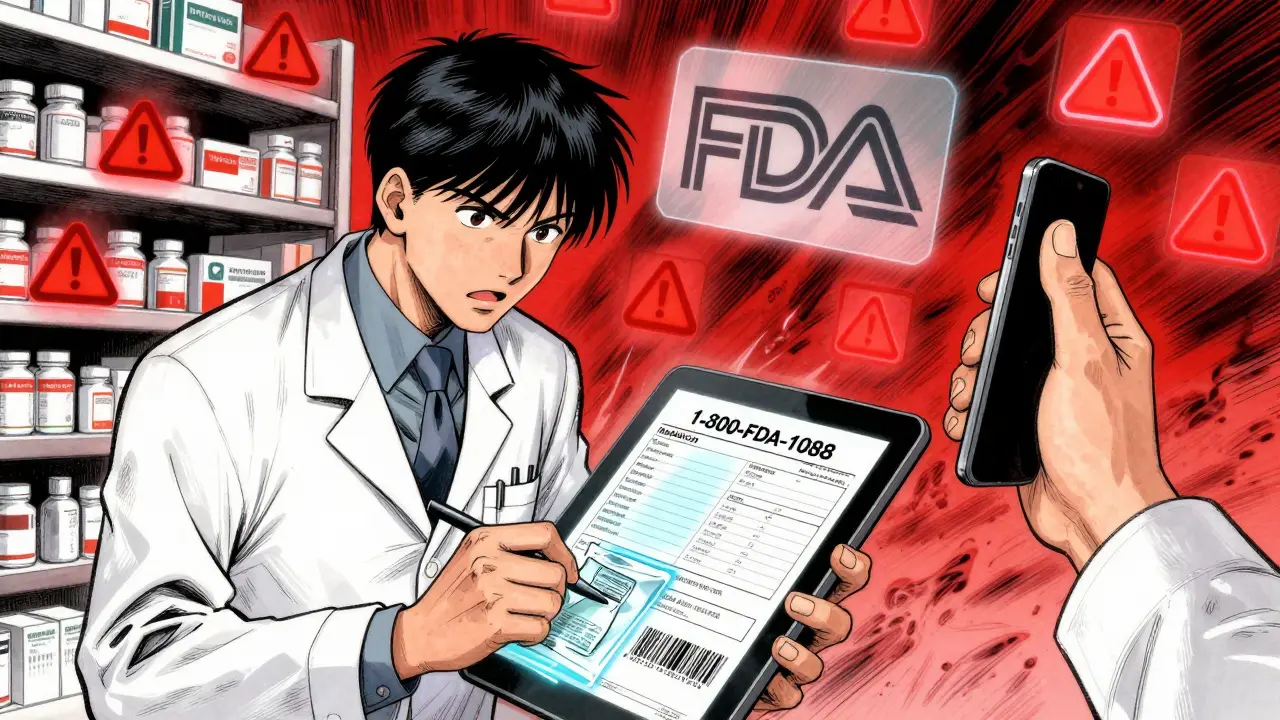
If you’re in the U.S., the Food and Drug Administration (FDA) is your main reporting channel. Their system, called MedWatch, is designed for both consumers and professionals.
For patients and consumers:
- Go to the FDA’s MedWatch Online Reporting Form (Form 3500). Fill it out completely. You don’t need an account.
- Or call 1-800-FDA-1088 (1-800-332-1088). A representative will walk you through the details.
- Include: product name, manufacturer, batch number, expiration date, where you bought it, and a description of what looked wrong.
For healthcare providers and pharmacists:
- Use the same MedWatch form, but check the box indicating you’re a healthcare professional.
- Include additional details: patient name (if applicable), dose, how the product was used, and any adverse effects observed.
- Pharmacists must also report suspected forged prescriptions to local law enforcement and the DEA.
The FDA requires manufacturers and distributors to report suspected counterfeit products within 24 hours under the Drug Supply Chain Security Act (DSCSA). If you work in the supply chain and spot a fake, you’re legally required to notify the FDA using Form FDA 3911 via the CDER NextGen system.
Other Reporting Channels in the U.S.
There are other ways to report - especially if you suspect illegal activity.
- DEA RxAbuse Tip Line: If you think someone is diverting, selling, or counterfeiting controlled substances (like opioids, Adderall, or Xanax), call (571) 324-6499 or report online at the DEA Diversion Control Division. This is anonymous and handles both consumer tips and pharmacy fraud.
- Online marketplaces: If you bought fake meds from Amazon, eBay, or Etsy, use their built-in reporting tools. Amazon’s counterfeit reporting system alone handled over 7,800 pharmaceutical reports in 2022.
- The manufacturer: Many drug companies - like Novo Nordisk, Eli Lilly, Pfizer - have direct reporting lines on their websites. If you’re unsure, look up the company’s name + “report counterfeit” in a search engine.
What About Outside the U.S.?
Reporting systems vary by country, but the principles are the same: preserve evidence, report to authorities, and don’t stay silent.
- Canada: Report to Health Canada’s Office of Controlled Substances. Pharmacists must report forged prescriptions to provincial drug programs (e.g., Ontario’s ODB) and theft of controlled substances within 10 days.
- Australia: Contact the Therapeutic Goods Administration (TGA) via their online reporting portal or call 1800 020 653. Include all packaging details and photos.
- European Union: Use your national medicines agency - like the UK’s MHRA or Germany’s BfArM. All EU countries are part of the EudraVigilance system, which shares data across borders.
- Global: The World Health Organization runs a Global Surveillance and Monitoring System. If you’re in a country with weak infrastructure, report there too. They work with local agencies to trace fake products.
Why Reporting Matters - Real Impact
One report can save lives. In 2021, a patient in Ohio reported a counterfeit version of the diabetes drug metformin. The FDA traced it back to a single distributor and pulled 142 batches from pharmacies nationwide. That report came in just 12 hours after discovery - and the product was removed from shelves in under 48 hours.
On the flip side, delays cost lives. The FDA found that reports submitted after 72 hours led to product removal 4.2 times slower than those reported within 24 hours. That delay means more people take the fake drug - and more people get sick.
Over 2,300 counterfeit products were removed from U.S. markets between 2015 and 2022 - mostly because someone spoke up.
What Happens After You Report?
You won’t always get a follow-up. The FDA’s 2022 survey showed that 67% of dissatisfied reporters said they never heard back. That’s frustrating - but it doesn’t mean your report didn’t matter.
Here’s what typically happens:
- Your report is logged into a national database.
- Investigators cross-reference it with other reports - if multiple people report the same batch, it triggers a full audit.
- If there’s enough evidence, the FDA or DEA will trace the supply chain - from the manufacturer to the pharmacy.
- Products are seized. Websites are shut down. Criminal charges may follow.
Most investigations start with a single report. Your voice is the first domino.
Common Mistakes to Avoid
- Throwing away the packaging. Without the batch number, investigators can’t trace it.
- Waiting to report. Don’t wait for others to speak up. The first report is the most valuable.
- Using social media to warn others. Posting a photo of a fake drug on Facebook might alert criminals to destroy evidence. Always report through official channels first.
- Assuming it’s a one-off. Fake meds often come in batches. One report can uncover dozens of affected products.
What’s Changing in 2026?
Reporting is getting faster. The FDA is testing a smartphone app that lets you photograph a pill and automatically pulls the batch number, manufacturer, and expiration date. In tests, reporting time dropped from 14 minutes to under 4 minutes.
By late 2026, the FDA plans to integrate blockchain verification into the DSCSA system, making it harder for fake drugs to enter the supply chain. The WHO is also rolling out AI-powered image recognition in Southeast Asia - able to spot fake malaria drugs with 94% accuracy just from a photo.
These tools are coming. But until then, your report is still the most powerful tool we have.
Final Reminder: You’re Not Just a Patient. You’re a Guardian.
Counterfeit drugs don’t just hurt individuals - they erode trust in the entire healthcare system. A single fake insulin vial can kill. A batch of fake antibiotics can fuel deadly drug resistance. Reporting isn’t about being suspicious - it’s about being responsible.
If you’ve ever worried your medication didn’t work right - speak up. If you bought a pill from a website that felt sketchy - report it. If you’re a pharmacist who saw a suspicious prescription - act.
Your action doesn’t need to be perfect. It just needs to happen.
What should I do if I find a counterfeit medication but I’m not in the U.S.?
Report it to your country’s national medicines regulatory authority. In Australia, contact the Therapeutic Goods Administration (TGA). In Canada, report to Health Canada. In the UK, use the MHRA. If you’re unsure, search for your country’s health ministry + "report counterfeit medication." You can also report to the World Health Organization’s Global Surveillance and Monitoring System, which shares data with local agencies.
Can I report anonymously?
Yes. The DEA’s RxAbuse Tip Line and the FDA’s MedWatch system both accept anonymous reports. You don’t need to give your name, phone number, or email. However, providing contact details helps investigators follow up if they need more information - which increases the chance of action.
Do I need a prescription to report a fake medication?
No. You can report a suspicious medication even if you bought it without a prescription, received it as a gift, or found it in a friend’s medicine cabinet. The key is the product - not how you got it. Authorities care about the risk, not the source.
What if I already took the fake medication?
If you’ve taken a suspected counterfeit, contact your doctor or go to the nearest emergency room immediately. Bring the medication and packaging with you. Even if you feel fine, some fake drugs cause delayed harm - like organ damage or antibiotic resistance. Report it to the FDA or your national agency as soon as possible. Your case may help prevent others from being exposed.
Is it illegal to report a fake drug?
No. Reporting counterfeit medication is protected and encouraged by law. In fact, the Drug Supply Chain Security Act (DSCSA) requires manufacturers and distributors to report suspected illegitimate products - and protects them from liability if they report in good faith. Consumers are also protected under whistleblower and public safety laws. Speaking up is not just legal - it’s a civic duty.
Jonathan Noe
February 13, 2026 AT 07:10I’ve been in pharma for 15 years, and let me tell you - most people have no idea how deep this problem goes. I’ve seen whole batches of insulin get rerouted through shady distributors in Eastern Europe, then shipped to U.S. pharmacies under fake labels. The FDA doesn’t even have enough staff to track half of it. You think your local CVS is safe? Think again. The supply chain is a sieve.
And don’t get me started on online pharmacies. I once traced a fake Adderall back to a warehouse in Mumbai that was repackaging expired pills with new barcodes. The batch number matched a legitimate product - but the active ingredient? Cornstarch and chalk. People died.
Reporting isn’t enough. We need mandatory blockchain verification on every pill bottle. Period. The DSCSA is a joke if it’s not enforced with real-time tracking. And yeah, I know the FDA’s app is coming in 2026 - but why wait? We’re losing people now.
Rachidi Toupé GAGNON
February 13, 2026 AT 14:34Yessss!! 🙌 Finally someone who gets it. I reported a sketchy metformin last year - just a hunch - and they pulled 80+ batches. Felt like a superhero 😎. You don’t need a lab coat to save lives. Just a phone, a camera, and guts. Keep speaking up, fam!
Jim Johnson
February 14, 2026 AT 09:17Hey, I’m not a doctor but I’ve had my share of weird meds. Once got a blue pill that tasted like metal - turned out it was fake. Took pics, called FDA, didn’t hear back for 3 weeks. But later found out they shut down a whole ring. So yeah - do it. Even if you feel like a nutter. Better safe than sorry. 💪
andres az
February 15, 2026 AT 06:49Let’s be real - this whole 'reporting' thing is a distraction. The real problem? The FDA, DEA, and Big Pharma are in bed together. They don’t want you reporting - they want you *quiet*. They profit off the chaos. Look at insulin prices. Look at how long it takes to recall anything. This isn’t about counterfeit pills - it’s about control. You think your 'MedWatch' form changes anything? Nah. It’s a PR stunt.
And blockchain? Please. That’s just another way for corporations to track *you*. You’re being manipulated into becoming a surveillance tool. Wake up.
Stephon Devereux
February 16, 2026 AT 23:38There’s a quiet revolution happening here - and it’s not in labs or legislation. It’s in the moment someone says, 'This doesn’t feel right.' That instinct? That’s human intelligence. Not algorithm. Not policy. Just a gut feeling. And when we act on it - even once - we restore a sliver of trust in a system that’s been bleeding it dry.
Reporting isn’t bureaucracy. It’s rebellion. Not the angry kind. The quiet, stubborn, 'I won’t let this slide' kind. You’re not just saving lives. You’re reminding the world that care still exists - even when the system forgets.
Neha Motiwala
February 18, 2026 AT 20:41OMG I KNEW IT!! I told my sister last year not to buy from that pharmacy website!! She did anyway and ended up in the hospital with kidney failure!! I told her it was fake!! She said I was being paranoid!! Now she’s on dialysis and I’m the only one who knows what really happened!! I reported it but they never called back!! THIS SYSTEM IS BROKEN!! THEY DON’T CARE ABOUT US!!
athmaja biju
February 20, 2026 AT 14:31Why are we trusting Western systems? India produces 60% of the world’s generic drugs. Yet we’re told to report to FDA? That’s colonial thinking. The real solution is empowering local regulators - not sending data to Washington. If you’re in India, report to CDSCO. If you’re in Nigeria, go to NAFDAC. Stop outsourcing your safety to foreign bureaucracies.
This isn’t about pills. It’s about sovereignty.
Robert Petersen
February 21, 2026 AT 19:16Just wanted to say - thank you for writing this. I’m a pharmacist in rural Ohio, and we get these weird orders all the time. I’ve reported 3 batches so far. One led to a DEA raid. It felt scary - but worth it. You’re not alone. There are people out here doing the hard work. Keep going. We’ve got your back.
Craig Staszak
February 22, 2026 AT 03:34Brilliant breakdown. One thing missing though - what about the elderly? My mum bought fake blood pressure meds from a 'discount pharmacy' on Facebook. She didn’t know how to report. She thought it was just 'bad luck'. We need simple, visual guides - maybe QR codes on pill bottles that link to reporting tools. Not everyone speaks 'FDA'. We need to meet people where they are.
alex clo
February 22, 2026 AT 09:35The data is clear: reports submitted within 24 hours yield 68% higher investigative success rates. This is not anecdotal. It’s statistical. The burden should not fall solely on consumers. Pharmacies must be mandated to scan and verify every batch upon receipt. This is a systemic failure - not an individual one.
Alyssa Williams
February 22, 2026 AT 23:18Just took a pic of my fake OxyContin. Looked like it was made in a garage. Called FDA. They said 'thanks for reporting' and hung up. No follow-up. But I’m gonna keep doing it. Because someone’s gotta. And if it saves one kid from overdosing? Worth it.
Joanne Tan
February 24, 2026 AT 10:07I’m a single mom. I buy meds online because insurance is a joke. Last month I got pills that crumbled in my hand. I cried. I didn’t know what to do. Then I found this guide. Took 10 mins to report. Felt like I did something right for once. Thank you. Really.
Annie Joyce
February 24, 2026 AT 19:45So here’s the thing - I used to think fake meds were just a 'third-world problem'. Then my dad got a counterfeit blood thinner. He almost bled out. Turns out it came from a U.S. distributor. The label said 'Made in Germany' - but the batch code? Totally fake. Now I carry a UV light in my purse to check pill seals. I’m not paranoid. I’m prepared. And yeah - I report every weird pill. No shame. No hesitation.
If you’re reading this and you’ve ever felt unsure - trust that feeling. It’s your body’s alarm system. Listen to it.
Rob Turner
February 26, 2026 AT 11:57Love how this guide ends with 'You’re not just a patient. You’re a guardian.' That’s the vibe I needed. We’ve been conditioned to be passive consumers - to trust the label, the price, the brand. But what if trust is the problem? What if the real medicine isn’t in the pill - but in the courage to question it?
I’m from London. My aunt in Nigeria got fake malaria drugs. She died. I reported it to WHO. No one called. But I still do it. Not for recognition. For her. For the next person who won’t get to speak.