FDA Drug Label Knowledge Quiz
Test Your Knowledge
Question 1 of 5
What is the purpose of the Boxed Warning section in FDA drug labels?
Your Results
Key Takeaways
When you or someone you care about is prescribed a new medication, the first thing you might see is a small paper label on the bottle. But that’s just the tip of the iceberg. Behind that label is a detailed, legally required document called the FDA drug label-a comprehensive guide that holds everything doctors, pharmacists, and patients need to know about how to use the drug safely. Most people never look beyond the bottle. But if you understand what’s inside the full prescribing information, you can make smarter decisions and avoid dangerous mistakes.
What’s Inside the FDA Drug Label?
The FDA drug label isn’t a single page. It’s a structured, 17-section document called the Full Prescribing Information (FPI). This format was created in 2006 under the Physician Labeling Rule and has been updated regularly since, with the latest changes to the Dosage and Administration section released in March 2024. Every approved prescription drug in the U.S. must follow this exact structure. That means no matter if it’s a blood pressure pill or a cancer treatment, the information is always organized the same way.The label starts with a condensed summary called the Highlights of Prescribing Information. This half-page section gives you the most urgent details: what the drug treats, how much to take, and the biggest risks. But here’s the catch: the Highlights are meant to be a quick reference, not the full story. The FDA requires it to include a disclaimer: "This is a summary of important information. Read the full prescribing information for complete details." Skipping the rest can be risky.
The Boxed Warning: Don’t Skip This
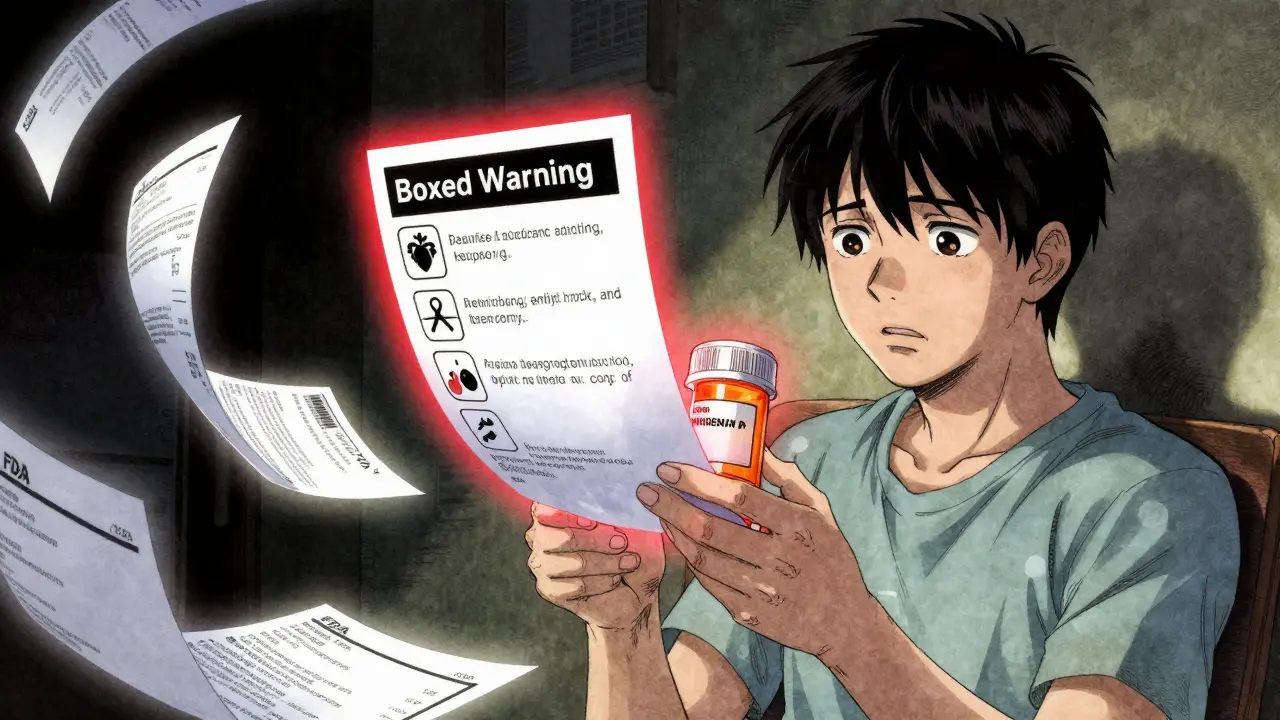
Right after the Highlights, you’ll find the Boxed Warning-the most serious alert the FDA can require. It’s called that because it’s surrounded by a thick black border, like a stop sign on a highway. This section flags life-threatening risks: severe allergic reactions, organ damage, suicidal thoughts, or increased risk of death. For example, some diabetes drugs carry a Boxed Warning for heart failure. Some antidepressants warn of increased suicide risk in young adults. These aren’t theoretical risks. They’re based on clinical trials and post-market reports. If a drug has a Boxed Warning, you need to know it before you take it. Your doctor should discuss it. If they don’t, ask.Indications and Usage: Is This Drug Right for You?
Section 1 tells you exactly what the drug is approved to treat. This is not the same as "off-label" uses doctors might suggest. The FDA only approves drugs for specific conditions based on strong evidence. For instance, metformin is approved for type 2 diabetes-but not for weight loss, even though some doctors prescribe it for that. If your condition isn’t listed here, the drug hasn’t been proven safe and effective for it. Be careful with off-label use. It’s legal, but it’s not the same as FDA approval.Dosage and Administration: The Right Amount, at the Right Time
Section 2 is where people make the most mistakes. It doesn’t just say "take one pill daily." It tells you:- How much to take based on your age, weight, or kidney function
- Whether to take it with food or on an empty stomach
- How to adjust the dose if you have liver or kidney disease
- What to do if you miss a dose
For example, the anticoagulant warfarin has different dosing rules for elderly patients, people with heart failure, or those on dialysis. Taking too much can cause internal bleeding. Too little won’t prevent clots. The label gives precise guidance. Never guess. If your doctor changes your dose, check the label to see if it matches.
Contraindications: When Not to Take the Drug
Section 4 lists situations where the drug should never be used. These are hard rules. For example, statins like atorvastatin are contraindicated in people with active liver disease. Taking them could cause liver failure. Another example: erectile dysfunction drugs like sildenafil shouldn’t be taken with nitrates (used for chest pain), because the combination can drop blood pressure to dangerous levels. If you have any of these conditions, the drug is off-limits. No exceptions.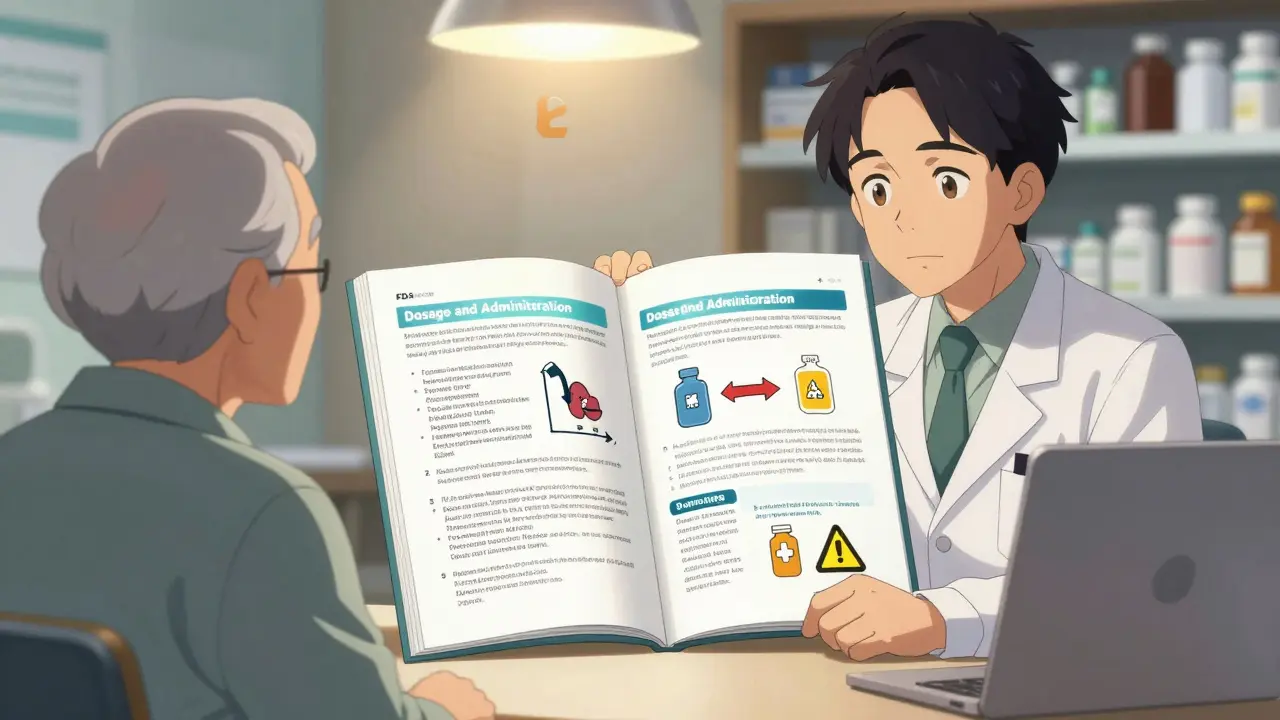
Warnings and Precautions: The Hidden Risks
This section (Section 5) is longer than most people expect. It covers risks that aren’t severe enough for a Boxed Warning but still matter. These include:- Increased risk of falls in older adults
- Drug-induced electrolyte imbalances
- Interactions with certain foods (like grapefruit juice and some statins)
- Need for regular blood tests while on the drug
Some drugs require monitoring. For example, lithium for bipolar disorder needs regular blood tests to stay within a safe range. The label tells you how often. If your doctor doesn’t order those tests, ask why.
Adverse Reactions: What Side Effects Are Common?
Section 6 lists side effects reported in clinical trials. The FDA requires them to be grouped by frequency:- Very common: >10% of users
- Common: 1-10%
- Uncommon: 0.1-1%
- Rare: <0.1%
Don’t panic if you see a long list. Most side effects are mild-headache, nausea, dizziness. But if you see something serious listed as "common," like muscle damage with statins or pancreatitis with certain diabetes drugs, that’s a red flag. Know what’s likely and what’s rare. And remember: side effects in trials aren’t always the same as in real life. If you experience something new, report it to your doctor.
Drug Interactions: What You Mix Matters
Section 7 is critical. Many drug problems come from mixing medications. For example, fluoxetine (Prozac) can increase levels of certain blood thinners, raising bleeding risk. Omeprazole (Prilosec) can reduce the effectiveness of clopidogrel (Plavix), a heart drug. The label lists specific drugs to avoid. But it doesn’t list everything. Herbal supplements like St. John’s Wort or even over-the-counter painkillers like ibuprofen can interact too. Always tell your doctor and pharmacist everything you take-including vitamins, supplements, and cannabis products.Use in Specific Populations: Pregnancy, Kids, Seniors
Section 8 breaks down safety for groups often left out of clinical trials:- Pregnancy: Is it safe? Does it cause birth defects? (Categories like "Category D" mean evidence of risk)
- Lactation: Does it pass into breast milk? At what level?
- Pediatric: Is it approved for children? What dose?
- Geriatric: Do older adults need lower doses? Are they more sensitive?
Many drugs aren’t tested on pregnant women. That doesn’t mean they’re unsafe-but it means data is limited. If you’re pregnant or breastfeeding, this section is your best starting point. For seniors, kidney and liver function decline with age. Many drugs need lower doses, but doctors often forget to adjust them.
How Supplied and Storage: Check the NDC Code
Section 16 tells you how the drug comes packaged. It lists the National Drug Code (NDC)-a 10-digit number split into three parts: labeler code, product code, and package code. This isn’t just for pharmacists. If you’re comparing generic brands, the NDC helps you confirm you’re getting the same drug. It also tells you how many pills are in the bottle and what the container looks like. If your pill looks different this month, check the NDC. It might be a different manufacturer.Storage instructions matter too. Some drugs need refrigeration. Others must be kept away from moisture. Leaving insulin in a hot car or keeping antibiotics in a bathroom cabinet can make them useless-or dangerous.
Patient Counseling Information: What You Should Know
Section 17 is often ignored. But it’s written for you. It gives clear, plain-language talking points doctors should use when explaining the drug. For example:- "Take this medication at the same time every day."
- "Avoid alcohol while taking this drug."
- "If you develop swelling in your face or throat, seek emergency help."
Studies show only about 38% of providers actually use this section during patient visits. If your doctor doesn’t mention these points, ask. You have a right to know what to watch for.
Recent Major Changes: Is This Label Updated?
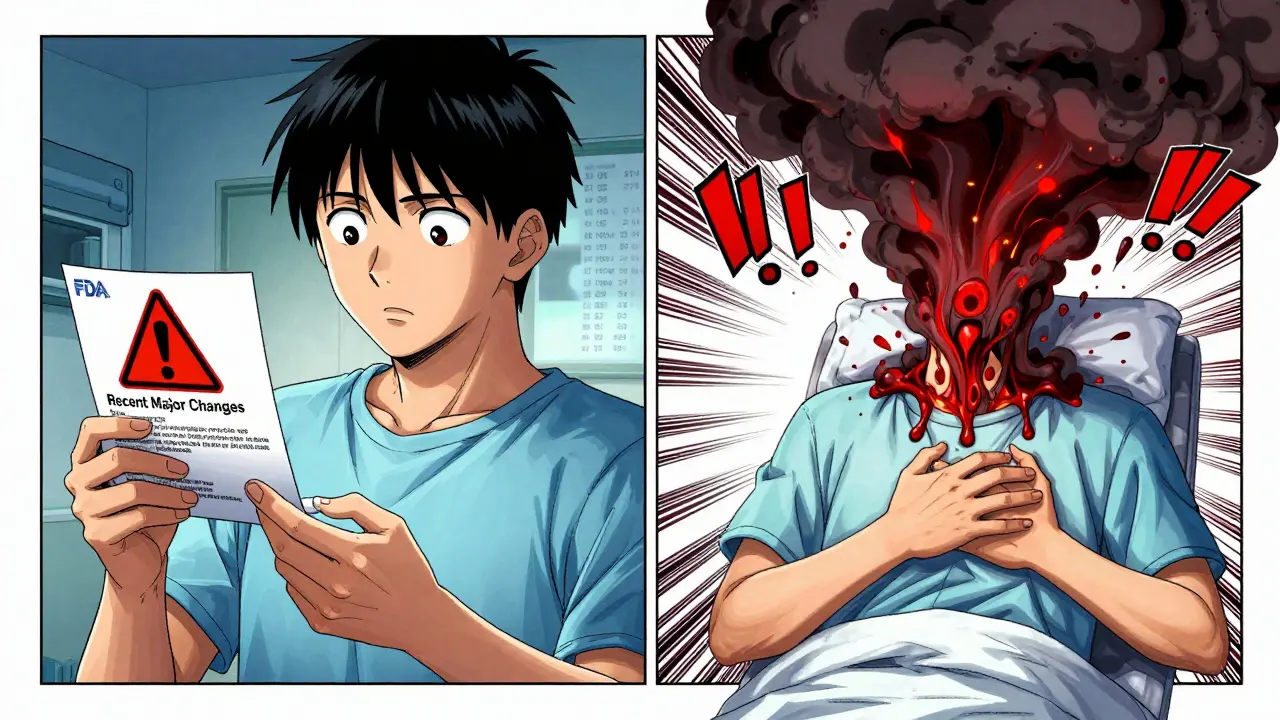
Since 2018, every label must include a "Recent Major Changes" section. This tells you what’s new in the last six months. Maybe a new warning was added. Maybe a dose recommendation changed. If your drug’s label was updated last month, your doctor might not know. Always check this section before starting a new prescription or refilling an old one. The FDA tracks that this feature has cut the time between label updates and clinical adoption by 35%.How to Use This Information
For patients: Don’t rely on the bottle label alone. Go to the FDA’s website and search for the drug’s full prescribing information. Print it. Highlight the Boxed Warning, contraindications, and side effects. Bring it to your next appointment. Ask: "Does this match what you told me?" For caregivers: If you’re helping an elderly parent or someone with memory issues, keep a printed copy of the label. Note the dosing schedule. Set phone reminders. Write down warning signs to watch for.For healthcare providers: Use the Highlights to start the conversation, but always refer to the full label. Check the "Recent Major Changes" before prescribing. Use Section 17 to guide patient education. Don’t assume patients read the materials you give them-explain the key risks in your own words.
What Happens If the Label Is Wrong?
The FDA doesn’t just set rules-it enforces them. In 2023 alone, the agency issued 47 warning letters to drug companies for labeling violations. That means companies got caught giving out inaccurate, incomplete, or misleading information. If a label is wrong, patients can be harmed. That’s why the system is so tightly controlled. All labels must be submitted in a machine-readable format called SPL (Structured Product Labeling), which ensures consistency across electronic health records. Nearly all U.S. hospitals and pharmacies pull drug data directly from these FDA-approved files.But mistakes still happen. That’s why you need to be your own advocate. If something feels off-dose too high, side effects not listed, conflicting instructions-double-check with the official label. Don’t trust a pharmacy printout or a website that isn’t FDA-linked.
What’s Changing in 2025?
The FDA is working on a new initiative called "Patient-Focused Labeling." Starting in 2025, they plan to test labels that include clearer language, visual icons, and simplified summaries for patients. The goal? Reduce medication errors by up to 29%, according to Johns Hopkins research. This doesn’t mean the professional sections will disappear. It means they’ll be easier to navigate. Think of it like a smartphone app: experts get the full settings menu. Patients get a simple mode.For now, the current system is the standard. It’s complex, but it’s designed to save lives. The more you understand it, the safer you are.
Can I trust the drug label if my doctor says something different?
Always compare what your doctor says with the official FDA label. Doctors are human-they can forget updates or rely on outdated information. The FDA label is the legal standard. If there’s a conflict, ask your doctor to explain why they’re recommending something different from the approved label. It might be an off-label use, which is legal but requires careful consideration.
Where can I find the official FDA drug label?
Go to the FDA’s website at [email protected] or search "FDA drug labels" on the FDA’s official site. You can also use Drugs@FDA, a public database that links directly to the full prescribing information for every approved drug. Avoid third-party sites like WebMD or MedlinePlus for official details-they may not reflect the latest updates.
Why does the label list so many side effects?
The FDA requires all side effects observed in clinical trials to be listed, no matter how rare. That doesn’t mean you’ll get them all. Most people only experience one or two common ones. But listing everything ensures transparency. If you develop a new symptom, even if it’s not listed, report it. The FDA uses these reports to update labels later.
Do generic drugs have the same label as brand-name drugs?
Yes. Generic drugs must have identical active ingredients, strength, dosage form, and labeling as the brand-name version. The only differences are in inactive ingredients (like fillers) and packaging. The Boxed Warning, contraindications, and dosing instructions are exactly the same. If your generic looks different, check the NDC code to confirm it’s the same drug.
What if I can’t understand the medical terms on the label?
Ask your pharmacist. They’re trained to translate complex medical language into plain terms. You can also ask your doctor to explain any section you don’t understand. Don’t be embarrassed. The FDA’s own Patient Counseling Information section is meant to be read aloud to patients. If you’re unsure, say: "Can you explain this in simpler terms?"
Reading an FDA drug label isn’t about becoming a pharmacist. It’s about taking control of your health. The information is there. You just need to know where to look-and what to look for.
Will Neitzer
December 26, 2025 AT 20:33The FDA's Full Prescribing Information is one of the most underutilized tools in modern healthcare. Most patients don't realize that every section is legally mandated, meticulously reviewed, and updated with new safety data as it emerges. The Boxed Warning isn't just a red flag-it's a lifeline. If your prescriber skips discussing it, they're not being negligent; they're assuming you won't ask. But you should. Knowledge isn't just power-it's protection.
And let's be clear: the Highlights section exists for speed, not completeness. It's like reading the movie trailer and thinking you've seen the film. The real substance-the drug interactions, the renal dosing adjustments, the black box contraindications-is buried in the body of the document. That's where the truth lives.
Pharmacists are trained to parse this. Doctors are expected to. Patients? We're left guessing. That's a systemic failure, not a personal one.
If you're on any chronic medication, print the FPI. Highlight the sections relevant to you. Bring it to your next appointment. You'll be amazed at how many questions your provider didn't even know they needed to answer.
This isn't paranoia. It's precision medicine. And it's your right.
Janice Holmes
December 28, 2025 AT 14:41So many people treat meds like candy. Pop a pill, hope for the best, ignore the fine print. The FDA label isn't legalese-it's a survival guide. That 'Contraindications' section? That's the list of when NOT to take it. Not 'maybe don't,' not 'probably avoid.' NOT. Full stop.
And grapefruit juice? It's not just a myth. It can turn a safe dose into a lethal one by wrecking your liver's ability to metabolize the drug. I've seen it. People think 'natural' means 'safe.' Nope. Natural can kill you too.
Read the label. Not the bottle. The full document. You're not being paranoid-you're being responsible.
Olivia Goolsby
December 29, 2025 AT 08:10EVERYTHING IS A CONSPIRACY. The FDA? Controlled by Big Pharma. The Boxed Warning? A distraction. They want you to think you're safe because there's a black border, but what they're really doing is making you feel like you’ve been warned so you won’t sue them when you’re dead. And don’t get me started on the ‘Highlights’-it’s a sugar-coated lie wrapped in bureaucratic jargon to make you feel like you’ve been informed when you’ve actually been manipulated.
Who wrote this? A pharmaceutical lobbyist? A doctor who gets kickbacks? The fact that they changed the Dosage section in 2024? That’s not an update-that’s a cover-up. They’re hiding something. And if you’re not asking why the same drug has different dosing rules across countries, you’re not paying attention. The WHO doesn’t even recognize half these guidelines. Why? Because they’re not global-they’re profit-driven.
And the ‘adverse reactions’ section? That’s the laundry list of what they KNOW happens. The real dangers? The ones they don’t list. The ones they bury in Phase IV trials. The ones they suppress until someone dies. And then they tweak the label and call it ‘transparency.’
Wake up. They’re not protecting you. They’re protecting their stock price.
And if you think your doctor is on your side, you’re even more naive than I thought.
Alex Lopez
December 31, 2025 AT 01:47Wow. Someone actually took the time to explain the FPI properly. Kudos. 🙌
For those who think this is overkill: imagine your car manual had a section called 'When Not to Drive'-and you ignored it because 'it's just paperwork.' You'd be dead. Or in jail. Or both.
The FDA label is your car manual for your body. Don't skip the 'Warnings and Precautions' section just because it's long. That's where the real driving rules are. And yes, if your doctor doesn't mention grapefruit juice or kidney dosing? Ask. Politely. But insist.
Also-lithium monitoring? Yes. Blood tests every 3 months? Yes. If your psych doctor doesn't order them, find a new one. This isn't optional. It's science.
Gerald Tardif
January 1, 2026 AT 11:09Reading the label is like learning the rules of a game you didn’t know you were playing. Most people just show up, grab a random card, and hope for the best. But if you actually read the manual? You start seeing patterns. You notice when the dosage changes based on age, or why your meds say 'take on empty stomach'-because food turns it into a paperweight.
I used to skip the 'Adverse Reactions' section. Then my aunt had a bad reaction to a drug she thought was 'safe' because it was 'commonly prescribed.' Turns out, the label said 'rare but fatal liver toxicity'-and she had the exact risk factors listed.
Don’t wait for a tragedy to read the fine print. Do it now. It’s not scary. It’s empowering.
And if you’re scared of the jargon? Google it. Or ask your pharmacist. They love this stuff. Seriously. They’ll be thrilled you asked.
James Bowers
January 1, 2026 AT 11:26While the intent of this article is commendable, it fundamentally misrepresents the nature of regulatory compliance. The FDA’s labeling framework is not a patient empowerment tool-it is a liability mitigation structure designed to shield manufacturers from litigation while creating the illusion of transparency. The so-called 'Full Prescribing Information' is written in legalese deliberately to discourage lay interpretation. The inclusion of 'Highlights' is performative: a cosmetic concession to public relations, not patient safety.
Moreover, the assertion that patients can 'make smarter decisions' by reading the label ignores the cognitive burden placed on individuals without medical training. The terminology is intentionally obfuscated. 'Contraindications' is not a plain-language term. 'Electrolyte imbalances' is not actionable information without context. The system is not designed for patient autonomy-it is designed for institutional insulation.
Therefore, while the article encourages diligence, it fails to address the structural coercion inherent in the current paradigm. The onus should not be on the patient to decode a legal document written by lawyers and pharmacologists. It should be on the system to deliver clarity.
Until then, this is performative transparency at its finest.
Monika Naumann
January 2, 2026 AT 23:42How can you trust a system that allows foreign drugs to be approved while Indian pharmaceuticals are scrutinized for every gram? The FDA label is a Western colonial tool disguised as science. We in India have been producing life-saving generics for decades-cheaper, effective, and safe-but you Americans still cling to your $500 pills with your fancy black boxes and 17-section documents.
Why do you need so much paper to tell someone to take a pill? We give one pill. One instruction. One life saved. No bureaucracy. No fear-mongering. No 'Boxed Warnings'-just results.
Your system is broken. It profits from confusion. We don’t need your labels. We need your respect.
Elizabeth Ganak
January 4, 2026 AT 21:42lol i just google my med and read the first 3 results. sometimes the patient forums are way more helpful than the label. like, people actually say what it felt like to take it, not just 'common: nausea'.
also, my pharmacist gave me a one-pager summary. way better than the 40-page pdf.
Nicola George
January 5, 2026 AT 02:52Wow. Someone actually wrote a whole thing about reading the label. And here I was thinking the bottle said 'take one, don't die.'
Anyway, I read the label once. Then I cried. Not because I was scared-because I realized I’d been taking my blood pressure med with grapefruit juice for two years. And no one told me.
So now I print it. I highlight it. I put it next to my coffee mug.
Turns out, being responsible is just… doing the thing. No drama. No conspiracy. Just… reading.
Also, my pharmacist is my hero. She gave me a sticky note with the top 3 things to watch for. That’s all I need.