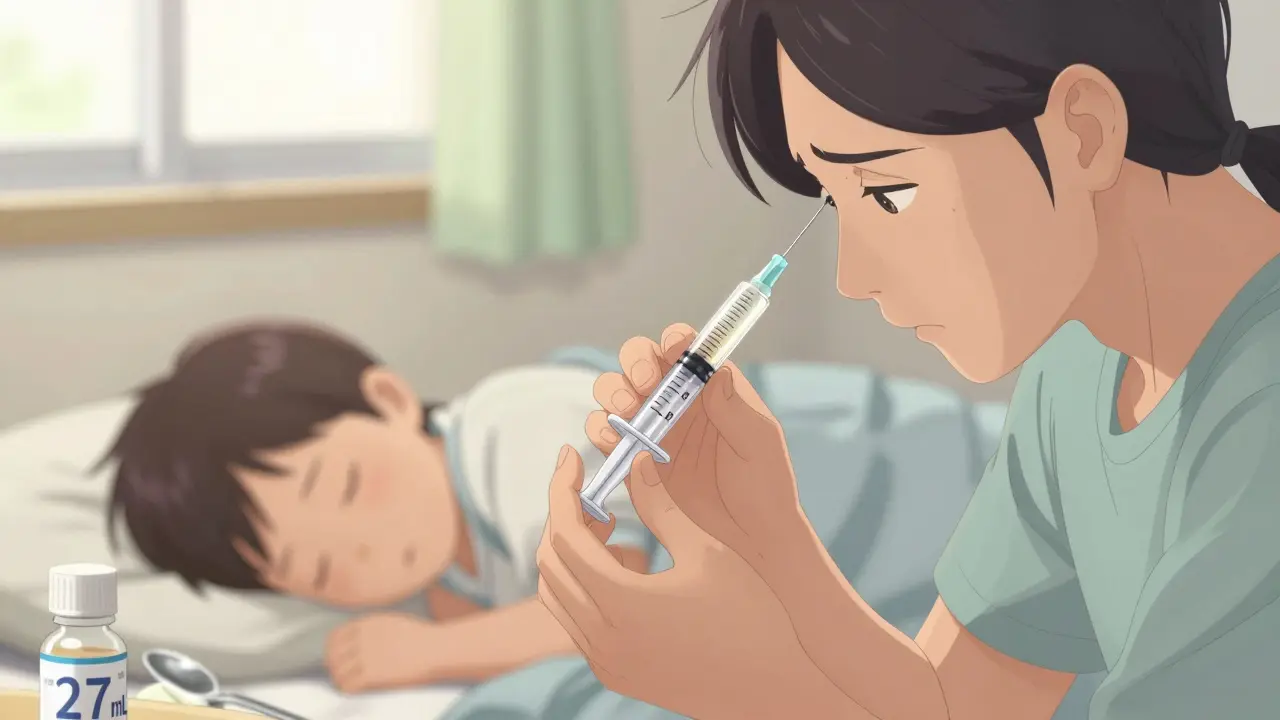
Every year, thousands of people-especially children-are harmed because someone gave them the wrong amount of liquid medicine. It’s not because someone was careless. It’s because the system is set up to fail. A 2023 study in the Journal of Pediatrics found that 80% of pediatric home medication errors involve liquid doses that are too high or too low. That’s not a small risk. That’s a silent epidemic.
Why Liquid Medications Are So Dangerous
Liquid medications are tricky. They look simple-just pour, drop, or squirt-but they’re full of hidden traps. A teaspoon of medicine might seem easy to measure, but kitchen spoons vary wildly. One household teaspoon can hold 3 mL, another 7 mL. That’s more than double the dose. And if the label says “1 tsp,” but the prescription was written in milliliters, confusion is guaranteed. The Institute for Safe Medication Practices calls wrong-dose liquid errors one of the top 10 persistent medication hazards. And it’s not just kids. Adults on anticoagulants, seizure meds, or chemotherapy are just as vulnerable. A 20% overdose of warfarin can cause dangerous bleeding. A 30% underdose of epilepsy medicine can trigger a seizure. These aren’t theoretical risks-they happen daily.The Biggest Culprits: Tools and Units
The most common mistake? Using the wrong measuring tool. A 2022 NIH study tested three common devices: oral syringes, dosing cups, and household spoons. For a 2.5 mL dose:- Oral syringes: 94% accurate
- Dosing cups: 76% accurate
- Household spoons: 62% accurate
What Works: The Proven Solutions
The good news? We know exactly how to fix this. And it’s not expensive. Here’s what actually reduces errors:1. Use an Oral Syringe-Every Time
If you’re giving liquid medicine to a child-or anyone-use an oral syringe. Not a cup. Not a spoon. A syringe. Look for one with clear 0.1 mL markings for doses under 1 mL, and 0.5 mL for 1-5 mL. These are cheap-under $1 each-and should come with every prescription. If your pharmacy doesn’t give you one, ask. Demand it.2. Demand mL-Only Labels
Check the label. Does it say “1.5 mL” or “½ tsp”? If it says “tsp” or “tbsp,” call the pharmacy. Ask them to re-label it. Under 2023 ASHP guidelines, they’re required to provide metric-only labeling. If they refuse, ask to speak to the pharmacist. This isn’t a favor-it’s a safety standard.3. Never Guess the Dose
Don’t estimate. Don’t “eyeball it.” If the dose is 2.7 mL, you don’t round to 3. You draw exactly 2.7. Oral syringes let you do that. Use the lines. If the syringe only has 0.5 mL marks and you need 2.7, ask for a finer one. Pharmacies have them.4. Store Medications Safely
Keep liquid meds out of reach, but also out of sight. Look-alike bottles cause mistakes. Amber-colored containers with bold “FOR ORAL USE ONLY” labels reduce confusion by 42%, according to the Institute for Healthcare Improvement. If your bottle looks like a cough syrup but says “antibiotic,” ask for a different one.5. Use Technology When You Can
In hospitals, barcode scanning cuts wrong-dose errors by 48%. At home, smartphone apps with dose calculators are starting to appear. Boston Children’s Hospital is testing AR apps that let you point your phone at the bottle and see the correct dose overlaid on the syringe. These aren’t sci-fi-they’re coming soon.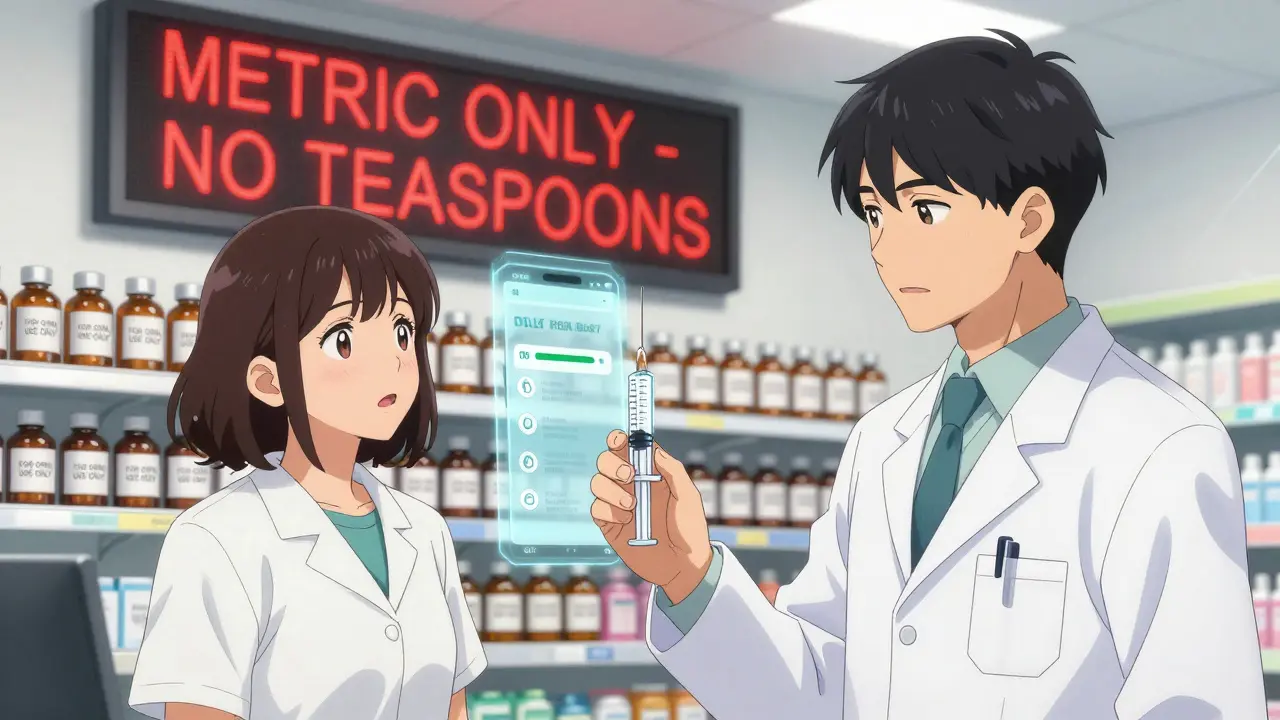
What Hospitals and Pharmacies Must Do
Healthcare systems aren’t off the hook. The biggest wins come from systemic changes:- ENFit connectors: Since 2016, new oral syringes and feeding tubes use a unique, non-interchangeable design that prevents them from attaching to IV lines. This stopped 98% of deadly wrong-route errors in hospitals that adopted it.
- Electronic prescribing with dose alerts: Systems that flag doses over 20% of standard weight-based ranges cut pediatric errors by 58% (Cochrane Review, 2023).
- Pharmacist-led education: A 15-minute conversation with a pharmacist about how to measure the dose reduces errors by 50%. Yet only 54% of caregivers receive this help.
- Pre-measured doses: Some pharmacies now offer single-dose oral syringes pre-filled with the exact amount. Patients report 94% satisfaction with this system.
What You Can Do Right Now
You don’t need to wait for a hospital policy change. Here’s your action plan:- When you get a liquid prescription, ask: “Do you have an oral syringe?” If they say no, say: “I need one. It’s the only safe way to measure.”
- Check the label. If you see “tsp,” “tbsp,” or “drop,” call the pharmacy and ask for a corrected label in mL.
- Keep the syringe with the medicine. Don’t throw it away. Store it in the same spot every time.
- Take a photo of the dose you’re giving. It helps you double-check and gives you proof if something goes wrong.
- Teach everyone who gives medicine-grandparents, babysitters, partners-the same method. Show them the syringe. Don’t assume they know.
The Cost of Inaction
Wrong-dose errors cost the U.S. healthcare system $8.3 billion a year. About 14% of these errors cause permanent harm or death. That’s not just money. That’s lives. And the biggest tragedy? Almost all of them are preventable. You don’t need a new law or a million-dollar system. You just need to stop using cups and spoons. You just need to ask for the syringe. You just need to say “milliliters, not teaspoons.”Final Thought: Safety Is a Habit
Medication safety isn’t about being perfect. It’s about being consistent. One time you use a spoon because you’re tired? That’s the moment a child ends up in the ER. One time you don’t ask for a syringe because you think it’s “no big deal”? That’s the moment a dose goes wrong. The tools are here. The guidelines are clear. The data is undeniable. What’s missing is the will to use them. Start today. Use the syringe. Demand the mL. Protect the dose. It’s not just medicine. It’s safety.Why are dosing cups unsafe for liquid medications?
Dosing cups are unsafe because their markings are hard to read accurately, especially for small volumes. The curve of the cup distorts the liquid level, leading to misreading. Studies show dosing cups have a 41% error rate for doses under 5 mL, compared to just 8% for oral syringes. They also often include non-metric units like teaspoons, which vary in size and cause confusion.
Should I always use an oral syringe for liquid medicine?
Yes. Oral syringes are the most accurate tool for measuring liquid medications. They offer precise 0.1 mL or 0.5 mL graduations, which allow you to measure exact doses. Dosing cups, spoons, and droppers are unreliable. Even if the pharmacy doesn’t give you one, ask for it-it’s your right under current safety guidelines.
What if the prescription says “teaspoon” instead of “mL”?
Call the pharmacy immediately. The American Academy of Pediatrics and ASHP have required metric-only labeling since 2015. A “teaspoon” can mean anything from 3 mL to 7 mL. Ask them to re-label the prescription in milliliters. If they refuse, ask to speak to the pharmacist or request a different formulation.
Can I reuse an oral syringe for different medications?
No. Never reuse an oral syringe for a different medicine without thoroughly cleaning it. Residue from one drug can mix with another, causing dangerous interactions. Use a new syringe for each medication, or clean the syringe with warm water and air-dry it completely between uses. Some pharmacies sell single-use syringes to avoid this risk.
Are there apps or tools to help measure liquid doses correctly?
Yes. Several smartphone apps now help calculate and visualize correct doses. Boston Children’s Hospital is testing augmented reality apps that overlay the right dose on your syringe when you point your phone at the bottle. While not yet widely available, apps from trusted health organizations like HealthyChildren.org offer dose calculators based on weight and concentration. Always double-check with a pharmacist before relying on an app.
How do hospitals prevent these errors?
Hospitals use layered safety systems: ENFit connectors to prevent IV mix-ups, barcode scanning to verify doses, electronic prescribing with dose alerts, and mandatory oral syringe distribution. Staff training and pharmacist reviews are required. Hospitals that implement all these measures reduce liquid medication errors by up to 67%, according to Harvard Medical School data.
What should I do if I think I gave the wrong dose?
Call your pharmacist or doctor right away. Don’t wait for symptoms. Tell them the medicine name, the dose you gave, the time, and the child’s weight. They can tell you if it’s dangerous and what to do next. Keep the bottle and syringe-they may need to check the concentration. It’s better to be safe than sorry.
Haley Graves
January 15, 2026 AT 19:13Just got my daughter's antibiotics today. Asked for the syringe. Pharmacist handed me a dosing cup and said, 'It's fine.' I told him I'd be back with a copy of the ASHP guidelines. He gave me the syringe. Don't let them gaslight you. This isn't optional safety-it's survival.
Diane Hendriks
January 17, 2026 AT 09:06The institutional failure here is not merely technical-it is epistemological. The continued reliance on imperial units in a metric-saturated world reflects a deeper cultural malaise: the refusal to prioritize precision over convenience. The American Academy of Pediatrics banned teaspoons in 2015, yet pharmacies still peddle ambiguity as compliance. This is not negligence. It is ideological decay.
ellen adamina
January 18, 2026 AT 00:15I used to use spoons until my nephew had a seizure from an underdose. Now I keep three syringes in the fridge with the meds. Label them. Color code them. Never guess. Ever.
Gloria Montero Puertas
January 19, 2026 AT 11:41Of course, the system is broken-because it's designed by people who don't have children, don't read studies, and think 'teaspoon' is a unit of trust. And now you're telling me I need to buy a $1 syringe? What next? Should I pay extra for a pharmacist to hold my hand? This isn't medicine-it's a performance of parental guilt.
Frank Geurts
January 20, 2026 AT 13:52As a healthcare professional with over two decades of international experience, I can affirm that the data presented here is not merely accurate-it is universally applicable. The adoption of ENFit connectors, metric-only labeling, and pharmacist-led education represents the gold standard in global medication safety protocols. The United States lags behind nations such as Canada and the Netherlands, where these measures have been mandatory since 2012. It is not a question of cost-it is a question of moral responsibility.
Mike Berrange
January 22, 2026 AT 06:36Why are we still talking about syringes? This is a corporate scam. The real issue is that pharmacies don't want to stock them because they cost money. And the FDA? They're in bed with the cup manufacturers. I've seen the emails. They call it 'convenience engineering.' This isn't about safety-it's about profit.
Dan Mack
January 23, 2026 AT 05:44They say 'use a syringe' but they don't tell you that the syringes they give you are often expired or reused. I once got one that smelled like bleach and had a crack. The pharmacy said 'it's fine.' You think this is about safety? Nah. They're just trying to avoid lawsuits. The real solution? Ban liquid meds entirely. Give pills or patches. End of story.
Amy Vickberg
January 23, 2026 AT 09:40I used to think this was overkill until my sister almost lost her baby. Now I carry a syringe in my purse. I give them to friends. I leave them in waiting rooms. I text my mom every time I refill a prescription. This isn't just about medicine-it's about love. Don't wait for a tragedy to change your habits.
Nishant Garg
January 23, 2026 AT 22:45In India, we don’t have oral syringes in every pharmacy, but we’ve adapted. We use insulin syringes-small, precise, and widely available. We label them with tape and a marker. We teach grandparents to hold the syringe like a pen, not a spoon. The solution isn’t always high-tech. Sometimes it’s just resourcefulness, patience, and a community that refuses to let children pay for systemic laziness.
Nicholas Urmaza
January 24, 2026 AT 21:03Use the syringe. Demand mL. Period. This isn't complicated. Stop making it emotional. Stop making it political. Just do the thing that saves lives. Your kid doesn't care about your frustration. They care about the right dose. Be the adult.
Jan Hess
January 26, 2026 AT 20:58My wife and I started a little thing-we call it Syringe Sunday. Every Sunday we check all meds, refill syringes, clean them with warm water, and label them. We’ve done it for three years. No errors. No stress. Just peace of mind. It takes 10 minutes. It’s worth it.