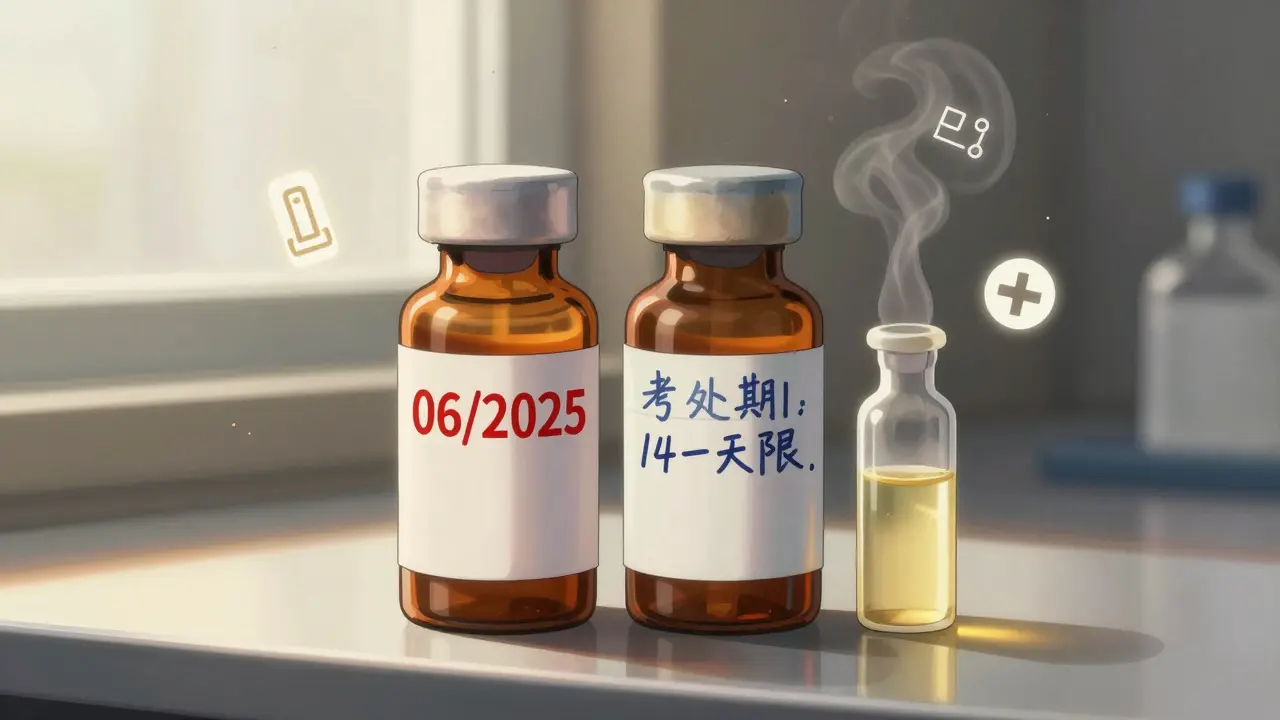
When you pick up a prescription, you might see two different dates on the bottle: one printed by the drugmaker, and another written by the pharmacist. One says expiration date. The other says beyond-use date. They look similar, but they’re not the same. Using the wrong one could mean taking a drug that’s lost its strength-or worse, one that’s unsafe.
What an Expiration Date Really Means
The expiration date on your pill bottle comes from the manufacturer. It’s not a guess. It’s the result of months, sometimes years, of lab testing. The company puts the medicine under extreme conditions-heat, humidity, light-to see how long it stays stable. The FDA requires this testing for every approved drug sold in the U.S. since 1979.This date guarantees the drug will still have at least 90% of its labeled potency until that day. It also ensures the medicine won’t break down into harmful substances. That guarantee only applies if the drug stays in its original, unopened container, stored as directed-usually at room temperature, away from moisture.
For example, a bottle of amoxicillin might say "Exp. 06/2025." That means the manufacturer stands behind its effectiveness and safety until June 2025, as long as you haven’t opened it or stored it in a hot bathroom. Even after opening, the expiration date still holds. You don’t get extra time just because you haven’t finished the bottle.
What a Beyond-Use Date Is (And Why It’s Shorter)
Now, imagine your doctor prescribes a medication that isn’t made by a big drug company. Maybe you’re allergic to the dye in the commercial version. Or you need a liquid form of a pill. Or you’re a child who can’t swallow tablets. That’s where compounding pharmacies come in.These pharmacies mix ingredients to create custom medicines. When they do, they can’t use the original manufacturer’s expiration date. Why? Because they changed the formula. They added water. They crushed pills. They mixed powders. That changes how the drug behaves.
So the pharmacist gives you a beyond-use date-or BUD. This isn’t a marketing claim. It’s a safety limit based on USP (United States Pharmacopeia) guidelines. The BUD tells you the last day the compounded medicine is likely safe and effective.
Here’s the catch: BUDs are almost always shorter than expiration dates. Why? Because compounded medicines lack the preservatives, stabilizers, and controlled manufacturing of commercial drugs. They’re more fragile. A liquid antibiotic made in the pharmacy might have a BUD of just 14 days-even if the original powder had a 5-year expiration. A pill made by mixing two powders might last 30 days at room temperature. A sterile IV bag? Maybe 48 hours.
When the Two Dates Collide
Sometimes, you’ll get a commercial drug that’s been repackaged. Maybe your pharmacy took 100 pills from a big bottle and put them into a child-friendly blister pack. That’s still considered an alteration. So now, instead of the original expiration date, you get a BUD.USP rules say the BUD for repackaged drugs can’t be longer than:
- The original manufacturer’s expiration date, or
- One year from the day the pharmacy repackaged it
Whichever comes first. So if your 100-pill bottle of metformin expires in 2027, but the pharmacy repackages it in January 2026, your new BUD is January 2027. Not 2028. Not 2030. January 2027.
That’s why you should always check both dates when you get medication. If the pharmacist gave you a new bottle with a handwritten date, that’s your BUD. Ignore the original date on the big bottle from the manufacturer.
Storage Matters More Than You Think
Expiration dates assume ideal storage. But how many of us keep meds in a bathroom cabinet? Or next to the coffee maker? Heat and moisture destroy drugs faster.With compounded medicines, storage is even more critical. A pill that was stable at room temperature might need refrigeration once it’s mixed with liquid. A cream might separate if left in the sun. The pharmacist should tell you how to store it-but they don’t always do it clearly.
One patient in Adelaide told me their compounded thyroid medication came with a BUD of 6 months. But the original bottle said 2025. They thought they were fine until the 6-month mark. Then they found out the pharmacist had changed the formula. The medicine had to be kept cold. They didn’t refrigerate it. Half the dose was gone by month three. They had to pay $120 for a new batch.
Bottom line: if the BUD says "refrigerate," put it in the fridge. Even if the original drug didn’t need it. The pharmacy changed it. So the rules changed too.
Why BUDs Lead to Waste-and Higher Costs
Compounded medications are expensive. They cost 2 to 5 times more than the commercial version. Why? Because they’re made one at a time. No automation. No bulk pricing.And because BUDs are short, patients often throw away unused medicine. A 2022 survey found 68% of people on compounded drugs threw some away before finishing their course. Only 22% did that with regular prescriptions.
Imagine you’re on a 90-day course of a compounded hormone cream. The BUD is 60 days. You can’t refill early. You can’t store extra. You have to get a new batch after two months-even if you only used half. That’s not just inconvenient. It’s costly.
Some pharmacists are trying to fix this. They’re pushing for longer BUDs for low-risk compounds. But regulators are moving the other way. The USP is tightening rules. Proposed changes could cut maximum BUDs by up to 30% for certain formulations. Safety first. But waste increases.
What Happens If You Use Expired or Overdue Medicine?
You might hear stories: "My aspirin was 10 years past its date. Still worked fine." That’s true-for some drugs, under perfect storage. The FDA tested over 100 medications and found 90% still had at least 90% potency 15 years past expiration.But here’s the problem: you don’t know how your medicine was stored. Was it in a hot car? A damp basement? A sunny windowsill? The manufacturer’s testing didn’t account for that. That’s why the FDA says: don’t use expired drugs.
For compounded meds, the risk is higher. No preservatives. No controlled environment. Bacteria can grow. Chemicals can break down. A liquid antibiotic past its BUD might not kill infection. Worse-it might make you sick.
There’s no benefit to stretching either date. If it’s expired or past its BUD, it’s not worth the risk.
What to Do When Your Medicine Expires
Don’t flush it. Don’t toss it in the trash. Don’t give it to a friend.Most U.S. pharmacies offer free take-back programs. Ninety-two percent of them do, according to the National Community Pharmacists Association. Walk in with your old pills, creams, or liquids. They’ll dispose of them safely.
If your pharmacy doesn’t have a program, check with your local health department. Some cities have drop-off locations at police stations or community centers.
And next time you get a prescription, ask: "Is this a compounded medication? What’s the beyond-use date? How should I store it?" If they can’t answer clearly, ask for the pharmacist. You’re entitled to that information.
Key Takeaways
- Expiration dates are set by manufacturers and apply to unaltered, FDA-approved drugs.
- Beyond-use dates are set by pharmacists for compounded or repackaged medicines and are usually much shorter.
- Never use a compounded medicine past its BUD-even if the original bottle says it’s good for years.
- Storage conditions matter more for compounded drugs. Refrigerate if told to.
- Expired or overdue meds may not work-and could be dangerous.
- Always return old or expired medication to a pharmacy for safe disposal.
Frequently Asked Questions
Can I use a drug after its expiration date if it looks and smells fine?
No. Even if the pill looks unchanged, its potency may have dropped below safe levels. Chemical breakdown isn’t always visible. The FDA doesn’t recommend using expired drugs because storage conditions outside the lab are unpredictable. A tablet might look perfect but contain harmful degradation products.
Why does my compounded medicine have a shorter date than the original bottle?
Because the pharmacy altered the formula. Adding water, crushing pills, or mixing ingredients changes how the drug breaks down. The original expiration date only applies to the drug in its factory-sealed form. Once it’s changed, the manufacturer’s guarantee no longer applies. The pharmacist assigns a new, conservative date based on USP guidelines to ensure safety.
Is it legal to use a drug past its beyond-use date?
It’s not illegal for a patient to use it, but it’s unsafe and violates pharmacy standards. Pharmacists who dispense meds past their BUD can lose their license. Pharmacies are legally required to follow USP guidelines. Using a drug past its BUD puts you at risk of reduced effectiveness or contamination, with no medical benefit.
Can I ask my pharmacist to extend the beyond-use date?
No. BUDs are based on scientific standards, not convenience. Even if you’re only using half the dose, the pharmacist can’t legally extend the date. The stability of compounded drugs is unpredictable after the assigned period. If you need more, ask for a new prescription or refill.
What if I accidentally took medicine past its BUD?
If it was just one dose, you’re likely fine-but don’t do it again. Monitor for signs the drug didn’t work (e.g., symptoms returning) or new side effects. If you’re unsure, call your doctor or pharmacist. Don’t assume it’s harmless just because you feel okay. Some degradation products are toxic over time, especially in long-term medications like thyroid or heart drugs.
Astha Jain
January 20, 2026 AT 05:02so like… i just threw out my compunded thyroid med b/c the bud was 60 days but the bottle said 2025?? like wtf why do they even print both?? i thought the big date was the real one 😭
Erwin Kodiat
January 20, 2026 AT 05:39Honestly? This is one of those things that should be taught in high school health class. I had no idea the pharmacy changed the rules once they touched the med. Learned this the hard way when my grandma’s compounded pain cream stopped working. She was so mad she’d been wasting money for months.
Lydia H.
January 20, 2026 AT 16:24It’s wild how we trust medicine like it’s magic, but we don’t question the logistics behind it. The expiration date feels like a promise - but the beyond-use date? That’s a warning. And honestly, I think we’re all guilty of ignoring the little handwritten date on the bottle. We see ‘2025’ and we’re like, ‘Cool, I’ve got time.’ But the pharmacy didn’t make that pill. They assembled it. That’s a whole different ballgame.
Also - storage. I keep my meds in the bathroom because it’s convenient. But now I’m terrified. I’ve probably been poisoning myself with heat and steam for years. Time to move them to the back of the closet. Maybe even the fridge if it says so. No more excuses.
And the waste? It’s heartbreaking. People paying $150 for a 60-day supply of something that could’ve lasted a year if it were factory-made. But we don’t have a choice. The system doesn’t care if you’re poor, sick, or just trying to survive. It just says ‘use it or lose it.’
I wish there was a way to extend BUDs safely for low-risk meds. Like, if it’s a dry powder mixed into a capsule, why can’t it last 6 months? The science isn’t there yet, but maybe it should be. Safety first, yes - but also, common sense.
And the fact that pharmacists can’t even stretch the date if you only used half? That’s not efficiency. That’s bureaucracy wearing a white coat.
I’m not mad at the system. I’m just… disappointed. We’ve got the tech to track expiration dates in real time. Why can’t we have smart labels that say ‘this was mixed on 3/15 - use by 5/15’? Why are we still using handwritten stickers?
And why does no one talk about this? It’s a silent crisis. People die from underdosing. People get infections from contaminated liquids. And we just shrug and say, ‘Well, that’s how it is.’
Maybe next time you get a prescription, ask your pharmacist: ‘What did you change? And why?’ They’ll appreciate it. And you’ll walk out smarter.
Jake Rudin
January 21, 2026 AT 05:32Actually, the FDA’s 15-year stability study? It was on unopened, properly stored medications. That’s not a green light to keep your 2009 ibuprofen in your glovebox. And compounded meds? They’re not even in the same universe. No preservatives, no sealed packaging, no controlled humidity. One day, you’re fine. The next, you’ve got a bacterial bloom in your liquid antibiotic. And no - you won’t smell it. Or see it. Until you’re vomiting at 3 a.m.
And yes - the USP is tightening rules. Good. Because some pharmacies are stretching BUDs like they’re taffy. I’ve seen it. And when they get caught? They get fined. But the damage? Already done.
Also - don’t flush meds. Don’t toss them in the trash. Take them back. There’s a reason the EPA says it’s a hazardous waste. You’re not being ‘eco-friendly’ by dumping pills in the yard. You’re poisoning the water table. And no, your neighbor’s dog doesn’t deserve that.
Tracy Howard
January 21, 2026 AT 15:03Oh my god, this is why America is falling apart. We let some guy in a lab coat with a $2000 microscope mix your hormones like a cocktail? And then we act shocked when it doesn’t work? Meanwhile, in Germany, they have standardized, regulated, pharmaceutical-grade compounded meds with 12-month stability. But nooo - we’re too ‘innovative’ to follow basic science. We’re a nation of DIYers who think ‘custom’ means ‘better.’ It doesn’t. It means ‘riskier.’
And don’t get me started on the ‘I feel fine so it’s okay’ crowd. You’re not a lab rat. You’re not a superhero. You’re just someone who doesn’t read the fine print. And now you’re blaming the pharmacist for your ignorance.
Also - why are we still using paper labels? We have QR codes. We have blockchain. We have apps that track your fridge temperature. Why can’t a pill bottle just say: ‘This was compounded on 4/2/2025. Refrigerate. Discard after 60 days. Scan for stability data.’? Because we’re lazy. And we’re cheap. And we’re dumb.
Aman Kumar
January 22, 2026 AT 13:41Let me cut through the noise: BUDs aren’t arbitrary. They’re based on USP Chapter <795> and <797> - which are not suggestions. They’re legally binding standards. Compounded preparations are classified as low, medium, or high risk. Low-risk? Maybe 14-30 days. High-risk? 48 hours. No exceptions. No ‘but I only used half.’ You’re not special. Your thyroid isn’t special. Your cream isn’t special. The chemistry doesn’t care about your feelings.
And the fact that people still keep meds in the bathroom? That’s not negligence - that’s criminal. Heat accelerates degradation by 2-4x. Moisture? Hydrolysis. You’re not saving money. You’re gambling with your endocrine system.
And yes - I’ve seen patients die from contaminated compounded IVs. Not because they were ‘expired.’ Because they were stored at room temp. And the pharmacist didn’t label it properly. That’s malpractice. And it’s happening. Every. Single. Day.
Stop romanticizing ‘natural’ medicine. This isn’t herbal tea. This is chemistry. And chemistry doesn’t care about your Instagram bio.
Phil Hillson
January 23, 2026 AT 18:22so like… i just read this whole thing and i’m still confused. so the date on the bottle is fake? and the handwritten one is real? but only if you didn’t open the original? but if you did, then the original date still counts? wait no - the pharmacy changed it so now the handwritten one is the one? but only if it’s compounded? but if it’s repackaged then it’s a different rule? i think i need to lie down
Josh Kenna
January 25, 2026 AT 17:14Thank you for writing this. I’m a nurse and I see this all the time. Patients get mad because their compounded cream ‘expired’ after 30 days and they only used half. But I can’t give them more - I’m not allowed. I’ve had people cry. I’ve had people yell. I’ve had people say ‘I’ve had this for years and it’s fine!’ - and I just nod and say ‘I know. But it’s not.’
One time, a guy came in with a 6-month-old compounded antifungal cream he’d been using on his feet. He said it ‘still smelled fine.’ I asked if he’d kept it refrigerated. He said ‘no, I kept it in my sock drawer.’ I almost cried.
Please - if your pharmacist says ‘refrigerate,’ do it. If they say ‘use by June 12,’ don’t wait until June 15. And if you’re unsure? Call them. Don’t Google it. Don’t ask Reddit. Call the pharmacist. They’re trained for this. They want you to be safe.
Valerie DeLoach
January 27, 2026 AT 02:21This is such an important topic - and so rarely discussed. I love how you broke it down into the why, the how, and the what to do. I’ve been a pharmacist for 18 years, and I still get questions about BUDs every single day. Most people think it’s just paperwork. It’s not. It’s a lifeline.
I want to add one thing: if you’re on a compounded medication, ask for a written storage instruction sheet. Not just a verbal reminder. Ask for it to be printed. If they say no, ask for a supervisor. You deserve to know how to keep your medicine safe.
And if you’re feeling overwhelmed? You’re not alone. This system is confusing. But knowledge is power. Keep asking questions. Keep pushing for clarity. That’s how we change things.
Christi Steinbeck
January 28, 2026 AT 13:15Okay - I’m done being passive about this. I just called my pharmacy and demanded a printed BUD guide for my compounded meds. They sent me a 3-page PDF with storage tips, expiration charts, and even a QR code to scan for stability data. I’m sharing it with everyone I know. If we don’t demand better, nothing changes.
Also - I started keeping my meds in a small insulated box with a little ice pack. No, it’s not normal. But my cream lasts longer. And I’m not dying because I was lazy.
Stop normalizing waste. Stop normalizing ignorance. You’re worth more than a half-used bottle and a bad decision.
Jacob Hill
January 28, 2026 AT 14:14I’m just… wow. I never realized how much goes into this. I thought expiration dates were like milk cartons - ‘if it looks okay, it’s fine.’ But this? This is science. And I’m not qualified to guess. So now I’m keeping all my meds in a labeled box, refrigerating what I’m told to, and calling the pharmacy if I’m unsure. No more assumptions. No more ‘it’s probably still good.’ I’m done gambling with my health.
Thanks for the clarity. I’m sharing this with my mom. She’s on five compounded meds. She deserves to know the truth.
Astha Jain
January 28, 2026 AT 18:50also why does the pharmacist always write the date in pencil?? like is this a test?? am i supposed to erase it and write my own??