
Global Drug Approval Time Calculator
Compare Regulatory Approvals
Regulatory Profile
Global Safety InsightAverage Approval Time
Risk Assessment Approach
Key Characteristics
- Regulatory Model
- Approval Speed
- Public Transparency
Every pill you take, every injection you receive, has passed through a complex web of rules before it reached your hands. But those rules aren’t the same everywhere. In the United States, a drug might get approved in under a year. In Europe, the same drug could take months longer. And in some countries, it might not even be available at all - not because it’s unsafe, but because the system hasn’t caught up. This isn’t just bureaucracy. It’s a matter of life and death.
How the U.S. FDA Approves Drugs: Speed vs. Control
The U.S. Food and Drug Administration (FDA) runs a tightly centralized system. One agency, one set of rules, one decision. That means consistency - and speed. In 2022, the average time for a new drug to get FDA approval was just over 10 months. That’s faster than most other major countries. The FDA doesn’t just check if a drug works. It demands proof. Clinical trials must show clear benefits over existing treatments. Manufacturing facilities are inspected without warning. If a company cuts corners, the FDA shuts them down.
But that control comes at a cost. The FDA’s process is rigid. A drug that’s approved in Europe might sit on a shelf in the U.S. for months while the agency reviews the same data again. And during emergencies, like the pandemic, that rigidity became a bottleneck. Review times jumped by 37% in 2020-2021. Doctors say the FDA’s safety alerts are clear and timely - 83% of clinicians found them actionable. But the paperwork? A single new drug application can run 15,000 to 20,000 pages. It’s a mountain of data, and only a few companies can climb it.
The European Union: A Network of Rules
Europe doesn’t have one regulator. It has 27. The European Medicines Agency (EMA) handles new and complex medicines, but each country still has its own authority to approve generics and handle local issues. That’s flexibility - but also confusion. A pharmaceutical company might need to submit the same drug to five different national agencies just to cover the EU market.
Approval times are slower. The EMA’s centralized process takes about 12.7 months on average. But there’s a trade-off. European regulators publish detailed benefit-risk assessments. Seventy-one percent of doctors say these reports are easy to understand. That transparency builds trust. When the painkiller Vioxx was pulled from the market, EU countries acted in 14 days - faster than the U.S. Did that mean Europe was safer? Not exactly. It meant they moved as a group. The U.S. moved alone.
And here’s the kicker: the EU and U.S. don’t fully recognize each other’s inspections. Even though they’ve been negotiating since 2017, a factory approved in Ohio still needs a separate inspection in Brussels. That doubles the cost for manufacturers. And yet, the EU leads in approving cancer drugs - 12.7% more than the FDA in 2022. Why? They’re willing to accept smaller benefits if the risk is low. The U.S. demands bigger wins.
Canada and Australia: The Middle Ground
Canada’s Health Canada and Australia’s Therapeutic Goods Administration (TGA) sit between the U.S. and EU models. They’re smaller, so they move faster. Canada’s approval times are close to the FDA’s, but they’ve built a bridge with Europe. Since 2019, they’ve had a mutual recognition agreement. That means if the EU approves a drug, Canada can accept the inspection report - no repeat checks. The result? 87% alignment with EU safety decisions.
Australia’s TGA is even more independent. It doesn’t wait for the FDA or EMA to act. It makes its own calls. In 2022, it agreed with the FDA on 79% of safety warnings - but only 63% with the EMA. That tells you something: Australia trusts its own judgment more than either big player’s. It’s a small country with a big voice. And it’s one of the few that publishes its full decision-making logic online - for patients, doctors, and companies to see.
Why Safety Warnings Don’t Match Up
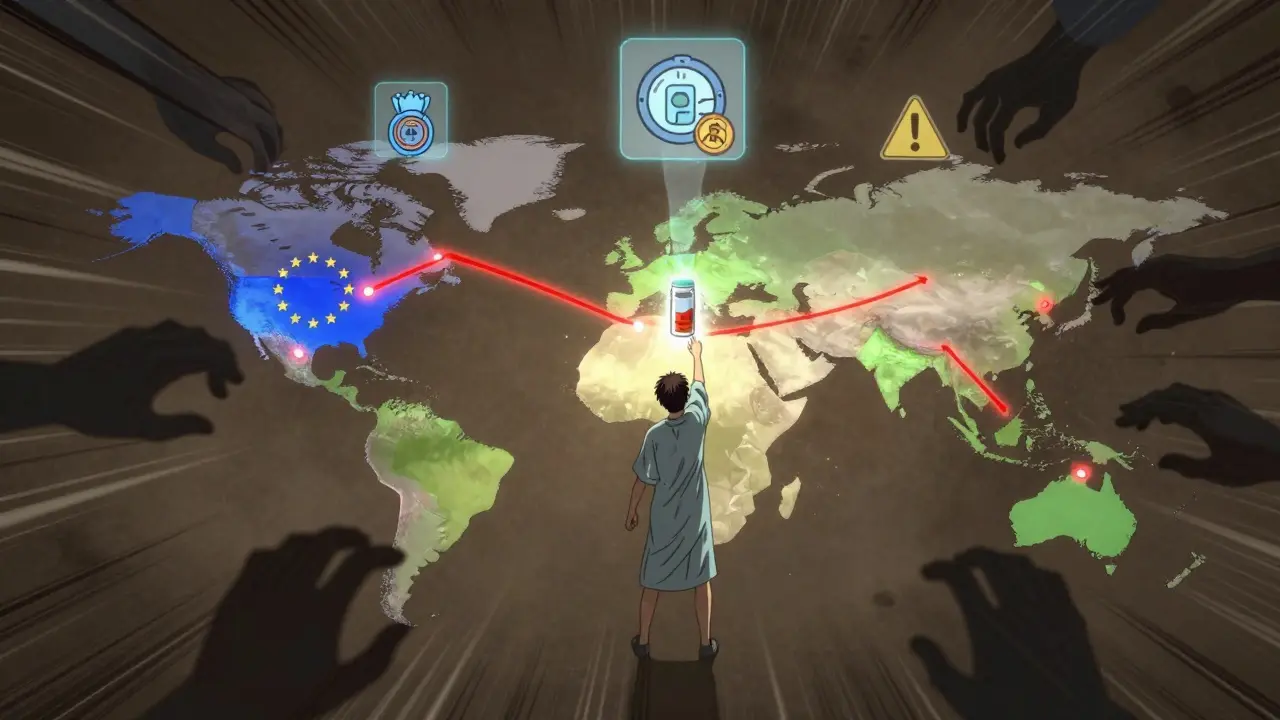
Here’s the scary part: when the U.S., Canada, the UK, and Australia issued safety warnings for the same drugs, they agreed only 10.3% of the time. That’s not a typo. Ten percent. That means if you take a drug in the U.S. and then travel to Australia, the safety advice you get might be completely different. The same pill. Two different warnings.
Why? Because each country weighs risk differently. The U.S. asks: "Is this drug clearly better than what’s already out there?" The EU asks: "Can we live with this risk if it helps a small group?" Australia asks: "Does the data hold up under our own scrutiny?" And Canada? It asks: "Can we trust the EU’s work?"
These aren’t just academic differences. They affect real people. A patient in Nigeria might get a drug approved in the U.S. but never hear about a warning because local health systems can’t keep up. The International Alliance of Patients’ Organizations found that only 42% of patients in low-income countries get timely safety alerts. That’s not a failure of the drug. It’s a failure of the system.
The Hidden Cost of Regulation
Behind every approved drug is a $2.6 billion price tag - and most of that goes to regulation. Companies spend 15-20% of their entire development budget just to meet the rules. In the U.S., that’s 15,000 pages of paperwork. In Europe, it’s 12,000 - but spread across 27 countries. That’s why small biotech firms struggle. They can’t afford to file in every region. So they pick one. Usually the U.S. Or sometimes, the EU. And then they wait.
Training a regulatory team to handle global approvals takes 18 to 24 months. And even then, they’re fighting mismatched rules. The U.S. requires pediatric studies for most new drugs. The EU does too - but the rules on how to do them are different. Sixty-one percent of companies say that’s one of their biggest headaches.
That’s where the International Council for Harmonisation (ICH) comes in. It’s not a government. It’s a group of regulators and drug makers working together. Their guidelines have been adopted by 89% of major countries. And they’ve cut clinical trial paperwork by 22%. But they’re not magic. They can’t force countries to change their laws. They can only nudge.

What’s Changing - and What’s Not
Things are moving. The FDA’s 2022 Modernization Act got rid of mandatory animal testing for some drugs. That could cut approval time by six months. The EU’s new Pharmaceutical Strategy aims to cut approval times by 25% by 2025. The WHO created a global benchmark tool - 89 measurable indicators to help weak systems improve. By 2022, 67 countries reached "functional" status. That’s progress.
But the biggest shift is digital. The FDA used AI to review 43% of manufacturing inspections in 2022. The EMA reviewed 189 advanced therapies - gene therapies, cell therapies - with new digital tools. That’s the future. Faster reviews. Fewer errors. But it also means regulators need new skills. And not every country can afford to upgrade.
Meanwhile, emerging markets are catching up. India increased its drug inspections by 40% in 2022. Africa’s new African Medicines Agency now covers 22 countries. But only 37% of facilities there meet basic safety standards. That’s not failure. That’s the starting line.
What This Means for You
If you’re a patient, it means you can’t assume a drug is safe just because it’s sold in your country. Check if your country’s regulator has issued a warning. If you’re traveling, bring your prescription bottle and look up the drug’s status in your destination. Don’t rely on the pharmacy’s word.
If you’re a doctor, know that your patients might be taking drugs approved under different rules. Ask them where they got their meds. A pill from Canada might have a different label than the same one bought online from a U.S. vendor.
If you’re in the industry - you already know the drill. But here’s the truth: the global system isn’t broken. It’s just messy. And until countries stop treating regulation like a national sport and start treating it like a shared responsibility, patients will keep paying the price.
Why do drug approval times differ so much between countries?
Approval times vary because each country has its own legal system, risk tolerance, and resources. The U.S. FDA prioritizes speed and centralized control, averaging 10.2 months for approval. The EU uses a hybrid model with national oversight, leading to longer reviews - about 12.7 months for centralized applications. Countries with fewer resources, like those in Africa or South Asia, may take years because they lack staff, funding, or infrastructure to process applications quickly.
Can a drug be safe in one country but unsafe in another?
The drug itself doesn’t change. But how regulators interpret its risks and benefits can. A drug approved in the U.S. might be restricted in Europe because the EMA considers its side effects too risky for the population size. In contrast, Australia might approve it because its population is smaller and the benefit outweighs the risk for specific patients. This isn’t about safety - it’s about how each country weighs the same data.
Why don’t all countries just use the FDA or EMA standards?
Regulation is tied to national sovereignty. Countries don’t want to give up control over their citizens’ health. Even when they adopt guidelines - like WHO’s GMP standards - they often add their own layers. For example, Canada follows EU rules for inspections but still requires its own labeling. The U.S. won’t accept EU inspection reports because it believes its own standards are stricter. Political, cultural, and economic factors make full harmonization difficult.
How do low-income countries handle drug safety?
Many rely on WHO guidelines and imported drugs approved by trusted agencies like the FDA or EMA. But they often lack the staff to inspect local manufacturers or monitor side effects. In 2023, only 37% of facilities in Africa met basic manufacturing standards. This creates gaps. A drug approved in the U.S. might reach Nigeria - but without safety alerts, local doctors and patients don’t know about risks. That’s why patient advocacy groups call for better global communication networks.
Is AI changing how drugs are regulated?
Yes - and fast. The FDA used AI to review 43% of manufacturing inspections in 2022, cutting review time and spotting patterns humans missed. The EMA now uses AI to analyze clinical trial data for rare side effects. These tools won’t replace regulators, but they’ll make them faster and more accurate. By 2027, AI could cut standard approval times by 30-40%. But only wealthy countries can afford the tech. That risks widening the gap between rich and poor nations.
Global medication safety isn’t about one country being better than another. It’s about how we choose to protect people - and who gets left behind when systems don’t talk to each other. The next time you pick up a prescription, remember: the story behind that pill is bigger than your doctor’s office. It’s written in laws, budgets, and politics - across borders, continents, and cultures.
srishti Jain
December 30, 2025 AT 06:15U.S. takes 10 months? My cousin in Delhi waited 3 years for the same drug. No one cares if you’re fast when half the world can’t even get it.
Joseph Corry
December 31, 2025 AT 03:51The entire framework is a performative illusion of safety. The FDA’s ‘rigor’ is just bureaucratic theater - 15,000 pages of obfuscation to justify a $2.6B price tag that no one in the Global South can afford. We’re not regulating drugs; we’re commodifying risk. The real tragedy isn’t the delay - it’s that we’ve convinced ourselves this mess is wisdom.
Cheyenne Sims
January 1, 2026 AT 14:42It is imperative to note that the United States Food and Drug Administration operates under the most stringent, scientifically validated protocols in the world. Any suggestion that other nations’ regulatory frameworks are equally robust is not merely inaccurate - it is dangerously misleading. The FDA’s approval process ensures that every drug administered to American citizens meets the highest possible standard of efficacy and safety.
kelly tracy
January 3, 2026 AT 02:18Oh please. The EU approves cancer drugs faster? That’s because they lower the bar. They don’t care if the drug only helps 2% of people - as long as it’s ‘affordable.’ Meanwhile, the FDA actually demands proof it works. You want safety? Stop romanticizing Europe’s half-measures. They’re not better - they’re just cheaper.
Shae Chapman
January 4, 2026 AT 02:35THIS. SO. MUCH. 🙌 I work in global health and every time I see a patient on a drug that’s approved in one country but banned in another, I just cry. We’re treating medicine like a political football instead of a human right. Can we PLEASE just align standards? I’m begging you.
Nadia Spira
January 4, 2026 AT 18:22The entire global regulatory apparatus is a grotesque parody of science. The ICH? A corporate front. AI-driven reviews? A distraction. The real issue isn’t speed - it’s the epistemic arrogance of Western regulators who assume their metrics are universal. Meanwhile, the Global South is left with orphaned data, obsolete guidelines, and a system that treats them as afterthoughts. This isn’t regulation - it’s colonialism with a GMP stamp.
henry mateo
January 4, 2026 AT 18:30man i just read this whole thing and honestly… i think we’re all just trying to do the right thing, but the system is so broken it feels like everyone’s playing a different game. i don’t know if anyone’s ‘right’ but i know patients are getting lost in the middle. sorry for the typos lol
Kunal Karakoti
January 4, 2026 AT 21:14Regulation is not a race. It is a reflection of societal values - who we protect, how we weigh suffering, and what we consider acceptable risk. The U.S. demands proof of superiority. The EU accepts marginal benefit. India and Nigeria? They accept whatever arrives. Perhaps the question isn’t ‘which system is best?’ but ‘whose life are we privileging?’
Kelly Gerrard
January 6, 2026 AT 04:56If we want global safety we must unify standards. No more duplication. No more bureaucracy. Just one set of rules based on science not politics. End of story.
Glendon Cone
January 8, 2026 AT 03:16Just wanted to say - this is one of the clearest breakdowns of global pharma regulation I’ve ever read. Honestly, I didn’t realize how much of a patchwork this was. I’m gonna share this with my sister who’s a nurse in rural Texas. She’s seen patients get meds from Canada and get confused when the warnings don’t match. This explains why. Thanks for writing it.
Henry Ward
January 9, 2026 AT 09:58You people are naive. The FDA isn’t slow - it’s the only agency that refuses to be bought. Every time a drug gets approved faster elsewhere, it’s because they ignored the red flags. The EU? They let Vioxx stay on the market longer than the U.S. You want to trade safety for speed? Fine. But don’t cry when someone dies because you wanted a cheaper pill.
Aayush Khandelwal
January 10, 2026 AT 06:08Imagine a world where regulators didn’t compete like sports teams. Where India’s 40% inspection increase isn’t a ‘catch-up’ but a contribution. Where Australia’s independence isn’t seen as ‘stubborn’ but as ‘critical thinking.’ The ICH is a start - but real harmony means ceding control. And that’s the one thing no country will do.
Sandeep Mishra
January 10, 2026 AT 11:01Let me tell you about my uncle in Bihar. He got a cancer drug from a U.S. pharmacy - same pill, same batch. But the warning label? Printed in Hindi, but missing the part about liver toxicity. Why? Because the distributor didn’t translate it. The drug wasn’t unsafe. The system was. We need global transparency - not just better rules. We need people to actually read them. And listen.