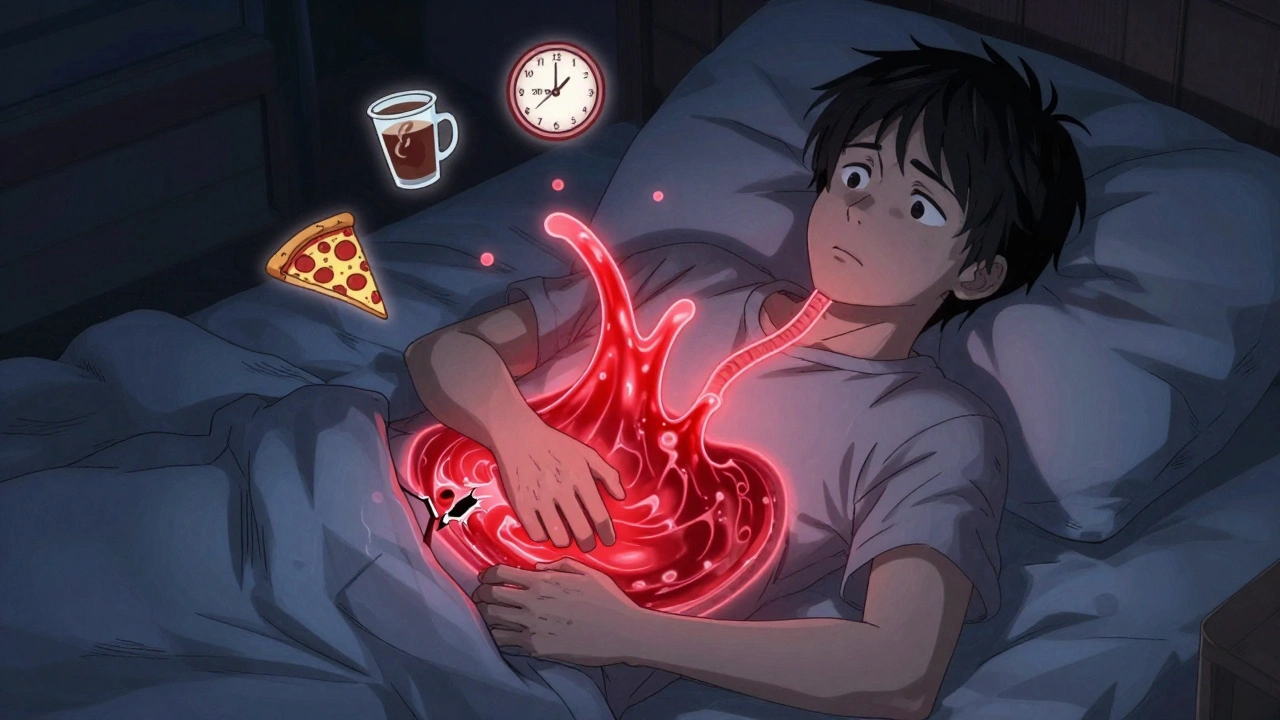
Heartburn that won’t quit. Waking up with a sour taste in your mouth. A chronic cough that doesn’t respond to cold medicine. If this sounds familiar, you’re not alone. About 20% of adults in the U.S. deal with GERD symptoms at least once a week. For many, it starts as an occasional annoyance-but left unchecked, it can lead to real damage in the esophagus, including strictures, ulcers, or even Barrett’s esophagus, a precancerous condition.
GERD isn’t just about spicy food or late-night snacks. It’s a breakdown in the body’s natural defense: the lower esophageal sphincter (LES). This ring of muscle sits where the esophagus meets the stomach. Normally, it opens to let food through, then snaps shut tight. In GERD, it relaxes at the wrong times-or doesn’t close fully-letting stomach acid (pH 1.5-3.5) splash back up. The esophagus has no protective lining like the stomach does, so that acid burns. And that’s when symptoms kick in: burning chest pain, regurgitation, hoarseness, even a persistent cough.
Why Lifestyle Changes Are the First Step-Not an Afterthought
Many people reach for a pill the moment they feel heartburn. But the American College of Gastroenterology says lifestyle changes should come first. And for good reason. Losing just 5-10% of your body weight can cut symptoms by half. That’s not magic. It’s physics. Extra belly fat pushes up on the stomach, forcing acid out. A 2022 study showed people who lost weight and stuck to it had fewer reflux episodes, even without medication.
What you eat matters more than you think. Coffee, tomatoes, chocolate, alcohol, and fatty or spicy foods trigger reflux in 70-80% of people. But here’s the catch: not everyone reacts the same way. One person’s trigger is another’s harmless snack. That’s why keeping a food diary for two weeks is more useful than any generic diet list. Write down what you ate, when, and how you felt an hour later. You’ll start spotting patterns. For example, eliminating coffee helped 73% of users in one survey. Cutting out spicy food helped 68%.
Timing matters too. Eating within two or three hours of bedtime? That’s a recipe for nighttime reflux. Lying down removes gravity’s help in keeping acid down. Studies show avoiding late meals reduces nighttime acid exposure by 40-60%. Elevating the head of your bed by 6 inches also helps-more than most people realize. It’s not about stacking pillows (that just bends your neck), it’s about raising the entire frame. A simple wedge under the bedposts works.
Smoking is another silent culprit. It weakens the LES and reduces saliva production, which normally helps neutralize acid. Quitting doesn’t just help your lungs-it helps your esophagus too. And if you’re pregnant? About 30-50% of pregnant women get reflux. Hormones relax the LES, and the growing baby presses on the stomach. It’s not always avoidable, but eating smaller meals and staying upright after eating can make a big difference.
How PPIs Work-and When They’re Necessary
If lifestyle changes alone aren’t enough, proton pump inhibitors (PPIs) are the most powerful tool we have. Drugs like omeprazole, pantoprazole, and esomeprazole work by shutting down the acid pumps in stomach cells. They don’t just reduce acid-they slash it by 90-98%. That’s why healing rates for erosive esophagitis hit 70-90% with PPIs, compared to 50-60% with older H2 blockers like famotidine.
But timing matters. PPIs aren’t antacids. They don’t neutralize acid already in your stomach. They prevent new acid from being made. That means you need to take them 30-60 minutes before your first meal of the day. Taking them after a meal? You’re missing the window. Most people do fine with once-daily dosing. But if symptoms are severe, especially at night, twice-daily dosing may be needed-though that should be reviewed by a doctor.
PPIs work fast. Most people feel better within a few days. But healing the lining of the esophagus? That takes time. Even if your heartburn is gone, you still need to take the full course-usually 4 to 8 weeks. Stopping early because you feel fine can mean the damage isn’t fully healed.

The Hidden Costs of Long-Term PPI Use
PPIs are effective. But they’re not harmless. Long-term use-especially beyond a year-comes with risks. The FDA has flagged possible links to vitamin B12 deficiency, low magnesium, kidney problems, and even hip fractures in older adults taking high doses for three or more years. One study found prolonged use increases the risk of intestinal infections like C. diff by 20-50%.
And then there’s rebound acid hypersecretion. When you stop PPIs suddenly, your stomach can overcompensate by making even more acid than before. That’s why 44% of people who quit PPIs cold turkey report worse heartburn than when they started. It’s not in their head. It’s physiology. The solution? Taper slowly. Switch to an H2 blocker like famotidine for a few weeks while cutting back on the PPI. This gives your stomach time to reset.
Here’s the truth: about half of all PPI prescriptions are unnecessary. People take them for years because they’ve forgotten why they started. Doctors don’t always check back. That’s why the American College of Gastroenterology recommends reevaluating PPI use every 8 weeks. If symptoms are under control, try stepping down. Can you switch to on-demand use? Maybe just take it before big meals? Can you rely on lifestyle changes alone?

When Medication Isn’t Enough: New Options and Real Stories
Some people try everything-diet, weight loss, PPIs-and still struggle. That’s when surgery or newer procedures come in. Fundoplication, where the top of the stomach is wrapped around the esophagus, has a 90% success rate at 10 years. But it’s invasive. A newer option is the LINX® device-a small ring of magnetic beads implanted around the LES. It lets food pass but blocks acid. Eighty-five percent of users report symptom relief at five years.
Then there’s Vonoprazan, approved by the FDA in 2023. It’s not a PPI-it’s a potassium-competitive acid blocker. It works faster, lasts longer, and may be more effective for some. In trials, it healed erosive esophagitis in 89% of patients, slightly better than PPIs.
Real success stories often mix approaches. One man in Adelaide stopped PPIs after 5 years by combining weight loss, a food diary app, and elevating his bed. His reflux vanished. Another woman, who developed Barrett’s esophagus despite taking PPIs, realized she’d been eating dinner at 10 p.m. and lying down immediately. Once she changed that, her symptoms improved even without more meds.
On the flip side, failure often comes from inconsistency. A 2022 case study followed a 55-year-old man who took his PPI daily but kept eating pizza at midnight. He ended up with Barrett’s esophagus. Medication isn’t a license to ignore triggers.
What to Do Next: A Simple Action Plan
Start here:
- Track your symptoms for two weeks. Note meals, timing, and symptoms.
- Eliminate the top three triggers: coffee, alcohol, and late-night eating.
- Try losing 5% of your body weight if you’re overweight.
- Elevate your bed head by 6 inches.
- If symptoms persist, see a doctor. Don’t self-prescribe PPIs long-term.
- If prescribed a PPI, take it 30-60 minutes before breakfast. Don’t stop suddenly.
- After 4-8 weeks, ask your doctor: “Can I try stepping down?”
Use tools like the RefluxMD app to log triggers. It’s rated 4.7/5 by over 8,500 users. Or check out the International Foundation for Gastrointestinal Disorders-they offer free, evidence-based guides used by over a million people.
GERD isn’t a life sentence. It’s a signal. Your body is telling you something’s off. The good news? Most people can control it without surgery. It just takes consistency, not perfection. Small changes, repeated daily, add up to real relief.
Can lifestyle changes cure GERD, or do I always need PPIs?
Lifestyle changes can control GERD for many people-sometimes completely. Losing weight, avoiding trigger foods, and not eating before bed reduce symptoms in 58% of users. But if you have erosive esophagitis or severe symptoms, PPIs are often needed to heal the damage. The goal isn’t to avoid meds forever, but to use them only as long as necessary. Many people eventually reduce or stop PPIs after making lasting lifestyle changes.
Why do I get worse heartburn when I stop taking PPIs?
This is called rebound acid hypersecretion. PPIs shut down acid production, so your stomach responds by making more acid-producing cells. When you stop suddenly, those cells go into overdrive. It’s temporary-usually lasts 2-4 weeks-but it’s real. The fix is to taper off slowly. Switch to an H2 blocker like famotidine for a couple of weeks while reducing your PPI dose. This gives your stomach time to reset.
Is it safe to take PPIs for years?
Long-term use (over a year) carries risks: vitamin B12 deficiency, low magnesium, increased risk of intestinal infections like C. diff, and higher hip fracture risk in older adults. The FDA warns about these. That’s why guidelines say to use the lowest dose for the shortest time. If you’ve been on PPIs for years without review, talk to your doctor about whether you still need them. Many people can step down safely.
What’s the best time to take a PPI?
Take it 30 to 60 minutes before your first meal of the day-usually breakfast. PPIs work by blocking acid pumps that activate during meals. If you take it after eating, you miss the window. Don’t take it at night unless your doctor specifically tells you to. For most people, once-daily morning dosing is enough.
How do I know if my GERD is getting worse?
Watch for warning signs: trouble swallowing, unexplained weight loss, vomiting blood, or black, tarry stools. These aren’t normal GERD symptoms-they suggest complications like strictures, ulcers, or Barrett’s esophagus. If you notice any of these, see a doctor immediately. You may need an endoscopy. Don’t wait. Early detection prevents serious outcomes.
Managing GERD isn’t about finding a quick fix. It’s about building habits that protect your body over time. You don’t need to be perfect. Just consistent. One less late-night snack. One more walk after dinner. One day at a time.
Elizabeth Grace
December 3, 2025 AT 03:49I used to take PPIs like candy until my stomach felt like it was screaming for mercy. Then I started sleeping with a wedge under my mattress-no joke, I used old textbooks-and within two weeks, my nighttime cough vanished. No more waking up tasting like a vinegar factory exploded in my mouth. I still eat pizza sometimes, but never after 7 p.m. Small wins, people.
Steve Enck
December 4, 2025 AT 12:09While the empirical data presented herein is statistically significant, it fails to account for the ontological dissonance between pharmaceutical intervention and phenomenological lived experience. The reductionist paradigm of acid suppression as a panacea obscures the deeper somatic semiotics of gastroesophageal dysfunction. One must interrogate not merely the mechanism of proton pumps, but the metaphysical implications of commodified bodily regulation.
Jay Everett
December 6, 2025 AT 12:06Y’all need to try the RefluxMD app-it’s a game changer 😊 I tracked my meals for 14 days and found out that dark chocolate was my silent killer. Who knew? I cut it out, started walking after dinner, and now I sleep like a baby. PPIs were my crutch, but lifestyle changes? That’s the real MVP. Also, elevating your bed isn’t fancy-it’s just science. No magic, just math. 🙌
Ella van Rij
December 7, 2025 AT 00:58So you're telling me I need to stop eating nachos at midnight and also raise my bed? Like, with a wedge? What is this, medieval torture? 😒 I’ll just keep taking my omeprazole and pretend I’m not a walking acid reflux billboard.
ATUL BHARDWAJ
December 7, 2025 AT 02:57Weight loss helps. Food diary helps. PPIs help. But sleep position matters most. In India we call it 'sitting up after meal'. Simple. Effective. No pills needed.
Steve World Shopping
December 7, 2025 AT 14:05Let me be clear: PPIs are a biochemical band-aid for a systemic failure of metabolic discipline. You’re not managing GERD-you’re enabling a dysbiotic, sedentary, chronically overfed civilization. The real solution? Intermittent fasting, ancestral nutrition, and eliminating all processed carbohydrates. The data is irrefutable. Your body is not a chemical reactor. It’s a sacred temple.
dave nevogt
December 8, 2025 AT 17:43I’ve been on PPIs for six years. I didn’t realize how much I’d come to depend on them until I tried to quit. The rebound was brutal-worse than any withdrawal I’ve ever experienced. I thought I was being responsible by taking them daily, but I never questioned whether I needed them at all. It took me months to taper down, and honestly? I still feel guilty when I skip a dose. It’s not just about the acid. It’s about the habit. The comfort. The illusion of control.
Arun kumar
December 10, 2025 AT 03:49bro i tried everything and the only thing that worked was sleeping with my head on a pillow stack. then i read that its bad for neck so i got a wedge from amazon for 15 bucks. now i sleep like a log. also i stopped drinking soda after 6pm. small changes man. no magic.
Zed theMartian
December 12, 2025 AT 03:05Of course the article recommends lifestyle changes. Because Big Pharma doesn’t profit from ‘eat earlier and lose weight.’ This is the same logic that told us smoking was fine if you drank milk. PPIs are a multibillion-dollar industry built on turning a temporary condition into a lifelong dependency. Wake up. The real cure is not in a pill-it’s in your choices. And most people aren’t willing to make them.
Alicia Marks
December 13, 2025 AT 10:10You got this. One less late-night snack. One more walk. One day at a time. You’re not failing-you’re learning. ❤️
Paul Keller
December 14, 2025 AT 13:45While I appreciate the empirical rigor of this piece, I must emphasize that the longitudinal efficacy of lifestyle modifications remains statistically underpowered in most clinical cohorts. The 58% success rate cited for dietary intervention is derived from self-reported data with high attrition bias. Moreover, the recommendation to elevate the bed by six inches lacks biomechanical validation in supine gastric pressure studies. Until peer-reviewed RCTs confirm these interventions as first-line, I remain skeptical of their scalability in populations with comorbid obesity, sleep apnea, or metabolic syndrome.