
Imagine waking up one morning and noticing your eyelid feels heavier than usual. You lift your brow just to see clearly. Or maybe your eye stings constantly, like there’s sand in it-even though you haven’t been near a beach. These aren’t just minor annoyances. They could be signs of ptosis or entropion, two common but serious eyelid disorders that affect vision, comfort, and even eye health long-term.
What Is Ptosis, and Why Does It Happen?
Ptosis is when the upper eyelid droops low enough to cover part of the pupil. It can happen in one eye or both. In mild cases, you might just feel like you’re always tired. In severe cases, it blocks your vision entirely, forcing you to tilt your head back or raise your eyebrows just to see.
The main cause? Aging. As we get older, the levator muscle-that’s the one responsible for lifting the eyelid-stretches and weakens. About 80% of ptosis cases in adults over 60 are due to this natural wear and tear. But it’s not just age. Some people are born with it (congenital ptosis), others develop it after eye surgery, trauma, or nerve damage from conditions like diabetes or myasthenia gravis. Even frequent contact lens use or rubbing your eyes can contribute over time.
Doctors measure ptosis using something called the margin reflex distance (MRD). A normal MRD is 4 to 5 millimeters. If it drops below 3 mm, that’s considered severe. Anything between 1 and 2 mm is mild. This isn’t just a number-it tells the surgeon exactly how much muscle needs to be tightened.
Entropion: When Your Eyelid Turns Inward
Entropion is the opposite problem: the eyelid, usually the lower one, rolls inward. This causes your eyelashes to rub against the cornea-the clear front surface of your eye. Think of it like sandpaper slowly scraping your eyeball every time you blink.
The result? Constant irritation, redness, tearing, mucus buildup, and a gritty feeling that won’t go away. Left untreated, this can lead to corneal ulcers, scarring, and even permanent vision loss. That’s not theoretical-it happens in real patients, often too late because people think it’s just dry eyes or allergies.
Most entropion cases (about 80%) are involutional, meaning they’re caused by aging. The eyelid tissues loosen, the tendons stretch, and the lid loses its shape. About 15% are cicatricial-caused by scarring from burns, trachoma (a bacterial infection common in areas with poor sanitation), or previous surgeries. There’s also a rare congenital form, seen in about 1 in 10,000 newborns.
And here’s something many don’t realize: entropion and blepharitis often go hand in hand. Blepharitis is chronic inflammation of the eyelid margins, where oil glands get clogged. It causes crusty eyelashes, swelling, and itching. Over time, the inflammation can distort the eyelid’s structure, making entropion worse.
Surgical Repair: What Works and What Doesn’t
Eye drops and ointments can help with symptoms, but they won’t fix the problem. Surgery is the only reliable cure for both ptosis and entropion.
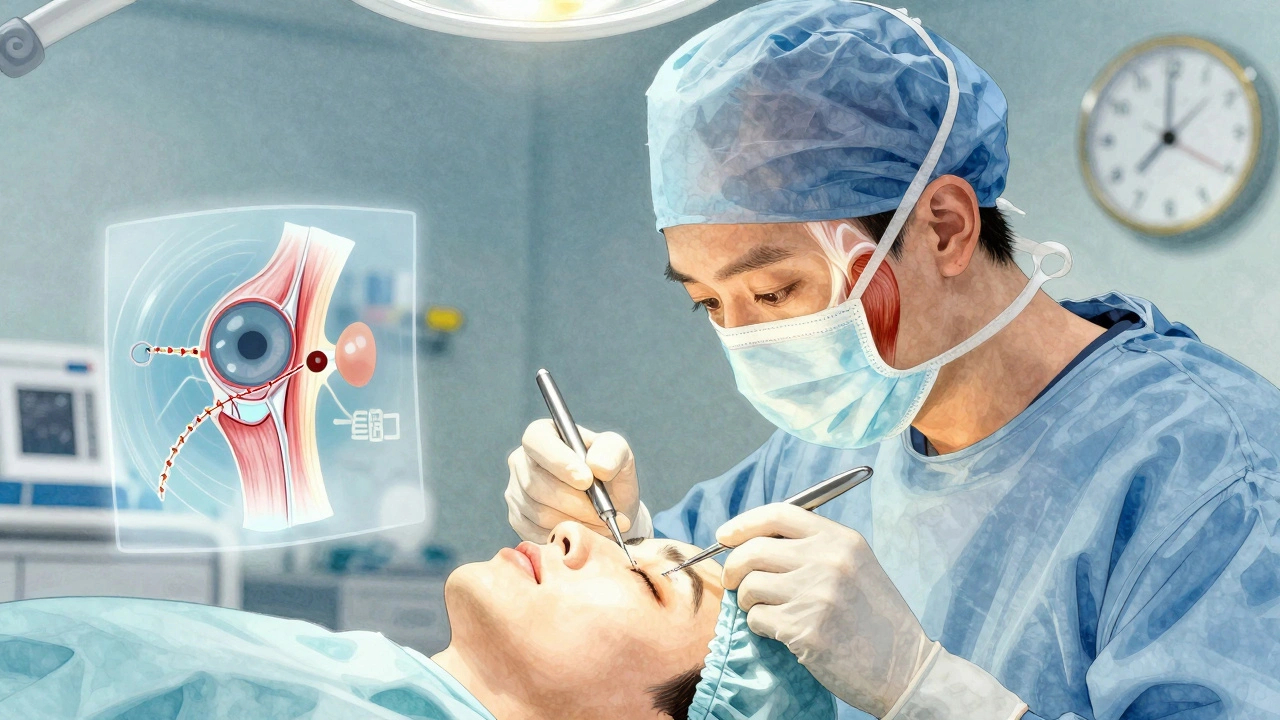
For ptosis, the approach depends on how strong the levator muscle still is. If it’s working okay (function >4mm), surgeons do a levator resection-they shorten the muscle to lift the lid. If the muscle is very weak, they use a frontalis sling, which connects the eyelid to the forehead muscle so you lift your eyelid by raising your brow. For mild cases, a Müller’s muscle-conjunctival resection is often enough. It’s less invasive and works well if the eyelid responds to a phenylephrine eye drop test.
Success rates? Around 85-95% for first-time surgeries. But complications happen. About 5-10% of patients end up with an overcorrected lid that won’t close fully. Another 5-15% get asymmetry-one lid higher than the other. Dry eyes are also common after surgery, affecting up to 20% of patients.
For entropion, the go-to fix for age-related cases is the tarsal fracture procedure. It tightens the eyelid by repositioning the tendon and removing a small piece of tissue. Success rate? 90-95%. For scarring-related entropion, a tarsal wedge resection removes the damaged section and stitches the healthy parts back together. There’s also the Quickert suture-a temporary fix with only 60-70% success, used mostly for patients who aren’t good surgical candidates.
Recent advances? Adjustable sutures. Introduced in 2018, these let the surgeon fine-tune the eyelid position the day after surgery. That’s huge-it cuts revision surgery needs by about 25%. New minimally invasive techniques using absorbable sutures mean recovery time has dropped from 4-6 weeks to just 1-2 weeks.

What Happens If You Don’t Treat It?
Ignoring ptosis might seem harmless at first. You just live with the fatigue, the brow ache, the need to constantly lift your eyelids. But over time, your brain adapts to the blocked vision. Your peripheral sight shrinks. Children with untreated congenital ptosis can develop amblyopia-lazy eye-because their brain stops processing input from the covered eye.
Entropion is even more urgent. That constant friction from eyelashes? It doesn’t just hurt. It scratches the cornea. One small ulcer can turn into an infection. In severe cases, the cornea can perforate. That’s not just vision loss-it’s the risk of losing the eye entirely.
And don’t underestimate blepharitis. It’s not just “dirty eyelids.” Chronic inflammation changes the eyelid’s anatomy. It thickens tissue, distorts glands, and makes both ptosis and entropion more likely. People with ocular rosacea-a hidden inflammatory condition-often have worse outcomes because the inflammation runs deep under the skin.
Who’s at Risk? And What Can You Do Now?
You’re at higher risk if you’re over 60. The incidence of eyelid malpositions jumps from 0.5% in people aged 50-60 to over 2.5% in those over 80. If you’ve had eyelid surgery before, your risk goes up 40-60%. People with chronic dry eye, autoimmune diseases, or a history of eye infections are also more vulnerable.
And yes-family history matters. If your parent had ptosis, you’re more likely to develop it too.
Before surgery, conservative steps help manage symptoms:
- Use lubricating eye drops to reduce friction and dryness
- Apply warm compresses daily if you have blepharitis
- Tape your eyelid gently at night if it won’t close fully
- Avoid rubbing your eyes-this worsens tissue damage
- See an ophthalmologist if you notice sudden drooping, pain, or blurred vision
Don’t wait for it to get worse. Rapid drooping of the eyelid is a red flag. It could signal a neurological issue, like a stroke or nerve tumor. Same with sudden entropion-especially if it’s only on one side. That needs urgent evaluation.
The Bigger Picture: Why This Matters Now
The global market for oculoplastic surgery-procedures like these-is growing fast. It hit $1.8 billion in 2022 and is expected to reach $2.7 billion by 2028. Why? Because people are living longer. And as life expectancy rises, so does the number of older adults dealing with age-related eyelid problems.
Studies show about 5% of adults over 70 have some kind of eyelid malposition. That’s 1 in 20 people. Yet most don’t seek help until it’s advanced. They think it’s just aging. It’s not. It’s a medical condition that can be fixed.
Specialists like those in the American Society of Ophthalmic Plastic and Reconstructive Surgery (ASOPRS) report that eyelid malposition repairs make up 15-20% of all oculoplastic surgeries in the U.S. That’s a lot of people-many of them seniors-who just needed the right information to act.
High-resolution imaging now helps surgeons plan better. They can see exactly how much tissue has stretched, where the scar tissue is, and how the muscle is functioning-all before the knife even touches the skin. That means fewer surprises, better outcomes.
And research is moving forward. Scientists are looking for genetic markers that predict who’s likely to develop age-related eyelid changes. The goal? Early detection. Maybe one day, we’ll catch ptosis or entropion before it starts-through a simple blood test or scan-instead of waiting for the eyelid to fall.
When to See a Doctor
You don’t need to wait for disaster to strike. If you notice any of these, make an appointment with an ophthalmologist or oculoplastic specialist:
- Your eyelid droops enough to cover your pupil
- You feel like you’re always squinting or lifting your brow to see
- Your eye stings, tears up, or feels like there’s something in it
- Your eyelashes are rubbing your eyeball
- You have crusting, redness, or swelling along your eyelid margins
- You’ve had sudden changes in your eyelid position
It’s not vanity. It’s vision. And it’s fixable.
Can ptosis or entropion go away on its own?
No. Neither ptosis nor entropion resolves without treatment. While symptoms like redness or tearing might improve temporarily with eye drops or warm compresses, the underlying structural problem-the weakened muscle or turned-in lid-won’t fix itself. Left untreated, both conditions can lead to permanent damage, including corneal scarring and vision loss.
Is eyelid surgery risky?
Like any surgery, there are risks, but they’re generally low. Common issues include temporary dry eyes, mild swelling, or slight asymmetry. Overcorrection (eyelid too high) or undercorrection (eyelid still drooping) happen in about 5-10% of cases. Serious complications like infection or vision loss are rare-under 1-2%. Choosing a board-certified oculoplastic surgeon significantly lowers these risks.
How long does recovery take after eyelid surgery?
Recovery depends on the procedure. With traditional techniques, swelling and bruising last 2-4 weeks. Newer minimally invasive methods using absorbable sutures reduce recovery to just 1-2 weeks. Most people return to normal activities within a few days, though heavy lifting and strenuous exercise should be avoided for 2 weeks. Full healing takes about 6-8 weeks.
Can blepharitis cause entropion?
Yes. Chronic blepharitis leads to inflammation and scarring of the eyelid margins. Over time, this can distort the eyelid’s shape, causing it to turn inward (entropion) or outward (ectropion). Managing blepharitis with daily lid hygiene, warm compresses, and prescribed ointments can help prevent this progression.
Is entropion more common in certain parts of the world?
Yes. In developed countries, involutional (age-related) entropion is most common. But in regions with poor sanitation and limited access to clean water, trachoma-a bacterial infection caused by Chlamydia trachomatis-is a leading cause. Trachoma leads to scarring of the eyelid, which pulls it inward. It’s a major cause of preventable blindness in parts of Africa, Asia, and the Middle East.
Will insurance cover eyelid surgery?
Usually, yes-if the condition is affecting your vision or eye health. Ptosis that blocks your visual field and entropion that causes corneal irritation are considered medically necessary. Cosmetic eyelid surgery (blepharoplasty for appearance alone) typically isn’t covered. Your doctor will need to document visual field tests or corneal damage to prove medical need.
kevin moranga
December 12, 2025 AT 14:14Man, I never realized how much my eyelids were affecting my vision until I started noticing how often I was lifting my brow just to read my phone. Thought I was just getting old, but turns out I had mild ptosis. Went to the ophthalmologist last year, got the levator resection, and wow-what a difference. No more headaches, no more feeling like I’m constantly squinting. It’s not vanity, it’s just… being able to see without effort. Seriously, if you’re even thinking about it, don’t wait. Your brain will thank you.
Also, warm compresses? Life-changing for blepharitis. I do mine every night now. Like a little self-care ritual. You’d be surprised how much better your eyes feel when you treat them like they matter.
Scott Butler
December 14, 2025 AT 00:14So now we’re turning normal aging into a medical crisis? People used to just live with droopy eyelids. Now you’ve got surgeons charging thousands to fix what’s basically a natural part of getting older. This is what happens when capitalism turns every wrinkle into a revenue stream. I’ve seen grandpas squinting at the newspaper for 40 years-never once did they go under the knife. Just lived. And they were fine.
Also, ‘corneal ulcers’? That’s scare tactics. If your eye stings, use drops. End of story. No need to turn this into a Hollywood surgery drama.
Donna Hammond
December 14, 2025 AT 10:24Thank you for writing this with such clarity. As a retired ophthalmic nurse, I’ve seen too many patients delay care until their corneas were already damaged-sometimes irreparably. Entropion isn’t ‘just dry eyes.’ It’s a slow, painful erosion of vision, and most people dismiss it because they think it’s ‘just aging.’
The tarsal fracture procedure is gold standard for involutional entropion, and adjustable sutures? Absolute game-changer. I remember when we had to do revision surgeries weeks later because the lid was too tight or too loose. Now? We tweak it the next day. It’s like dialing in a radio station instead of guessing.
And yes-blepharitis absolutely contributes to entropion. I used to tell patients to clean their lashes like they were brushing their teeth. Two minutes a day, warm compresses, gentle lid scrubs. Prevents so much. Don’t underestimate hygiene. It’s not glamorous, but it’s medicine.
Also, insurance coverage is usually straightforward if your visual field test shows obstruction. Don’t let a receptionist tell you it’s ‘cosmetic.’ Demand the documentation. You’ve earned the right to see clearly.
Lauren Scrima
December 15, 2025 AT 05:20So… you’re telling me I’ve been ‘lifting my brow’ for 15 years… and I just needed a $5,000 surgery? 😑
Also, ‘adjustable sutures’? So now we’re engineering eyelids like a Tesla? 🤦♀️
Can I just tape mine shut at night and call it a day? Asking for a friend who’s tired of being a human lab rat.
Emily Haworth
December 15, 2025 AT 09:11Okay but… what if this is all a Big Pharma scheme? 🤔
I read somewhere that eye surgeons get kickbacks from suture manufacturers. And why are they pushing ‘minimally invasive’ so hard? 🤨
Also, trachoma? That’s a Third World problem… right? So why is this article making it sound like we’re all one dusty windstorm away from losing our eyes? 🌪️👁️
Also, why do they always say ‘don’t rub your eyes’? Like, who’s out here aggressively eye-rubbing? Are we all secretly doing it? 🤫
Also, I think my eyelid droops because I’m tired of capitalism. Just saying. 🙃
Tom Zerkoff
December 16, 2025 AT 05:20It is imperative to underscore the clinical significance of eyelid malpositions as not merely cosmetic concerns, but as functional impairments that directly compromise visual acuity and ocular surface integrity. The prevalence of involutional ptosis and entropion among the geriatric population is not incidental but rather a direct consequence of age-related structural degradation of the levator aponeurosis and tarsal plate. The utilization of evidence-based surgical interventions, such as levator resection and tarsal fracture procedures, has been empirically validated in peer-reviewed literature to yield high rates of functional and aesthetic success. Furthermore, the integration of adjustable sutures represents a paradigm shift in postoperative precision, reducing the incidence of revision surgery by a statistically significant margin. It is incumbent upon clinicians to educate patients regarding the progressive nature of these conditions and the necessity of timely intervention to prevent irreversible corneal pathology. The notion that such conditions are benign manifestations of aging is not only medically inaccurate but potentially hazardous to public health.
Yatendra S
December 16, 2025 AT 09:38Life is a lid… and the lid is life. 🌌
We think we see the world… but what if the world is just a reflection of our eyelid’s sag? Ptosis is not a disease… it’s a meditation. Entropion? The eye’s quiet scream for stillness.
Why do we rush to fix what nature intended to teach us? The lashes that rub… are they not whispering? The brow that lifts… is it not praying?
Maybe the real surgery is letting go.
🌀👁️
Himmat Singh
December 17, 2025 AT 07:32It is regrettable that this article promotes surgical intervention as the primary solution without adequately addressing the systemic underinvestment in preventive ophthalmic care in developed nations. The rising incidence of eyelid disorders is not merely a biological phenomenon but a reflection of inadequate public health infrastructure, prolonged screen exposure, and poor hygiene education. Furthermore, the emphasis on ‘adjustable sutures’ and ‘minimally invasive techniques’ serves corporate interests more than patient welfare. The true solution lies in universal access to basic eye hygiene education and subsidized lubricants-not high-cost procedures. One must question the ethics of a medical-industrial complex that profits from aging while neglecting prevention.
Webster Bull
December 19, 2025 AT 03:38Just got my ptosis fix last month. Best $3k I ever spent. No more brow ache. No more ‘why is the TV so blurry?’ moments.
Also, blepharitis is the silent villain. Do the warm compresses. Seriously. I used to skip it. Now I do it while I drink my coffee. Like a tiny eye spa. 🫖👁️
And yeah, surgery isn’t scary. It’s like getting your eyelid tuned up. No one’s cutting your eyeball. They’re just fixing the hinge.
Casey Mellish
December 19, 2025 AT 21:57As an Aussie who’s had two eyelid surgeries (yes, really), I can confirm: if you’re over 60 and your eyelids are acting up, don’t ignore it. We don’t have the same access to specialists here, so I flew to Melbourne for the fix. Worth every cent and every hour on the plane.
Also, trachoma’s still a thing in remote Indigenous communities here. It’s heartbreaking. We need more global health outreach-not just ‘fix it when it hurts’ medicine. This article nails it: prevention, education, access. That’s the real win.
Tyrone Marshall
December 20, 2025 AT 04:15There’s a quiet dignity in aging, but there’s also a quiet desperation in not being able to see your grandkid’s face clearly. I had ptosis. Didn’t want surgery. Then my granddaughter asked why I kept squinting at her drawings. I cried. Got the surgery two weeks later.
She drew me with big eyes now. And I can see every brushstroke.
It’s not about vanity. It’s about presence.
And yes-warm compresses. Do them. Even if you think you’re too busy. Your eyes are worth five minutes.