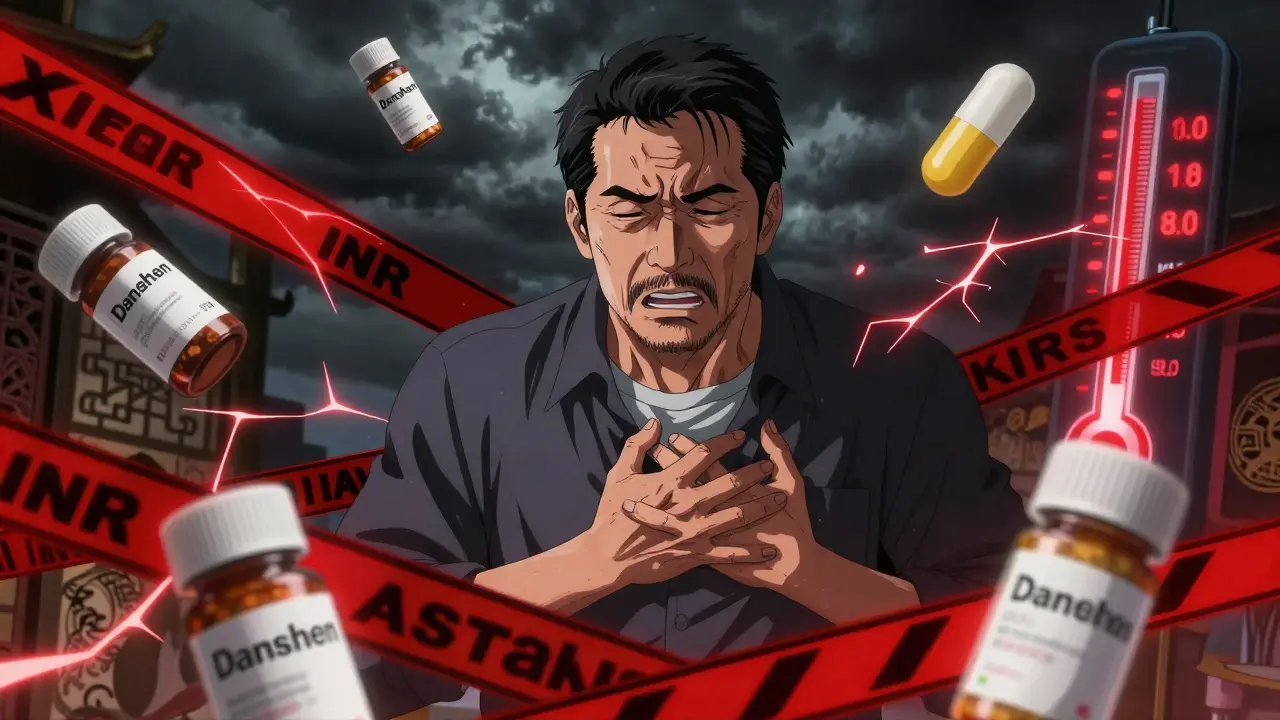
Danshen Interaction Risk Checker
Check Your Medication Risk
This tool helps identify dangerous interactions between Danshen and your heart medications. Based on the latest medical research, Danshen can cause life-threatening bleeding when combined with blood thinners and other heart medications.
High Risk Warning
Combining Danshen with the medications you selected can cause dangerous bleeding. Danshen significantly increases the effects of blood thinners and other heart medications, potentially leading to life-threatening internal bleeding.
Stop taking Danshen immediately and contact your doctor. Do not wait for symptoms to appear.
What This Means for You
Based on medical research, Danshen is known to interact dangerously with blood thinners and other heart medications. It inhibits liver enzymes that break down these drugs, causing potentially fatal increases in bleeding risk.
Real-world case: One patient taking warfarin saw their INR level rise from 2.5 to over 8.4 after taking Danshen for just two weeks, requiring emergency blood transfusions.
Many people assume that if something is natural, it’s safe-especially when it comes to herbs. But Danshen, a traditional Chinese herb used for heart health, can be dangerously unpredictable when mixed with common heart medications. This isn’t theoretical. Real patients have ended up in emergency rooms with life-threatening bleeding after taking Danshen alongside blood thinners. The risk isn’t just possible-it’s well-documented, preventable, and often overlooked.
What Exactly Is Danshen?
The active compounds-tanshinones and salvianolic acids-work in multiple ways: they thin the blood, relax blood vessels, and lower blood pressure. That sounds helpful, right? But here’s the catch: these same effects are exactly what make Danshen dangerous when combined with prescription heart drugs.
How Danshen Interacts with Blood Thinners
If you’re taking warfarin (Coumadin), rivaroxaban (Xarelto), apixaban (Eliquis), or any other anticoagulant, Danshen is a red flag. It doesn’t just add to the effect-it multiplies it unpredictably.
Warfarin works by blocking vitamin K, and its dosage is carefully tuned based on regular blood tests (INR levels). A normal target is between 2.0 and 3.0. But Danshen inhibits the liver enzyme CYP2C9, which breaks down warfarin. Studies show this inhibition can be as high as 73%. That means warfarin builds up in your system, and your INR can skyrocket-sometimes beyond 8.0. At that level, even a minor bump can cause internal bleeding.
Case reports confirm this. One man on warfarin for a mechanical heart valve took Danshen for two weeks. His INR jumped from 2.5 to over 8.4. His hemoglobin dropped to 7.6 g/dL-signaling severe internal bleeding. He needed a blood transfusion. Another woman saw her INR rise from 2.0 to 5.5 after just a few days of Danshen. She had no warning signs until she started bleeding internally.
It’s not just warfarin. Newer blood thinners like rivaroxaban are also affected. Research shows Danshen blocks the enzymes that clear these drugs from your body. That means higher drug levels, longer duration, and a higher risk of bleeding-even if you’ve never had a problem before.
Why This Risk Is Hard to Spot
Unlike prescription drugs, herbal supplements like Danshen aren’t standardized. One bottle might have 0.05% tanshinone; another might have 5.2%. That’s a 100-fold difference in potency. You can’t predict how your body will react.
Also, most people don’t tell their doctors they’re taking herbs. A 2019 study found only 28% of patients using herbal supplements mentioned them to their physician. Many assume their doctor doesn’t need to know-until they’re lying in the ER with uncontrolled bleeding.
Even worse, some TCM practitioners in Western countries recommend Danshen alongside anticoagulants, believing the combination is “balanced” or “natural.” But there’s no scientific support for this. The Cleveland Clinic, Mayo Clinic, and the Natural Medicines Database all classify the interaction as “Major-Do Not Take.”
What Happens When You Mix Danshen with Other Heart Drugs?
Danshen doesn’t just interfere with blood thinners. It can also interact with:
- Antiplatelet drugs like aspirin or clopidogrel-increasing bruising and bleeding risk.
- Beta-blockers like metoprolol-potentially causing excessive drops in blood pressure or heart rate.
- Calcium channel blockers like amlodipine-since Danshen itself blocks calcium channels, the combined effect can lead to dizziness, fainting, or heart rhythm issues.
There’s no safe threshold. Even low doses of Danshen-like one capsule a day-have triggered dangerous reactions in sensitive individuals. And unlike prescription drugs, there’s no antidote. If you bleed because of Danshen, doctors can’t reverse it. They can only transfuse blood, stop the bleeding, and hope you survive.

Who’s Most at Risk?
While anyone on heart medication should avoid Danshen, certain groups are at higher risk:
- People of Asian descent, especially Chinese immigrants, who may have cultural familiarity with the herb.
- Older adults taking multiple medications-more drugs mean more chances for interaction.
- Patients with liver or kidney disease-these organs process both Danshen and heart drugs, so reduced function increases risk.
- Those who buy supplements online without checking ingredients-many products labeled “heart support” contain undisclosed Danshen.
A 2021 survey found 41.7% of Chinese immigrants in the U.S. used Danshen regularly while taking prescription heart meds-and only 32.4% told their doctor. That’s a dangerous gap.
What Should You Do?
If you’re on a heart medication:
- Stop taking Danshen immediately. Even if you feel fine, the damage can be silent until it’s too late.
- Tell your doctor. Be specific: say “Danshen” or “red sage,” not just “an herbal supplement.”
- Check all your supplements. Look at the ingredient list. Danshen might be listed as Salvia miltiorrhiza, Chinese sage, or Red Sage Root.
- Don’t replace your medication with herbs. There’s no evidence Danshen is safer or more effective than prescribed drugs for heart conditions.
If you’ve been taking Danshen and notice unusual bruising, nosebleeds, blood in urine or stool, or sudden dizziness, seek medical help right away. Don’t wait.
Is There a Safe Way to Use Danshen?
Not while you’re on heart medication. Even researchers at the Shanghai Institute of Materia Medica admit the complexity of Danshen’s compounds makes reliable dosing impossible. They’re working on standardized extracts, but those aren’t available yet.
The American Heart Association says it plainly: “Natural does not mean safe.” And the FDA has issued multiple warnings about unapproved Danshen products sold online. The European Medicines Agency requires warning labels on Danshen products sold in the EU. But in the U.S., supplements fly under the radar.
What About Other Herbal Alternatives?
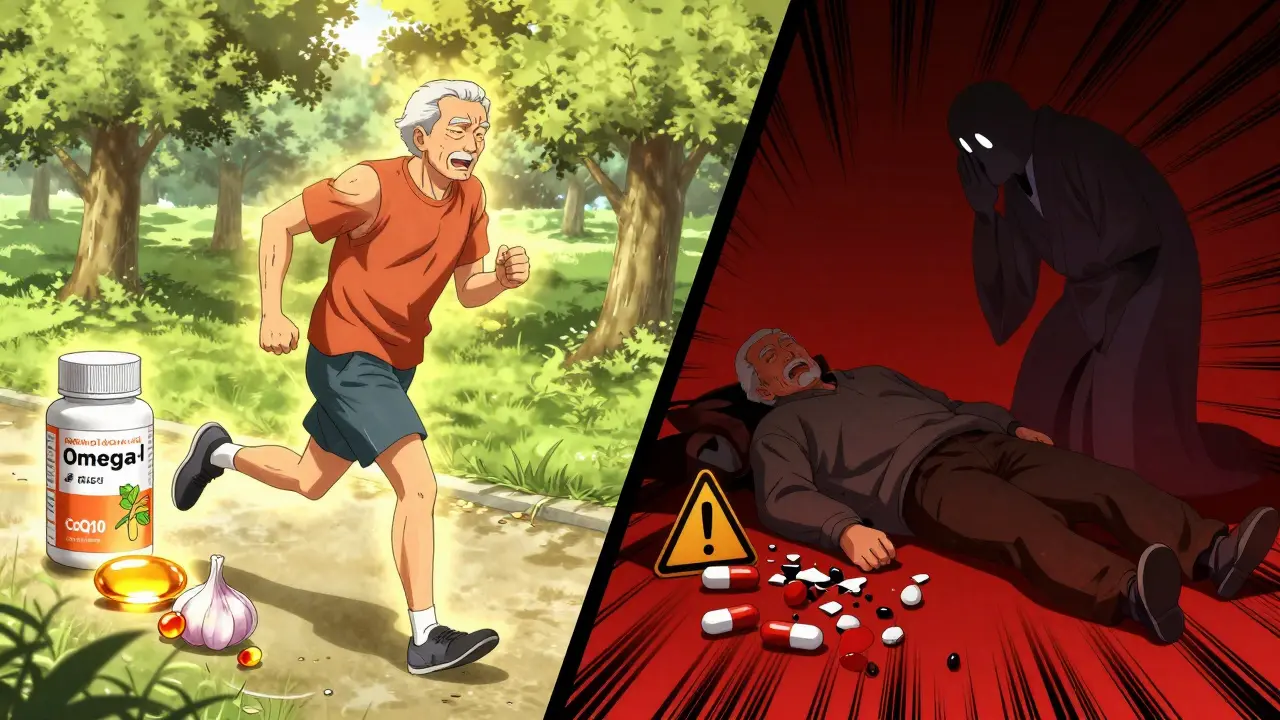
If you’re looking for natural support for heart health, focus on evidence-backed approaches:
- Omega-3 fatty acids (fish oil)-shown to reduce triglycerides and inflammation.
- Coenzyme Q10-may help with statin-related muscle pain and heart function.
- Garlic-mild blood pressure-lowering effect, with lower interaction risk than Danshen.
- Regular exercise and a Mediterranean diet-the most proven heart protectors.
None of these carry the same bleeding risks as Danshen. And unlike Danshen, their dosages are standardized and monitored.
Final Warning
Danshen isn’t a harmless herb. It’s a potent biological agent with real, documented, life-threatening risks when mixed with heart medications. The global market for Danshen is growing fast-$1.23 billion in 2022, projected to hit $1.84 billion by 2027. But more sales don’t mean safer use. In fact, the rise in sales coincides with a rise in emergency cases.
If you’re taking any blood thinner, beta-blocker, or heart medication, Danshen has no place in your regimen. The science is clear. The cases are real. The consequences can be fatal. Your heart deserves better than guesswork.
Can I take Danshen if I’m not on blood thinners?
Even if you’re not currently on blood thinners, Danshen can still affect your liver enzymes and blood pressure. If you’re planning surgery, have high blood pressure, or take any other medication-even over-the-counter ones-there’s still risk. It’s safest to avoid it unless under direct supervision of a doctor who knows your full medical history.
I’ve been taking Danshen for months with no problems. Is it safe for me?
Just because you haven’t had symptoms doesn’t mean you’re safe. Danshen’s effects are cumulative and unpredictable. One person might take it for a year with no issue, then after a minor illness or change in diet, their body processes it differently-and their INR spikes overnight. Waiting for symptoms to appear is like waiting for a car accident to happen before checking your brakes.
Can my doctor test for Danshen in my blood?
There’s no routine blood test for Danshen. Doctors can’t measure its levels like they do with warfarin or statins. The only way to know if it’s affecting you is by monitoring your INR or watching for signs of bleeding. If you’ve taken Danshen, tell your doctor so they can adjust your testing schedule.
Are all Danshen products the same?
No. The amount of active ingredients varies wildly-from 0.05% to over 5% tanshinone. One brand might be nearly harmless; another could be lethal. There’s no regulation in most countries to ensure consistency. That’s why even “high-quality” supplements can still be dangerous when mixed with heart meds.
What should I do if I accidentally took Danshen with my heart medication?
Stop taking Danshen immediately. Call your doctor or go to the nearest emergency room. Tell them exactly what you took and when. If you’re on warfarin, they’ll likely check your INR right away. Don’t wait for symptoms. Bleeding can start internally without warning.
Next Steps for Patients
If you’re on heart medication, here’s your action plan:
- Check every supplement bottle in your medicine cabinet. Look for Salvia miltiorrhiza, red sage, or Danshen.
- Call your doctor or pharmacist and ask: “Is it safe to take Danshen with my current medications?”
- Use the NCCIH’s Herbal Supplement Questionnaire to track what you’re taking-bring it to your next appointment.
- If you’re considering herbal remedies, ask your doctor for evidence-based alternatives that won’t interfere with your treatment.
Your heart has carried you this far. Don’t let a supplement unknowingly put it at risk.
Kathy Scaman
January 27, 2026 AT 17:31Danshen is literally a ticking time bomb if you're on blood thinners. I had a neighbor take it for 'circulation' and ended up in the ER with a brain bleed. No joke. Stop pretending herbs are harmless.
Howard Esakov
January 28, 2026 AT 06:23Of course the FDA doesn’t regulate this - because big pharma doesn’t own Danshen. 😏 Natural doesn’t mean safe, but it *does* mean you’re not paying $500 for a pill that does the same thing. Still, yeah, this post is 100% correct. Don’t be that guy.
Mindee Coulter
January 28, 2026 AT 12:20I’m a nurse and I’ve seen this too. Patients always say 'but my cousin in Taiwan takes it and she’s fine!' - and then they show up with INR 9. Just tell your doctor. It’s not awkward. It’s life-saving.
Anna Lou Chen
January 30, 2026 AT 01:47The epistemological crisis here isn’t just pharmacological - it’s ontological. We’ve constructed a binary between 'natural' and 'pharmaceutical' that is fundamentally colonial, reductionist, and rooted in Cartesian dualism. Danshen, as a rhizomatic entanglement of bioactive compounds, resists the hegemony of the pill. But the medical-industrial complex fears what it cannot patent. The real danger isn’t Danshen - it’s the epistemic violence of pharmaceutical hegemony.
And yet - I still wouldn’t mix it with warfarin. Just saying.
Timothy Davis
January 31, 2026 AT 05:19Let’s be real - 41.7% of Chinese immigrants are taking it and not telling their doctors? That’s not cultural ignorance, that’s willful negligence. And the fact that TCM practitioners in the West are recommending it with anticoagulants? That’s malpractice. This isn’t a 'risk' - it’s a preventable epidemic of stupidity.
Katie Mccreary
February 1, 2026 AT 12:19So you’re saying I can’t take my 'heart support' supplement from GNC anymore? 😭
Robert Cardoso
February 3, 2026 AT 02:09That’s the problem - people think 'heart support' means something. It’s a marketing term with zero regulatory meaning. The label doesn’t even have to list the actual dose of Danshen. You could be getting 0.05% or 5%. That’s like saying 'I took some painkiller' and then dying because you accidentally swallowed 100 aspirin.
Jess Bevis
February 4, 2026 AT 13:16My grandma in Guangzhou takes Danshen tea every morning. She’s 89. Still walks 3 miles. No meds. She’d laugh at this post. But yeah - if you’re on blood thinners? Don’t. Cultural context ≠ medical advice.
Kevin Kennett
February 6, 2026 AT 03:52Listen - I get it. We all want to believe in natural healing. I used to take turmeric for everything too. But this isn’t about 'Western vs Eastern medicine.' This is about chemistry. Danshen thins blood. Blood thinners thin blood. Two + two = bleeding out. No magic, no balance, no 'yin and yang' fixes it. Just stop.
SRI GUNTORO
February 6, 2026 AT 07:17People who take herbs are just playing Russian roulette with their lives. God gave us medicine for a reason. You think your grandma’s tea is better than science? Shame on you.
Jeffrey Carroll
February 8, 2026 AT 01:49This is one of the clearest, most necessary posts I’ve read in months. Thank you for compiling the evidence so thoroughly. The fact that this isn’t on every pharmacy shelf as a warning label is a systemic failure. I’ve shared this with my entire family.
fiona vaz
February 8, 2026 AT 08:15I used to sell Danshen supplements online. I stopped after reading the case studies. People think 'organic' means 'safe' - but safety isn’t about farming methods. It’s about pharmacology. I’m sorry I ever sold it.
Bryan Fracchia
February 9, 2026 AT 11:09I used to think herbal remedies were just 'gentler' versions of drugs. But this? This isn’t gentle. It’s a silent saboteur. I’m glad I never took it. I’ll be checking my supplements tonight. Thanks for the wake-up call.
Rose Palmer
February 9, 2026 AT 14:14Per the American Heart Association guidelines and FDA guidance on dietary supplements, it is imperative that patients on anticoagulant therapy discontinue all unregulated botanical agents with known CYP450 inhibition profiles, including Salvia miltiorrhiza. Consultation with a clinical pharmacist is strongly advised prior to initiating or continuing any complementary therapy.