
Have you ever been told to take your antibiotic on an empty stomach, but then wondered if that meant skipping breakfast entirely? If you’re on a course of tetracycline or ciprofloxacin, and you’re drinking milk, eating yogurt, or even having a calcium-fortified orange juice with it - you might be sabotaging your treatment without even knowing it.
The problem isn’t that dairy is bad for you. It’s that the calcium in dairy products - along with magnesium, iron, and aluminum - binds tightly to certain antibiotics in your gut, forming a chemical shell that your body can’t absorb. This isn’t a myth. It’s chemistry. And it’s been proven in labs and clinics for over 50 years.
How Calcium Blocks Antibiotics
When you swallow a pill like doxycycline or ciprofloxacin, it needs to pass through the lining of your small intestine to get into your bloodstream. That’s how it reaches the infection and kills the bacteria. But when calcium from milk, cheese, or yogurt is also in your gut at the same time, the two latch together like magnets. The result? An insoluble complex that just sits there, useless. Your body can’t pull the antibiotic out of it. So instead of entering your blood, it gets flushed out with your next bowel movement.
Studies show this isn’t a small drop in effectiveness. It’s a crash. For tetracycline, dairy can cut absorption by 50% to 90%. For ciprofloxacin, milk reduces peak blood levels by 70%, and yogurt by 92%. That’s not a minor inconvenience - that’s a treatment failure waiting to happen.
Which Antibiotics Are Most Affected?
Not all antibiotics are created equal when it comes to dairy. The two big offenders are:
- Tetracyclines - including tetracycline, doxycycline, and minocycline. These are commonly used for acne, Lyme disease, and respiratory infections. Tetracycline is the most sensitive. Doxycycline is a bit better, but still affected.
- Fluoroquinolones - including ciprofloxacin (Cipro), levofloxacin (Levaquin), and moxifloxacin (Avelox). These are often prescribed for UTIs, sinus infections, and pneumonia. Even a small amount of dairy can slash their effectiveness.
Other drugs like bisphosphonates (for osteoporosis) and some antifungals have similar issues. But if you’re on antibiotics, these two classes are the ones to watch.
Meanwhile, antibiotics like amoxicillin, azithromycin, or penicillin? They don’t care about dairy. You can take them with your cereal. No problem.
Timing Isn’t Just Advice - It’s a Rule
So what do you do? The answer isn’t "avoid dairy forever." It’s "time it right."
For tetracyclines:
- Take the antibiotic at least 1 hour before eating dairy.
- Or wait at least 2 hours after consuming milk, cheese, yogurt, or butter.
For fluoroquinolones like ciprofloxacin:
- Take it 2 hours before any dairy product.
- Or wait 4 to 6 hours after - yes, that long.
Why the difference? Fluoroquinolones bind to calcium even more tightly than tetracyclines. A single cup of yogurt can drop ciprofloxacin levels by over 90%. That’s why the American Pharmacists Association says: "Give the antibiotic 2 hours before or 4 hours after dairy products." This isn’t a suggestion. It’s a minimum.

It’s Not Just Milk - Calcium Is Everywhere
Most people think the problem is just dairy. But it’s not. Any product with added calcium can do the same thing:
- Calcium-fortified orange juice
- Almond milk, soy milk, oat milk - if they say "enriched with calcium"
- Calcium supplements (even the ones you take for bones)
- Antacids with calcium, magnesium, or aluminum
A 2023 study in the Journal of the American Pharmacists Association found that nearly 40% of patients who thought they were avoiding dairy were still getting calcium from fortified plant milks or breakfast cereals. And they didn’t realize it until their infection came back.
If you’re unsure whether a product has added calcium, check the label. Look for "calcium carbonate," "calcium citrate," or "calcium phosphate" in the ingredients. If it’s there, treat it like milk.
What Happens When You Ignore This?
Let’s say you take your doxycycline with your morning oatmeal and milk. You feel fine. You finish the full 10-day course. You think you’re cured.
But here’s the truth: your blood levels of the antibiotic were only 30% of what they should have been. The bacteria didn’t die. They adapted. And now they’re tougher.
This isn’t theoretical. A 2023 study in the Journal of Antimicrobial Chemotherapy found that 22% of recurrent urinary tract infections in adults were linked directly to dairy consumption during antibiotic treatment. One patient described her UTI coming back three times - until her pharmacist asked, "Do you eat yogurt after your pill?" She did. She stopped. It never came back.
And this isn’t just about one person. The World Health Organization estimates that improper antibiotic timing - including dairy interactions - contributes to 5-10% of antimicrobial resistance in community settings. That means more people getting sicker, longer hospital stays, and fewer drugs that work.
Real Stories: Patients Who Learned the Hard Way
On Reddit, a nurse shared: "I had a patient on doxycycline for Lyme disease. She drank milk with every dose. Her symptoms didn’t improve for weeks. We finally figured it out. She switched to taking it at bedtime, no dairy for 2 hours after. Within 48 hours, her fever broke."
A Drugs.com user wrote: "My UTI kept coming back. My doctor just said, ‘Take the pill.’ My pharmacist said, ‘Wait 4 hours after your pill before yogurt.’ I did. It worked. I’m not kidding - it was that simple."
And here’s the scary part: a 2022 survey by the American Society of Health-System Pharmacists found that 43% of patients received no specific instructions about dairy when prescribed tetracyclines or fluoroquinolones. That’s not negligence - it’s a system failure.
What About Newer Antibiotics?
Pharma companies know this is a problem. That’s why they’ve developed extended-release versions like Cipro XR - designed to release slowly and reduce the chance of calcium interference. But they cost 14 times more than generic ciprofloxacin. And even those aren’t foolproof.
There’s also new research into calcium-resistant tetracycline derivatives. One study from March 2023 showed promising results in phase II trials. But they’re not expected to hit the market until late 2026 or later.
So for now? The old rule still stands: timing is everything.
How to Get It Right
Here’s a simple, real-world plan:
- Take your antibiotic first thing in the morning - with a full glass of water, and no food for 1 hour after.
- Wait until lunch to have dairy.
- If you take it twice a day, take the second dose at bedtime - at least 2 hours after your last dairy snack.
- Check all supplements and juices. If it says "calcium-fortified," treat it like milk.
- Set a phone alarm: "No dairy until 2 hours after pill."
It’s not hard. It’s just unfamiliar. And that’s why so many people mess it up.
Bottom Line
You’re taking antibiotics to get better. Not to make your infection worse. The calcium in your milk isn’t the enemy - it’s just doing its job. But your body can’t absorb the antibiotic if it’s locked up with calcium. So separate them. Give your body space. Give your treatment a chance.
One hour before. Two hours after. Four to six for fluoroquinolones. That’s all it takes. No magic. No pills. Just timing.
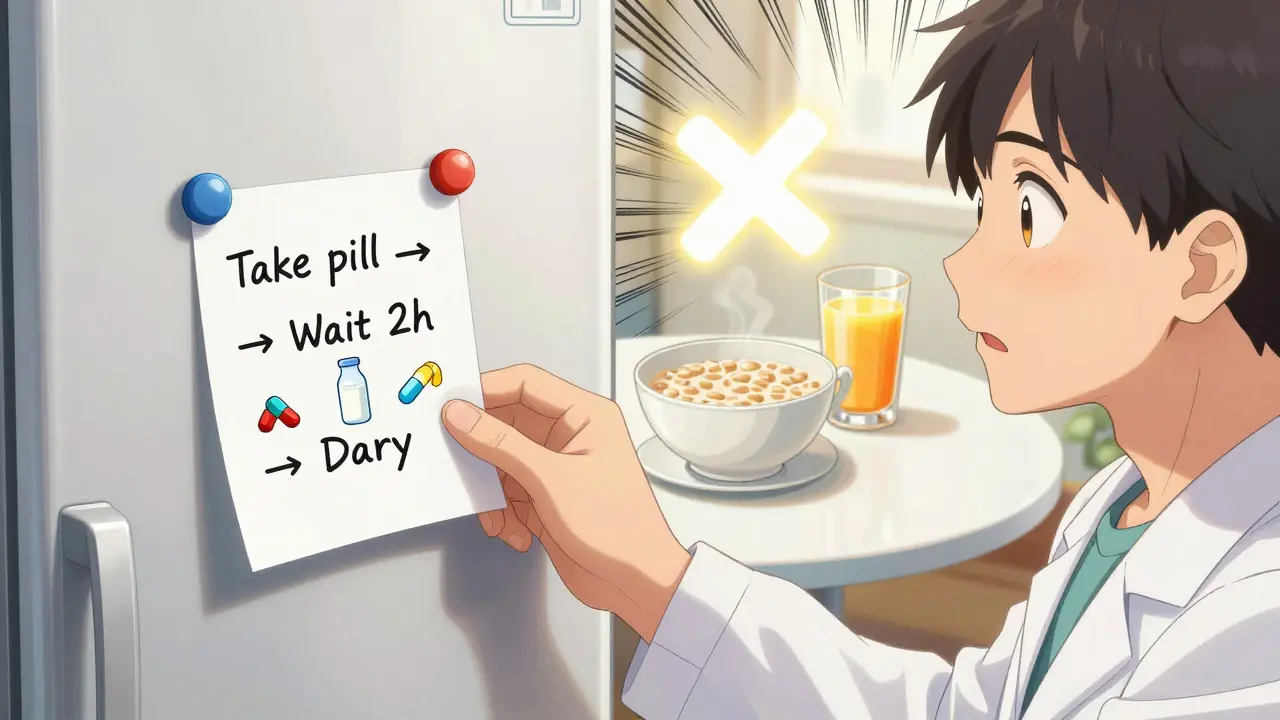
If you’re on one of these antibiotics, don’t guess. Ask your pharmacist. Write it down. Stick it on your fridge. Your body will thank you.
Can I take my antibiotic with a small amount of cheese?
No. Even a small amount of cheese - like a slice on a sandwich or a sprinkle on a salad - contains enough calcium to interfere with tetracyclines and fluoroquinolones. The interaction isn’t dose-dependent in a linear way; even a little can drop absorption by 30% or more. Stick to the timing rules: 1-2 hours before or 2-6 hours after, depending on the drug.
What if I accidentally took my antibiotic with milk?
If you realize right away, don’t panic. Don’t take another dose. Wait until the next scheduled dose, and take it correctly with water and on an empty stomach. If you’re on a short course (like 5-7 days), you might still be okay - but if you’re treating something serious like pneumonia or Lyme disease, call your doctor. They may want to check your progress or adjust the treatment.
Is almond milk safe to drink with antibiotics?
Only if it’s unsweetened and unfortified. Most store-bought almond, soy, and oat milks are fortified with calcium - sometimes as much as dairy milk. Always check the label. If it says "calcium carbonate," "calcium phosphate," or "enriched with calcium," treat it like dairy. Stick to plain, unfortified versions if you’re unsure.
Why do some doctors say "avoid dairy" while others say "wait 2 hours"?
Some doctors give simple advice to avoid confusion. But the science says timing works. The European Association of Hospital Pharmacists recommends a 3-hour gap for tetracyclines. The American Pharmacists Association says 2 hours before or 4 after for ciprofloxacin. The difference comes down to how specific the guidance is. The best approach is to follow the exact timing for your specific antibiotic - not just a vague "avoid dairy" rule.
Can I take calcium supplements with my antibiotic?
No. Calcium supplements - whether tablets, gummies, or liquids - are just as bad as milk. If you take a calcium supplement for osteoporosis or vitamin D, space it at least 4 hours apart from your antibiotic. If you’re unsure, ask your pharmacist to help you time your doses. Many people don’t realize their bone supplement is sabotaging their antibiotic.
Brooke Exley
February 23, 2026 AT 15:48Okay but like-this is the kind of info I wish my doctor just *told* me instead of making me google it at 2am after my UTI came back for the third time. I took cipro with my almond milk smoothie and thought I was being healthy. Turns out I was just feeding the bacteria a five-star buffet. Now I set alarms: 'PILL → WATER → NO DAIRY UNTIL LUNCH.' Game changer. Seriously, thank you for writing this.
Emily Wolff
February 25, 2026 AT 12:16Clueless.
Lou Suito
February 25, 2026 AT 15:34Wait-so you’re saying calcium binds to antibiotics? Like… chemically? As in, ionic chelation? Because if that’s true, then why isn’t this taught in first-year pharmacy school? And why do drug inserts barely mention it? And why did my pharmacist say 'just take it with food' when I asked? This is… alarming.
David McKie
February 26, 2026 AT 02:13I’ve been on doxycycline for 14 days. I drank milk with breakfast. I ate yogurt at lunch. I had cheese on my sandwich. And now? My Lyme symptoms are worse. My doctor says ‘give it time.’ But I know. I know what I did. I’m not a monster-I just didn’t know. Now I feel like a fool. And everyone else who’s been told ‘avoid dairy’ without being told *why*? They’re just as guilty. This system is broken.
Southern Indiana Paleontology Institute
February 26, 2026 AT 11:11yo so if i take my antibiotic with my morning cereal and milk im just dumb? like yeah i get it calcium bad but its just milk bro. why are we making this a science project? i dont need a 1000 word essay to take my pill. just say 'dont drink milk with it' and move on.
Anil bhardwaj
February 27, 2026 AT 11:10Interesting. I’m from India, we don’t really have this problem here. Most people take antibiotics with food because it helps with stomach upset. But we don’t use fortified plant milks or calcium supplements like in the US. Maybe cultural differences matter more than we think. Still, good to know for those who do.
lela izzani
February 28, 2026 AT 13:47Just wanted to say this is one of the clearest, most practical medical explainers I’ve read in years. You didn’t just dump facts-you gave a *plan*. The alarm tip? Genius. The label-checking advice? Lifesaving. I’m printing this out and taping it to my fridge. If you ever write a pamphlet, I’ll buy ten copies. Thank you for making something that matters feel doable.
Joanna Reyes
March 2, 2026 AT 07:16I’ve been taking levofloxacin for a sinus infection, and honestly? I had no idea about the dairy thing. I thought the 'take on empty stomach' meant just no heavy meals, not that my oat milk latte was a silent saboteur. I’ve been drinking oat milk with calcium since January. I just checked the bottle-yep, 'calcium carbonate.' I’m mortified. I’ve been taking it with breakfast for two weeks. My infection is still lingering. I’m going to call my pharmacist today and ask if I need a restart. This isn’t just about avoiding dairy-it’s about recognizing how quietly modern food systems are undermining medical advice. We’ve been sold 'healthy' alternatives that are actually medical hazards. It’s terrifying.
Stephen Archbold
March 3, 2026 AT 08:10Man, I took cipro with my morning banana and soy milk-thought I was being smart. Turns out my soy milk had more calcium than my grandma’s milk. I didn’t know. I’m not mad at the article-I’m mad at the system. Why isn’t this on the prescription label? Why doesn’t the pharmacy print a little note? I’ve been taking meds for 15 years and no one ever told me this. I’m grateful for the heads-up but… kinda furious too.
Nerina Devi
March 4, 2026 AT 06:11This is why I love reading medical content from people who actually understand the human side of health. You didn’t just explain chemistry-you explained fear, confusion, and the quiet shame of being told 'just take it' without context. I’ve had two recurrent UTIs because I didn’t know. Now I’ve labeled my fridge: 'NO CALCIUM UNTIL 4 HOURS AFTER PILL.' My husband laughs. But I’m not taking chances anymore. Thank you.
Dinesh Dawn
March 5, 2026 AT 11:52Hey, I’m from India and we mostly use antibiotics with food. But I never had this issue. Maybe because we don’t use fortified plant milks here? Or maybe our calcium intake is lower? Just curious-does this problem really exist everywhere, or is it mostly a Western thing?
Vanessa Drummond
March 5, 2026 AT 14:16So you’re telling me my 'healthy' almond milk latte is what kept my infection alive? I’m furious. I spent $20 on that organic stuff. I thought I was doing the right thing. Now I feel like I’ve been lied to by marketing. And my doctor didn’t say a word. This isn’t just about antibiotics-it’s about how corporations sell us poison wrapped in wellness.
Nick Hamby
March 7, 2026 AT 11:24There is a profound philosophical dimension to this issue: we treat medical advice as if it were a command, when in reality, it is a negotiation between biology, culture, and individual circumstance. The calcium-antibiotic interaction is not merely a biochemical event-it is a symptom of a healthcare system that often assumes uniformity where none exists. The patient who takes cipro with yogurt is not careless; they are operating within a framework of information gaps, cultural norms, and commercial messaging that actively obscures the truth. To blame the individual is to ignore the architecture of ignorance we have built. The solution is not better patient compliance-it is better system design. Pharmacies should print color-coded timing charts on prescriptions. Pharmacist consultations should be mandatory for fluoroquinolones. This isn’t about discipline-it’s about dignity.
Haley Gumm
March 7, 2026 AT 19:00Let’s be real: if this were true, wouldn’t Big Pharma have fixed it by now? They’re not stupid. They’d make a drug that doesn’t bind to calcium if they could. The fact that they haven’t? Suspicious. Maybe it’s just a myth to sell more expensive versions of the drug? I’m not saying you’re wrong-I’m saying I need peer-reviewed data from double-blind trials. Not a Reddit post.