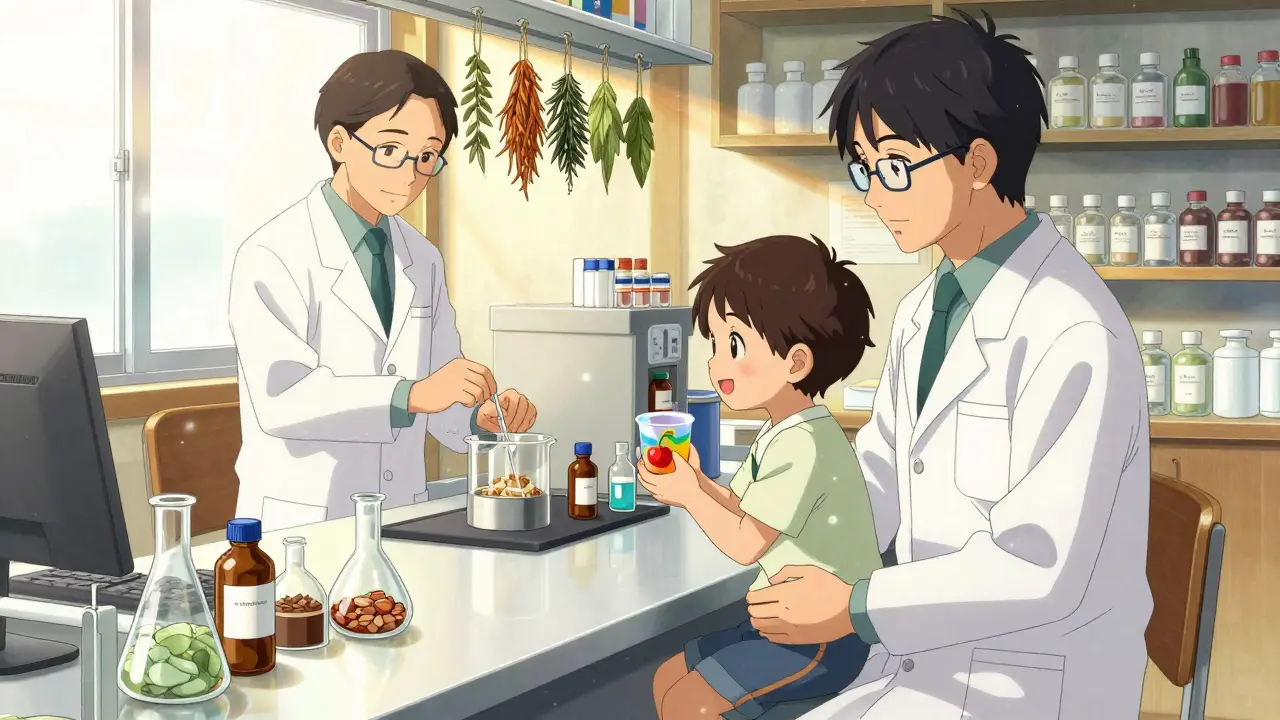
When a standard pill just won’t work - because you’re allergic to the dye, can’t swallow capsules, or need a dose that doesn’t exist - compounded medications step in. These aren’t mass-produced drugs you find at your local pharmacy. They’re made from scratch, one patient at a time. And while they solve real problems, they also carry risks most people don’t know about.
Why Compounded Medications Exist
Most drugs are made in huge batches. That’s efficient. But it doesn’t work for everyone. About 3% to 5% of patients need something different. Maybe they’re a child who gagges on pills. Or an elderly person with a sensitive stomach. Or someone allergic to lactose, gluten, or dyes in commercial products. For them, a regular prescription isn’t just inconvenient - it’s unsafe.
Compounding lets pharmacists rebuild a drug from the ground up. Need 1.5 mg of a medication when only 1 mg and 2 mg are sold? A compounding pharmacist can make it. Can’t take a pill? It can be turned into a gel, a liquid, or even a flavored lollipop. Allergies to preservatives? Those can be stripped out. Five daily pills? They can be combined into one.
This isn’t science fiction. It’s everyday practice. In 2022, the market for compounded medications was worth over $10 billion. By 2030, it’s expected to hit $15.8 billion. Demand is rising because more people are seeking control over how their meds are made - and because doctors are recognizing that one-size-fits-all doesn’t work for complex cases.
Where Compounding Shines
Some conditions simply can’t be treated with off-the-shelf drugs. Here are the most common situations where compounding makes a real difference:
- Pediatrics: Kids often refuse pills. A compounded cherry-flavored liquid can turn a 40% adherence rate into 95%. Studies show flavored formulations improve compliance by nearly a third.
- Geriatrics: Up to 70% of older adults have trouble absorbing pills through their gut. Transdermal gels - applied to the skin - bypass that problem entirely.
- Hormone therapy: Bioidentical hormone creams or capsules can be customized to match a patient’s exact hormone levels, something no FDA-approved product can do.
- Pain management: Topical creams with three or four pain-relieving ingredients in one formula reduce side effects and improve local relief.
- Veterinary use: Dogs and cats can’t swallow human pills. Compounded medications come in meat-flavored liquids or treats made for specific species.
These aren’t niche cases. They’re common. A 2022 survey by the International Academy of Compounding Pharmacists found 82% of patients who used compounded meds would recommend them to others with similar needs.
The Hidden Risks
But here’s the catch: compounded medications aren’t FDA-approved. That means the agency doesn’t test them for safety, strength, or purity before they leave the pharmacy. Unlike commercial drugs, which go through years of clinical trials, compounded meds rely on the pharmacist’s skill - and the pharmacy’s standards.
The consequences can be deadly. In 2012, a compounding pharmacy in Massachusetts shipped contaminated steroid injections. It led to 64 deaths and 798 cases of fungal meningitis. That outbreak changed everything.
Even today, compounded drugs make up only 1% of all prescriptions, but they account for 17% of drug recalls between 2010 and 2020. Why? Because quality control varies wildly. One pharmacy might follow strict sterile procedures. Another might cut corners.
One Reddit user shared: “My compounded thyroid med was inconsistent. My TSH levels jumped around like a yo-yo. I had to switch back to a commercial version.” That kind of inconsistency isn’t rare. It’s a known issue.

How to Find a Safe Compounding Pharmacy
If you need a compounded medication, not all pharmacies are equal. Out of roughly 7,500 pharmacies in the U.S. that offer compounding, only about 350 are accredited by the Pharmacy Compounding Accreditation Board (PCAB). That’s less than 5%.
PCAB accreditation means the pharmacy has passed independent inspections for cleanliness, equipment, staff training, and record-keeping. Ask your pharmacist: “Are you PCAB-accredited?” If they don’t know what you mean, find another one.
Also, check if the pharmacy is registered as a 503B outsourcing facility. These are subject to FDA inspections and must follow the same quality rules as drug manufacturers. Traditional 503A pharmacies are regulated by state boards - which vary widely in how strictly they enforce rules.
Look for transparency. A good compounding pharmacy will tell you exactly what’s in your med, how it was made, and what tests were done. If they can’t or won’t explain, walk away.
Cost and Insurance
Compounded meds aren’t cheap. A simple non-sterile cream might cost $30-$100. A sterile injection? $200-$500. Compare that to a generic pill, which runs $10-$50.
Insurance coverage is spotty. Medicare Part D covers only 42% of compounded claims. Private insurers vary even more. Some won’t cover it at all. Others require prior authorization or proof that no commercial alternative exists.
Before you start, call your insurer. Ask: “Do you cover compounded medications for [your condition]? What’s the process?” Don’t assume it’s covered. Always get it in writing.

What the Experts Say
Most pharmacists agree: compounding is vital - but it should be rare.
Dr. Michael Ganio of the American Society of Health-System Pharmacists says, “Compounding should be the exception, not the rule.” The FDA agrees. Commissioner Robert Califf warned in 2023 that pharmacies compounding large batches of drugs like semaglutide for weight loss are crossing the line into manufacturing - and that’s dangerous.
The U.S. Pharmacopeia (USP) has clear standards: USP <795> for non-sterile compounding, USP <797> for sterile. These aren’t suggestions. They’re requirements for safe practice. Any pharmacy that skips them is putting lives at risk.
But when done right? The results speak for themselves. A parent on PatientsLikeMe wrote: “My son’s ADHD med was a nightmare until we switched to a compounded liquid. He actually takes it now. No more fights at breakfast.”
What You Should Do
If you’re considering a compounded medication:
- Make sure your provider has ruled out all FDA-approved alternatives.
- Ask for a PCAB-accredited pharmacy or a 503B-registered facility.
- Get a written prescription - no exceptions.
- Ask the pharmacy for documentation on how the med was made and tested.
- Monitor your symptoms closely. If something feels off - like unusual side effects or inconsistent results - contact your provider immediately.
Compounded medications aren’t a shortcut. They’re a lifeline - for a small group of people who have no other options. But that lifeline only works if it’s built right.
Are compounded medications FDA-approved?
No. The FDA does not review or approve compounded medications before they are made. Unlike commercial drugs, they don’t go through clinical trials or manufacturing inspections. This means their safety, strength, and purity aren’t guaranteed by the federal government. The responsibility falls entirely on the compounding pharmacy.
Can I get compounded meds without a prescription?
No. Federal law requires a valid prescription from a licensed provider - like a doctor, nurse practitioner, or dentist - before a pharmacy can compound any medication. Any pharmacy offering compounded drugs without a prescription is operating illegally and poses serious safety risks.
How do I know if my compounding pharmacy is safe?
Look for PCAB accreditation - only about 350 of the 7,500 U.S. compounding pharmacies have it. You can check their status on the PCAB website. Also, ask if they’re registered as a 503B outsourcing facility, which means they’re subject to FDA inspections. Avoid pharmacies that can’t or won’t explain their quality control processes.
Why are compounded meds so expensive?
They’re made by hand, in small batches, with specialized equipment and strict quality checks. A sterile injection, for example, requires a cleanroom, trained staff, and testing for contamination - all of which cost far more than mass-producing pills. A simple cream might cost $30-$100; a complex sterile compound can run $200-$500.
Can I switch back to a regular drug later?
Yes - and you should consider it. Compounded medications are meant for cases where no commercial option works. If a standard drug becomes available, or if your body responds better to it, talk to your provider about switching. Long-term use of compounded meds without a clear need increases your exposure to quality risks.
Levi Viloria
March 3, 2026 AT 16:10Compounded meds saved my mom’s life after she developed a severe allergy to every commercial thyroid med. We found a PCAB-accredited pharmacy after months of trial and error. It’s not perfect, but it’s the only thing that kept her stable.
Still, I wish more doctors knew how to guide patients toward safe options instead of just saying 'try this pill'.
Jeff Card
March 4, 2026 AT 19:14I’ve worked in pharmacy for 18 years and seen both sides. The good: a kid who finally takes his ADHD med because it’s grape-flavored liquid.
The bad: a patient who got a compounded pain cream that burned their skin - turned out the pharmacist mixed up the concentration.
It’s not about the idea. It’s about who’s making it.
Gretchen Rivas
March 5, 2026 AT 05:28PCAB accreditation is non-negotiable. If your pharmacy doesn’t mention it upfront, walk out. I’ve seen too many people get sick because they trusted a local shop that didn’t even have a laminar flow hood.
RacRac Rachel
March 6, 2026 AT 13:47My son’s compounded liquid ADHD med changed our lives 😊 No more morning battles, no more crushed pills in applesauce, just a tiny spoonful and he’s good to go. I’d pay double if I had to. Worth every penny.
Chris Beckman
March 8, 2026 AT 08:57why do people think compounding is magic? the 2012 outbreak wasnt an accident it was negligence. most of these places arent even inspected. if you want safety buy the generic. its cheaper and tested. end of story.
Diane Croft
March 9, 2026 AT 21:34I’ve been on compounded hormones for five years. My levels are stable. My energy is back. I don’t care if it’s not FDA-approved - what matters is that it works for me. The system doesn’t account for individual biology, and that’s the real problem.
John Cyrus
March 11, 2026 AT 08:21compounded meds are a scam designed to rip off people who dont know better. the fda lets them slide because big pharma doesnt want competition. if you use these youre playing russian roulette with your health
John Smith
March 12, 2026 AT 19:42you think the FDA gives a damn about you? they’re busy protecting big pharma’s profits. compounding pharmacies are the only thing keeping real medicine alive. if you dont like it go live in a cave with your generic pills
Jane Ryan Ryder
March 14, 2026 AT 15:01oh look another post from someone who thinks their personal anecdote is medical advice. congrats you found a pharmacy that didnt kill you. now go tell your friends to stop being dumb
Donna Zurick
March 15, 2026 AT 10:06My dad’s on a compounded blood thinner because he can’t swallow anything. It’s $300 a month. Insurance won’t cover it. We pay out of pocket because it’s the only thing that works. I don’t care about the politics. I care that he’s alive.
Renee Jackson
March 16, 2026 AT 03:07It is imperative to recognize that compounding pharmacies operate under a framework of professional responsibility and ethical obligation. While regulatory oversight may be fragmented, adherence to USP standards remains the cornerstone of patient safety. One must prioritize accredited facilities and demand transparency from providers. Compounding is not a loophole - it is a clinical necessity when executed with integrity.
Matt Alexander
March 18, 2026 AT 01:02If you need a compounded med, ask your doctor for a list of PCAB pharmacies. Call them. Ask if they test batches. If they say no, find another. It’s that simple. Don’t let price or convenience override safety.