
Rare Side Effect Detection Calculator
This calculator shows how clinical trial sample sizes impact the ability to detect rare side effects. Based on the article, many serious side effects only emerge after drugs are widely used.
Detection Analysis
When a new drug hits the market, you might think the safety profile is fully known. But here’s the truth: what you read in the package insert isn’t the whole story. Clinical trials give you one picture. Real-world use gives you another-and they often don’t match.
How Clinical Trials Really Work
Clinical trials are designed to answer one question: Does this drug work under perfect conditions? They’re tightly controlled. Participants are carefully selected-you need to be healthy enough to tolerate the study, without other major illnesses, and not taking other drugs that might interfere. Most trials exclude people over 75, pregnant women, or those with kidney or liver problems. That means the people in the trial don’t look much like the actual patients who’ll take the drug.
Side effects are tracked during scheduled visits. If you’re in a cancer trial, you might go in every week for blood tests and check-ins. The system used to grade side effects is called CTCAE version 5.0. It lists 790 specific reactions, from mild nausea to death. But here’s the catch: if a side effect doesn’t happen during a visit, or if it’s mild and you forget to mention it, it often doesn’t get recorded. Trials also have small numbers. The average Phase 3 oncology trial includes just 381 people. That’s not enough to catch side effects that happen in 1 out of 1,000 patients.
Take rosiglitazone, a diabetes drug approved in 1999. The clinical trials showed it was safe. But years later, when millions of people started using it, real-world data revealed a 43% higher risk of heart attacks. That risk was invisible in the trials because the sample was too small and the follow-up too short.
What Happens When the Drug Goes Real-World
Once a drug is approved and sold to the public, safety monitoring shifts. Now, side effects come from places like the FDA’s Adverse Event Reporting System (FAERS), electronic health records, and insurance claims. In 2022, FAERS alone received over 2.1 million reports. That’s more than double the number from 2018.
Real-world data doesn’t just come from doctors. It comes from patients. Someone using a health app like MyTherapy might log fatigue every evening after immunotherapy-even if their clinic visit was only once a month. That’s data clinical trials miss. In fact, one study found patients reported fatigue 27% more often than what was captured in trials because the trial only asked about it during office hours.
But real-world data has its own problems. Only 2-5% of actual side effects are ever reported to FAERS. Most doctors don’t report them. A 2021 AMA survey found only 12% of physicians consistently file reports, mostly because it takes 22 minutes per case. And when side effects do get recorded in electronic health records, only 34% have enough detail for regulators to act on.
The Big Gaps: What Each Method Misses
Clinical trials are great at finding common side effects. If 15% of people get nausea in a trial, you can be confident that’s a real drug effect. But they’re terrible at finding rare ones. If a side effect happens in 1 in 5,000 people, you’d need a trial with 10,000 participants just to have a shot at spotting it. Most trials don’t have that kind of size or duration.
Real-world data, on the other hand, can catch those rare events. But it can also create false alarms. In 2018, a real-world study linked anticholinergic drugs to dementia. It looked convincing-until researchers dug deeper and found that people who took these drugs were already more likely to have early dementia symptoms. The drug wasn’t causing it; the condition was leading to the prescription. That’s confounding-and it’s why real-world data needs heavy statistical cleaning.
Another problem? Timing. Clinical trials track side effects over weeks or months. Real-world data can show effects that appear years later. For example, the FDA’s 2020 warning about pioglitazone increasing heart failure risk was based on 10 years of real-world data from over 190,000 patients. No clinical trial could have lasted that long.

What the Experts Say
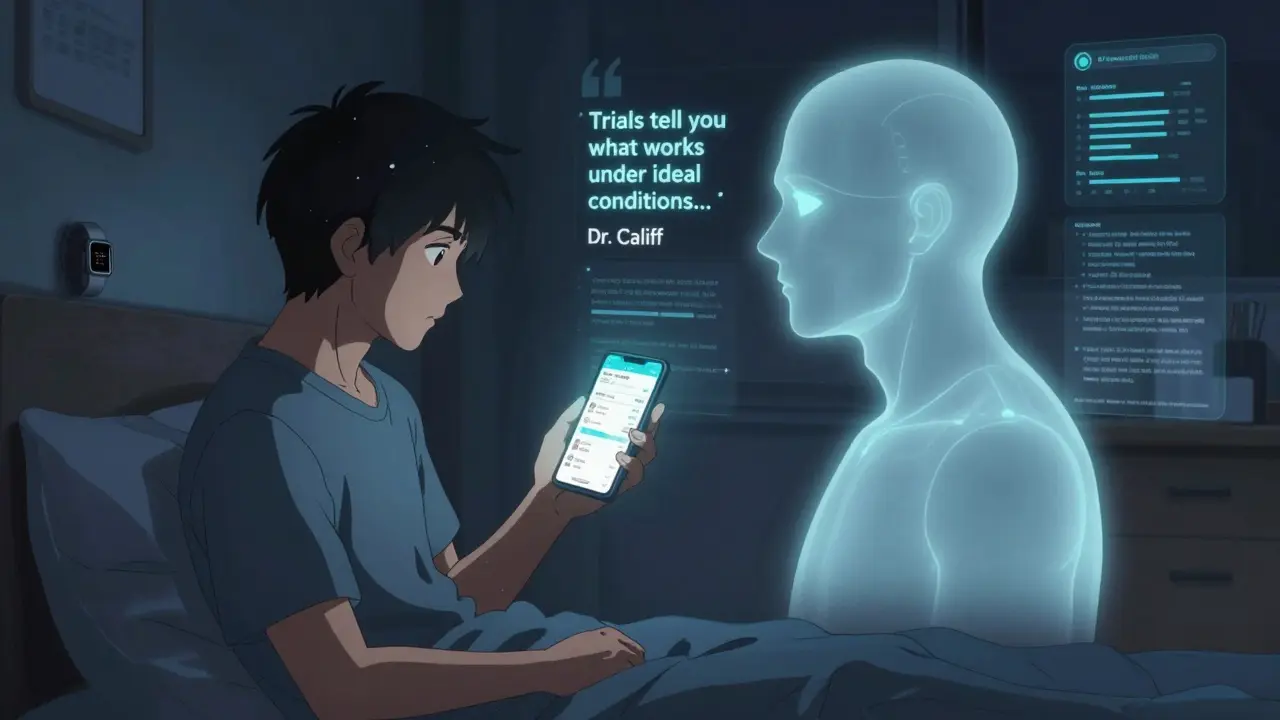
Dr. Robert M. Califf, former FDA Commissioner, put it simply: “Clinical trials tell you what works under ideal conditions; real-world evidence tells you what happens when you implement it broadly.”
Dr. Janet Woodcock, former FDA deputy commissioner, said clinical trials are built to answer whether a drug works-not how it works in everyone. That’s why 78% of serious side effects that emerge after approval were never seen in trials, according to a 2020 Harvard study.
But not everyone trusts real-world data. Dr. Steven Nissen pointed out that real-world evidence failed to catch the cardiovascular risks of Vioxx until 80 million people had taken it. That’s a massive delay.
The European Medicines Agency found 142 cases between 2015 and 2021 where real-world data led to regulatory action-like restricting fluoroquinolone antibiotics after reports of disabling nerve and tendon damage. Meanwhile, Pfizer’s Danny Wiederkehr admits real-world data doesn’t give the same confidence as a trial, but it adds important context.
What Patients Actually Experience
Patients notice the gap. A 2022 survey by the National Patient Advocate Foundation found 63% of people experienced side effects not listed on their drug’s label. Of those, 41% were moderate to severe enough to disrupt daily life.
On Reddit’s r/Pharmacy community, pharmacists shared that 78% of them see side effects in patients that don’t match clinical trial reports-especially with newer drugs like GLP-1 agonists for weight loss. Patients report nausea, vomiting, and dizziness that were labeled as “rare” in trials but show up in nearly every patient they see.
And it’s not just doctors and patients. Social media is now a frontline tool. Twitter picked up early warnings about ivermectin side effects 47 days before FAERS even registered them during the pandemic. Real-time data from apps and online forums is changing how we spot problems.
The Future: Blending Both Worlds
The FDA now requires every new drug application to include a plan for collecting real-world data after approval. That’s new. In 2017, only 29% of approvals included real-world evidence. By 2022, that number jumped to 67%.
Companies are building hybrid systems. Top pharma firms now collect real-world data during late-stage trials. Apple’s Heart Study, which enrolled over 400,000 people using smartwatches, proved you can monitor heart rhythms at trial scale without clinics. The FDA’s Sentinel Initiative now watches 300 million patient records in near real-time, catching signals 6-12 months faster than before.
AI is stepping in too. Google Health’s 2023 study analyzed 216 million clinical notes and found 23% more drug-side effect links than traditional methods. That’s huge.
But experts agree: real-world data won’t replace clinical trials. It complements them. Trials set the baseline. Real-world data watches what happens after the drug leaves the lab.
What This Means for You
If you’re taking a new medication, don’t assume the label tells you everything. Side effects listed might be the common ones-but what about the ones that show up after six months? Or the ones that only happen if you’re also on blood pressure meds? Or the ones that hit harder at night?
Keep track of how you feel. Use apps. Talk to your pharmacist. If something feels off, report it. The FDA’s FAERS system only works if people report.
And remember: if a drug looks safe in trials but you’re seeing different patterns in real life, you’re not imagining it. The system is designed to catch this. It just needs you to help.
Why aren’t all side effects listed on drug labels?
Drug labels only include side effects seen in clinical trials-and even then, only those that occurred frequently enough to be statistically significant. Rare side effects (under 1% occurrence) or those that appear after long-term use often aren’t detected until after the drug is approved and used by millions. Real-world data fills this gap, but it takes time to collect and verify.
Can real-world data lead to a drug being pulled from the market?
Yes. Between 2015 and 2021, the European Medicines Agency took regulatory action in 142 cases based on real-world evidence. Examples include restricting fluoroquinolone antibiotics after reports of permanent nerve damage and tightening warnings for certain diabetes drugs linked to heart failure. The FDA has also used real-world data to add black box warnings and limit use.
Why do clinical trials exclude so many people?
Trials exclude people with other illnesses, older adults, pregnant women, and those on multiple medications to reduce variables. This makes it easier to prove the drug works-but it also means the results don’t reflect how most people will actually use the drug. That’s why real-world data is critical: it shows what happens in messy, real life.
How long does it take for a side effect to be discovered after a drug launches?
It can take months or even years. Clinical trials last 1-5 years, but real-world side effects often emerge after 1-10 years of use. For example, the heart failure risk with pioglitazone wasn’t confirmed until 10 years after approval. Social media and health apps are speeding this up-some signals now appear within weeks.
Should I trust clinical trial data or real-world data more?
Neither alone is enough. Clinical trial data tells you what’s likely to happen under controlled conditions. Real-world data tells you what actually happens when millions of different people take the drug over years. The safest approach is to use both: trust the trial for initial safety, but stay alert to changes after the drug hits the market. Report anything unusual.
Kandace Bennett
March 12, 2026 AT 18:33Tim Schulz
March 13, 2026 AT 07:02Jinesh Jain
March 14, 2026 AT 04:40douglas martinez
March 14, 2026 AT 21:30Sabrina Sanches
March 15, 2026 AT 11:00Emma Deasy
March 15, 2026 AT 15:28tamilan Nadar
March 16, 2026 AT 13:46Rosemary Chude-Sokei
March 17, 2026 AT 14:12Noluthando Devour Mamabolo
March 18, 2026 AT 12:11Leah Dobbin
March 18, 2026 AT 19:12Ali Hughey
March 20, 2026 AT 12:26Alex MC
March 22, 2026 AT 06:58rakesh sabharwal
March 23, 2026 AT 21:38Aaron Leib
March 24, 2026 AT 14:14