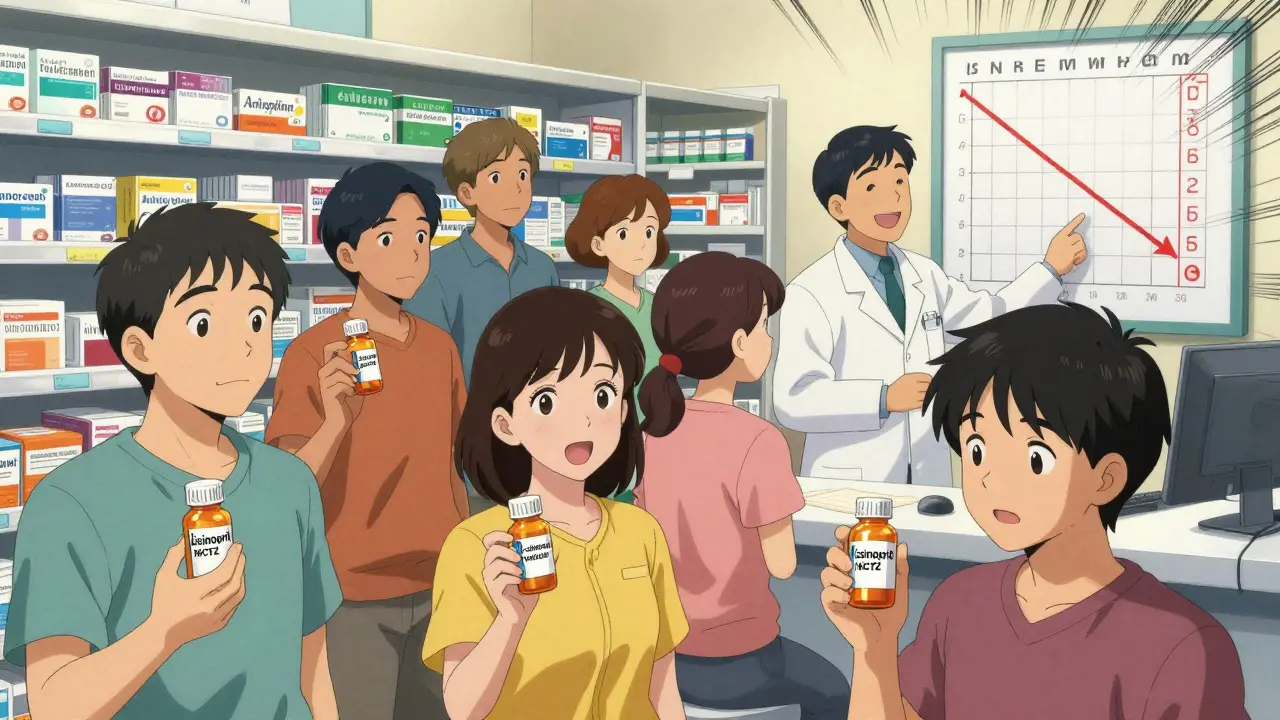
Most people with high blood pressure don’t need one pill. They need two. Or three. That’s the hard truth doctors have known for decades: antihypertensive combination generics aren’t just convenient-they’re often the only way to get blood pressure under control. If you’re taking multiple pills every day, or your doctor just suggested a combo, you’re not alone. About 70% to 80% of people with hypertension need more than one medicine to hit their target. The good news? There are dozens of generic versions of these combo pills now, and they’re cheaper than ever. But knowing which ones are available, how they compare, and how to get them without getting hit by insurance surprises? That’s where things get messy.
What Are Antihypertensive Combination Generics?
These are single tablets that pack two or three blood pressure medicines into one. They’re called fixed-dose combinations (FDCs) or single-pill combinations (SPCs). Instead of swallowing three separate pills in the morning, you take one. Sounds simple, right? But it’s not just about convenience. Studies show people who take a single pill are 15% to 25% more likely to stick with their treatment than those juggling multiple tablets. Miss a pill? It’s harder when you only have one to forget.
The science behind these combos isn’t new. The first one, Uniretic (enalapril + hydrochlorothiazide), got FDA approval back in 1987. Today, there are over 30 different generic versions on the market. They combine drugs from different classes that work in different ways: one relaxes blood vessels, another helps your kidneys flush out salt and water, a third slows down your heart rate. Together, they lower blood pressure more effectively than any single drug alone.
Common Generic Combinations You’ll Find
Not all combos are made equal. The most common ones fall into three categories:
- ACE inhibitor + thiazide diuretic: Examples include lisinopril/hydrochlorothiazide (HCTZ) and benazepril/HCTZ. These are often first-line choices, especially for people with diabetes or kidney issues.
- ARB + thiazide diuretic: Losartan/HCTZ and valsartan/HCTZ are popular here. ARBs are like ACE inhibitors but with fewer side effects like cough, so they’re a go-to for people who can’t tolerate ACE drugs.
- Calcium channel blocker + ACE/ARB: Amlodipine/benazepril and amlodipine/valsartan are common. Amlodipine is a strong vasodilator and works well paired with either an ACE or ARB.
There are also triple-combination pills now-amlodipine/valsartan/HCTZ, for example. These are for people who haven’t responded to two-drug therapy. They’re less common but growing fast. One 2022 study estimated they could cut the treatment gap in low-income countries by 35% if they became widely available.
Costs: Why Your Insurance Might Be Fighting You
Here’s the catch: generic combo pills aren’t always cheaper than buying the individual generics separately. Back in 2013, when brand-name versions still dominated, combos cost 15-20% less than buying the pills apart. But now? The math flipped.
Generic amlodipine costs about $4.50 a month. Generic valsartan? Around $7.80. Put them together? You’re paying $12.30. But the generic version of Exforge (amlodipine/valsartan) still runs $18.75. That’s nearly 50% more for the same two drugs in one pill. Same goes for losartan/HCTZ: the combo version (Hyzaar generic) can be $10.60, but buying losartan and HCTZ separately might cost less than $8 total.
So why do pharmacies even sell these combos? Because some insurance plans don’t cover the individual pills unless you prove you tried and failed the combo. Or worse-they cover the combo at a higher copay because it’s branded as a “combination product,” even though it’s generic. On PatientsLikeMe, users report being charged $45 for the combo while their individual pills are $5 each. It makes no sense. But it’s real.

Dosing Flexibility: The Hidden Limitation
Combination pills are rigid. If your doctor wants to adjust your dose-say, lower your amlodipine from 10mg to 5mg but keep your valsartan at 160mg-you’re stuck. That exact combo doesn’t exist in any pill. You’ll have to switch back to separate tablets. This is a big reason why some people stop using combos: they can’t get the right dose.
Take Azor (amlodipine/olmesartan). The available doses are 5/20, 5/40, 10/20, and 10/40. What if you need 2.5mg of amlodipine and 40mg of olmesartan? No pill exists for that. You’ll need to split pills or take two separate ones. And splitting pills isn’t always safe or accurate. Some tablets aren’t scored. Others crumble. Your doctor might not even know the combo you need isn’t available.
Availability: Global Gaps and Local Realities
Here’s where it gets uneven. In the U.S., 85% of antihypertensive combination prescriptions are generic. You can walk into any pharmacy and find at least five different combos. But globally? It’s a different story. In low- and middle-income countries, availability drops below 15%. A 2021 study found that even though generic SPCs are technically available in 26 countries, they couldn’t confirm access in four: Ethiopia, Morocco, Afghanistan, and Turkey.
The World Health Organization says 95% of hypertension cases need combination therapy. Yet in low-income countries, only 7.1% of patients have their blood pressure under control. Compare that to 57.9% in high-income countries. Lack of access to affordable combos is one of the biggest reasons why.
Even when the pills are available, they’re not always in guidelines. Only 12 of the 26 countries studied had SPCs officially recommended in their national hypertension protocols. That means doctors don’t know to prescribe them. Pharmacies don’t stock them. Patients don’t ask for them.

How to Get the Right Combo for You
If you’re considering a combination generic, here’s how to navigate the system:
- Ask for the generic: Don’t assume the combo your doctor recommends is the cheapest. Ask: “Is there a generic version of this?” and “What’s the cost difference between the combo and buying the two pills separately?”
- Check GoodRx or SingleCare: These apps show real-time pharmacy prices. You might be surprised. Sometimes the combo is cheaper. Sometimes it’s not. Know your options.
- Call your insurance: Ask: “Do you cover the individual components of this combo at a lower copay?” If yes, you might be better off with two separate pills.
- Ask about dose flexibility: If your blood pressure needs fine-tuning, make sure the combo you’re prescribed has a dose you can actually use. If not, push for separate pills.
- Stick with it: If the combo works and you can afford it, stick with it. Adherence rates jump from 60-70% with multiple pills to over 80% with one. That’s the difference between staying healthy and ending up in the hospital.
Why This Matters Beyond Your Prescription
High blood pressure doesn’t just affect you. It affects your family, your workplace, your healthcare system. Every uncontrolled BP increases your risk of stroke, heart attack, kidney failure. And it costs the U.S. healthcare system over $130 billion a year.
Generic combination pills are one of the most cost-effective tools we have to fight this. They reduce hospitalizations by 28% when patients stick with them. They cut down on pill clutter, confusion, and missed doses. But only if people can get them-and if doctors and insurers don’t get in the way.
The future is moving toward triple combos and wider access. But right now, the biggest barrier isn’t science. It’s bureaucracy. It’s pricing. It’s the gap between what’s available and what’s actually used.
You don’t need to be a doctor to understand this: one pill is easier than three. But you do need to be your own advocate to make sure you get the right one at the right price.
Are generic antihypertensive combos as effective as brand names?
Yes. The FDA requires generic combination pills to prove they deliver the same amount of medicine into your bloodstream as the brand-name version, within a strict 80-125% range. Studies show they lower blood pressure just as effectively. The only difference is the price-and sometimes, the pill shape or color.
Can I split a combination pill if I need a lower dose?
Only if it’s scored (has a line down the middle) and your doctor approves it. Not all combo pills are designed to be split. Splitting can lead to uneven doses, especially with pills that contain multiple active ingredients. If you need a dose that doesn’t exist in a combo, ask your doctor about switching to individual generics.
Why does my insurance cover the individual pills but not the combo?
Insurance companies often have formularies that favor cheaper options. If the individual generics cost less together than the combo, they’ll push you toward the separate pills. This isn’t always logical-especially if the combo improves your adherence-but it’s common. Call your insurer and ask for a prior authorization for the combo if you believe it’s better for you.
What’s the most common generic combination prescribed?
Losartan/HCTZ and amlodipine/benazepril are among the most commonly prescribed. Losartan/HCTZ is popular because it’s affordable and well-tolerated. Amlodipine/benazepril is often used for patients who need stronger blood pressure control. Both have been on the market as generics for over a decade and are widely available.
Are there triple-combination generics available?
Yes. Amlodipine/valsartan/HCTZ is the most common triple-combination generic. It’s typically prescribed when two-drug therapy hasn’t worked. These pills are less common than dual combos, and not all pharmacies stock them. But they’re growing in availability, especially in the U.S., and are expected to become more widespread in the next few years.
Can I switch from a brand-name combo to a generic?
Absolutely. Most doctors recommend switching to generics once they’re available because they’re equally effective and much cheaper. Make sure your pharmacist confirms the generic version is bioequivalent. You shouldn’t notice a difference in how you feel or how your blood pressure responds.
What to Do Next
If you’re on multiple blood pressure pills, ask your pharmacist to check if a generic combo exists for your meds. Bring your pill bottles with you. Ask your doctor if a combo would work for your dose. Check GoodRx for prices. If your insurance won’t cover the combo, ask for a prior authorization. If you’re in a country where these pills are hard to find, talk to your local health clinic-they might have access through public health programs.
One pill is easier than three. But only if you can get it. Don’t let cost or confusion keep you from the treatment that could keep you healthy for years to come.
Jeffrey Hu
January 8, 2026 AT 20:38Let’s cut through the BS-generic combos aren’t cheaper because pharmacies and insurers rigged the system to push single-pill products even when they cost more. I’ve seen it myself: $18 for amlodipine/valsartan vs $11 for two separate generics. It’s not about efficacy-it’s about profit margins disguised as convenience.
Micheal Murdoch
January 9, 2026 AT 16:19It’s wild how something so medically straightforward-take one pill instead of three-gets tangled in insurance red tape and pharmacy pricing games. People think hypertension is just about meds, but it’s really about access, dignity, and consistency. If you can’t afford or navigate the system, you’re not failing-you’re being failed by the system.
I’ve had patients cry because they had to choose between their combo pill and groceries. That’s not healthcare. That’s a moral crisis wrapped in a prescription bottle.
And yeah, splitting pills? Don’t. Especially with combo meds. The active ingredients aren’t evenly distributed, and you risk underdosing or overdosing. It’s not worth the gamble.
But here’s the hopeful part: when people get the right combo at the right price, adherence jumps. Stroke rates drop. Kidney damage slows. It’s one of the most cost-effective interventions in all of medicine. Why are we making it so hard?
Jacob Paterson
January 10, 2026 AT 00:36Wow. So we’re supposed to be grateful that Big Pharma lets us buy two drugs in one pill for $18 instead of $11? Congrats, we’ve been sold a marketing gimmick as medical innovation. Next they’ll package aspirin and water in a pill and call it a ‘hydration breakthrough.’
Lindsey Wellmann
January 10, 2026 AT 12:04OMG I JUST REALIZED I’VE BEEN TAKING THREE PILLS FOR YEARS 😭 I’M SO SAD AND ALSO SO ANGRY 😤 WHY DID NO ONE TELL ME??
Also, can we talk about how the color of the pill makes me feel more compliant? Like if it’s blue, I’m like ‘yes, I’m a responsible adult’ 🥺💙
Pooja Kumari
January 11, 2026 AT 14:00I remember when I first started on losartan/HCTZ-my body felt like it was being held hostage by my own kidneys. Then I switched to the combo and… I didn’t even notice the change. No dizziness, no nausea, just… calm. Like my blood pressure finally stopped screaming and whispered, ‘Hey, we got this.’
But then my insurance denied it because ‘separate pills are cheaper.’ So I paid out of pocket for three months. I cried in the pharmacy aisle. Not because of the cost-but because I felt so alone in this. No one talks about how lonely managing chronic illness feels.
Now I tell every person I know with high BP: ‘Ask for the combo. Ask for the price. Ask for help. You’re not being difficult-you’re being smart.’
And if your doctor says ‘it’s not in the guidelines’? Ask why. And then ask again. Because guidelines are written by people who’ve never had to choose between rent and their meds.
It’s not just about pills. It’s about being seen.
Diana Stoyanova
January 12, 2026 AT 01:48Let me tell you something-this isn’t just about blood pressure. It’s about autonomy. It’s about not having to be a pharmacist, a claims specialist, and a medical researcher just to stay alive.
I used to take four pills a day. Four. I’d set five alarms. I’d write them on sticky notes. I’d put them in my purse, my car, my desk drawer. And still, I missed one. Every. Single. Week.
Then I got the amlodipine/valsartan combo. One pill. One time. One less thing to stress about. My BP dropped 15 points in two weeks. My anxiety dropped too. I slept better. I laughed more.
And now? I’m the one pushing this on my mom, my uncle, my coworker who just got diagnosed. Because if you can make life easier for someone with a single pill? You owe it to them to try.
Yes, the math doesn’t always add up. Yes, insurance sucks. But if you can get the combo? Take it. Fight for it. Call your insurer. Write your rep. This isn’t a luxury-it’s a lifeline.
One pill. One chance. One less reason to give up.
RAJAT KD
January 13, 2026 AT 10:48India has 200 million hypertensive patients. Less than 5% have access to affordable fixed-dose combinations. The government subsidizes some, but pharmacies in rural areas don’t stock them. Doctors don’t prescribe them because they don’t know they exist. It’s a systemic collapse masked as a medical issue.
Generic combos are not a privilege. They are a right.
Jenci Spradlin
January 13, 2026 AT 18:05yo i just switched to amlodipine/benazepril last month and it’s been a game changer. used to take 3 pills, now just one. no more forgetting, no more pill organizer chaos. my bp’s been steady for 3 months now. also saved like $20 a month. also the pill is kinda pink? weird but i like it lol
tali murah
January 14, 2026 AT 23:22Oh, so now we’re romanticizing the ‘one-pill solution’ like it’s a TED Talk and not a corporate loophole? Let’s not pretend this isn’t Big Pharma’s way of locking patients into a single product they can control-price, availability, dosage. They don’t care if you can’t get 2.5mg/40mg. They just want you to take *their* pill.
And let’s not forget: the FDA’s bioequivalence standard allows for a 20% variance. That’s not ‘same medicine.’ That’s ‘close enough.’
Adherence is higher? Maybe. But is that because the pill is easier-or because patients are too exhausted to fight the system anymore?
Chris Kauwe
January 16, 2026 AT 23:04The fact that Americans are still debating whether to take one pill or three proves we’ve lost all sense of medical pragmatism. In Germany, Japan, and Canada, fixed-dose combinations are first-line. No debate. No insurance hoops. Just science. Here? We’ve turned hypertension into a bureaucratic obstacle course while pretending we’re saving money.
This isn’t about generics. It’s about cultural decay. We’ve outsourced responsibility to algorithms and formularies. We’ve forgotten that medicine is supposed to heal-not punish.
Aron Veldhuizen
January 18, 2026 AT 02:00Actually, the real issue isn’t the combo pills-it’s that we’re medicating hypertension instead of fixing diet, sleep, and stress. But hey, let’s keep selling pills instead of teaching people how to breathe.
Matthew Maxwell
January 19, 2026 AT 10:21It’s irresponsible to encourage patients to switch to generics without emphasizing the importance of pharmaceutical consistency. Many of these generics are manufactured in facilities with questionable quality controls. You’re gambling with your cardiovascular health for a $5 savings.
And don’t get me started on the moral hazard of patients ‘shopping’ for pills like groceries. This is medicine, not Amazon Prime.
Drew Pearlman
January 19, 2026 AT 16:47Look-I know it’s frustrating when the system feels rigged. I’ve been there. I’ve had to call my insurance 12 times just to get a combo approved. I’ve cried in the pharmacy parking lot because I couldn’t afford my meds.
But here’s the thing: you’re not powerless. You have a voice. You have a right to ask. To push. To demand. Your health is worth fighting for-even if it feels like no one’s listening.
And if you’re lucky enough to find a combo that works? Don’t just take it. Share it. Tell your friends. Tell your doctor. Tell your senator. Because someone out there is still taking three pills a day, wondering why they feel so tired.
One pill is easier. But it’s not just about convenience. It’s about dignity. It’s about living.
You’re not just managing blood pressure. You’re reclaiming your life.
Elisha Muwanga
January 20, 2026 AT 04:13Why are we even talking about this? The U.S. spends more on healthcare than any country in the world. Yet we can’t get a simple pill combo to cost less than the sum of its parts? This isn’t a medical problem. It’s a national disgrace.
And don’t tell me it’s about ‘market forces.’ If we can give $100 billion in tax breaks to billionaires, we can make a $12 pill cost $12.
It’s not complicated. It’s not science. It’s greed. And we’re letting it kill people.