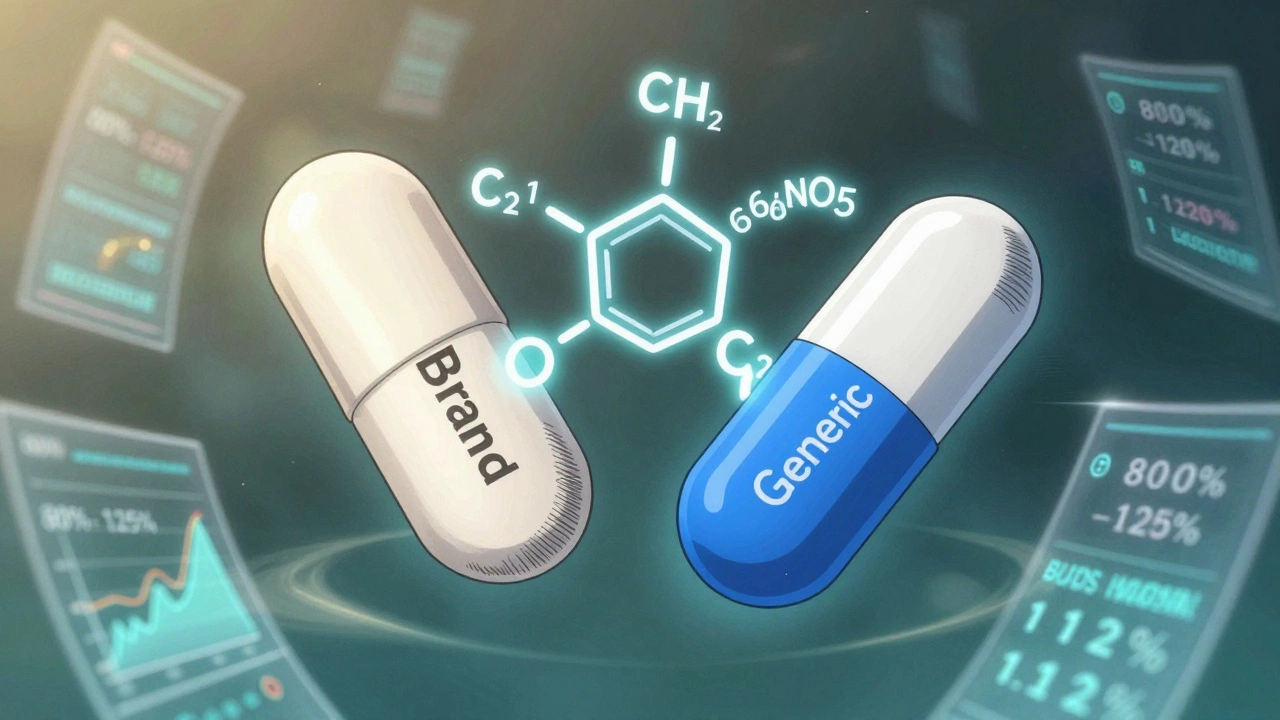
When you pick up a prescription, you might see two pills that look completely different-one white and oval, the other blue and capsule-shaped. One says generic, the other has a fancy brand name. You might wonder: Is this generic really the same? The answer isn’t just yes-it’s scientifically proven yes. But the confusion persists. And that’s where the real problem lies.
What Exactly Makes a Generic Drug "Equal"?
Generic drugs aren’t copies. They’re exact chemical twins. The FDA requires that every generic medication contain the same active ingredient, in the same strength, and delivered the same way as the brand-name version. That means if your brand-name pill has 10 mg of amlodipine, the generic has 10 mg of amlodipine-no more, no less. The difference? Everything else.
The inactive ingredients-fillers, dyes, binders, coatings-make up about 90% of the pill’s weight. These don’t affect how the drug works. They just hold it together, make it easier to swallow, or give it color. A generic version of Lipitor might be blue. The brand is white. One might have cornstarch; the other uses lactose. But the part that lowers your cholesterol? Identical.
The FDA doesn’t just trust manufacturers. They require proof. Every generic must pass a bioequivalence test. That means the drug must enter your bloodstream at the same rate and to the same extent as the brand-name version. The acceptable range? 80% to 125% of the brand’s performance. That’s not a guess. That’s a strict scientific standard backed by data from thousands of patients.
Real-World Proof: Do Generics Actually Work?
People don’t just believe this-they’ve lived it. A 2019 study in JAMA Internal Medicine tracked over 3.5 million patients across multiple conditions: high blood pressure, diabetes, depression, and osteoporosis. The results? No difference in outcomes. Patients on generic amlodipine had the same blood pressure control as those on Norvasc. Those on generic sertraline saw the same drop in depression symptoms as those on Zoloft.
Even in tricky areas like epilepsy or thyroid medication, where doctors sometimes worry about tiny variations, the FDA has approved generics that meet the same standards. The agency says: if a generic gets approved, it works the same. And they inspect every factory-whether it’s in the U.S., India, or Germany-to make sure quality doesn’t slip.
One of the biggest studies came from Kaiser Permanente in 2023. They analyzed millions of prescriptions and found that patients on generics had the same rates of hospital visits, emergency trips, and treatment failures as those on brand-name drugs. The only real difference? Cost.
The Cost Difference Isn’t Close-It’s Staggering
Let’s put numbers to it. Glucophage (brand-name metformin) used to cost $350 for a 30-day supply. The generic? $4. Norvasc (amlodipine) was $400. Generic amlodipine? $2. That’s not a discount. That’s a revolution.
On average, generics cost 85% less than brand-name drugs. That adds up. The Congressional Budget Office estimates the average patient saves $1,500 to $2,000 a year just by switching to generics. Over a decade, generic drugs saved the U.S. healthcare system $2.2 trillion.
Insurance companies know this. Most plans now require you to try the generic first. If your doctor insists on the brand, they often need to write a special note explaining why. Humana, one of the biggest insurers, automatically switches 92% of brand-name prescriptions to generics unless there’s a medical reason not to.

Why Do Some People Say Generics Don’t Work for Them?
Because they feel different.
It’s not always about chemistry. Sometimes it’s about the pill itself. A patient who’s taken a white, oval pill for five years might panic when they get a blue, round one-even if it’s the exact same drug. That’s psychology, not pharmacology. Some people report stomach upset, dizziness, or a strange taste after switching. But here’s the catch: those symptoms are rare.
GoodRx’s 2023 survey of 5,000 patients found that 87% noticed no difference in effectiveness. Only 12% reported mild side effects, and most of those were linked to new inactive ingredients-like a different dye or filler. For example, someone allergic to a specific dye in the generic version might get a rash. But that’s not the drug failing. That’s a reaction to something that wasn’t in the brand-name pill.
And here’s the thing: brand-name drugs aren’t perfect either. People switch from one brand to another and report side effects. The difference? No one blames the brand. They blame the generic.
When Should You Be Cautious?
There are exceptions. Drugs with a narrow therapeutic index (NTI) are trickier. These are medications where even a small change in blood level can cause problems. Think warfarin (blood thinner), levothyroxine (thyroid), and some seizure meds like phenytoin.
For these, doctors may recommend sticking with one version-brand or generic-and not switching back and forth. But that’s not because generics are less effective. It’s because consistency matters. If you’ve been stable on a generic for a year, don’t switch to the brand unless your doctor says so. And if you’ve been stable on the brand, switching to a generic is still safe-it just needs monitoring.
The FDA has approved generics for all these NTI drugs. They’ve tested them. They’ve watched patients. The data still shows equivalence. The caution is about minimizing change, not doubting quality.
Who Makes These Generics-and Are They Safe?
Most people assume generics are made in shady overseas labs. That’s a myth. Yes, many are made in India and China. But so are brand-name drugs. The FDA inspects all facilities the same way-whether it’s Pfizer’s factory or Teva’s. In 2022, the agency did over 3,500 inspections. If a plant fails, it’s shut down. No exceptions.
Major generic makers like Teva, Mylan, and Sandoz are huge companies with billion-dollar revenues. They’re not fly-by-night operations. They’re held to the same cGMP (Current Good Manufacturing Practice) standards as the brands. In fact, many brand-name companies make their own generics after the patent expires.
There have been quality issues-like the 12 plants flagged in 2022 in India and China. But that’s 0.5% of total production. The system works because it’s monitored. And when problems arise, the FDA pulls products fast.

How to Know You’re Getting a Real Generic
You don’t need to be a pharmacist to check. Every approved generic is listed in the FDA’s Orange Book. You can search it online for free. Look for the drug name, then check the “therapeutic equivalence” code. If it says “A,” it’s approved as equivalent.
Pharmacists can also tell you. Most will show you the FDA’s official equivalence rating on their screen. If you’re unsure, ask: “Is this generic approved as equivalent to the brand?” They’ll show you the proof.
And if your doctor writes “Dispense as Written” or “Do Not Substitute” on your prescription? That’s your right. But ask why. Most of the time, it’s habit-not science.
Why This Matters Beyond Your Wallet
Cost isn’t just about money. It’s about health. A 2022 study from Cedars-Sinai found that patients were 28% more likely to take their meds regularly when they used generics. Why? Because they could afford them. That led to 15% better control of blood pressure and diabetes.
When people skip doses because the pill is too expensive, they end up in the ER. They get sicker. They cost the system more. Generics keep people out of hospitals. That’s not just savings. That’s lifesaving.
The American College of Physicians says it plainly: the evidence overwhelmingly supports generics for nearly every condition. The only reason they’re not used more? Misinformation and fear.
Bottom Line: It’s Not a Guess. It’s Science.
Generics aren’t cheaper because they’re weaker. They’re cheaper because they don’t need to pay for advertising, fancy packaging, or decades of clinical trials. The science is already done. The FDA doesn’t approve a generic unless it performs the same way in your body as the brand.
Switching to a generic isn’t a compromise. It’s a smart, safe, proven choice. And if your doctor says you need the brand, ask for the reason. If it’s because “it’s better,” ask for the data. Chances are, they don’t have any.
Inna Borovik
December 7, 2025 AT 11:49Let’s cut through the noise: bioequivalence isn’t a suggestion-it’s a regulatory hammer. The 80–125% range? That’s not a loophole, it’s a statistically validated window of physiological equivalence. If your body absorbs 92% of the active ingredient compared to the brand, you’re not getting a ‘weaker’ drug-you’re getting the same therapeutic outcome, within the margin of human biological variability. Stop treating generics like they’re discount bin electronics.
Dan Cole
December 8, 2025 AT 18:21You know what’s more dangerous than a generic? The myth that you need to pay extra for peace of mind. People treat pharmaceuticals like luxury goods-brand = trust, generic = gamble. But the FDA doesn’t care about your emotional attachment to pill color. The molecule doesn’t know if it’s in a white oval or a blue capsule. It just does its job. The real tragedy? People skip doses because they can’t afford the brand-and then wonder why their BP is still through the roof.
Mayur Panchamia
December 9, 2025 AT 13:04India makes 60% of the world’s generics-and you’re still scared? Ha! You think Pfizer’s factory in New Jersey is some sacred temple? Nah. It’s a factory. Same cGMP. Same inspectors. Same FDA audits. The only difference? Indian manufacturers don’t charge you $300 for a pill that costs $2 to make. We don’t need your guilt-tripped capitalism to stay alive. Our generics save lives-yours included, whether you admit it or not!
Andrew Frazier
December 10, 2025 AT 14:08generic drugs are for peasants. i paid for brand name for a reason. if you cant afford the real thing then dont take the med. period. this country is falling apart because people want free stuff and think its the same. i dont trust some factory in bangalore making my heart pills. nope. nope. nope.
Karen Mitchell
December 11, 2025 AT 16:14While the FDA’s regulatory framework is ostensibly rigorous, one must consider the inherent limitations of bioequivalence thresholds. The 80–125% range permits a 45% variance in systemic exposure-a margin that, in the context of narrow therapeutic index agents, may precipitate clinically significant deviations in pharmacodynamic response. The data presented, while statistically compelling, fails to account for individual pharmacogenomic variability, which is neither standardized nor routinely screened for in generic approval protocols.
Rashmi Gupta
December 11, 2025 AT 20:03Everyone says generics are fine. But I switched from Zoloft to sertraline and felt like I was drowning in slow motion for three weeks. My doctor said it’s placebo. Maybe. But my body didn’t get the memo. And now I’m back on the brand. So no, not everyone’s experience is the same. And pretending it is? That’s just as dangerous as the hype.
Geraldine Trainer-Cooper
December 12, 2025 AT 12:45the pill doesn't care what color it is. your body doesn't care if it's made in india or ohio. what matters is you take it. stop overthinking. just take the damn thing.
brenda olvera
December 13, 2025 AT 23:34Generics are how we make medicine human again. Not a luxury. Not a status symbol. Just a tool to keep people alive. I’ve seen grandparents choose between rent and their blood pressure meds. Then they got the generic. They smiled again. That’s not science. That’s dignity. And it’s worth fighting for.