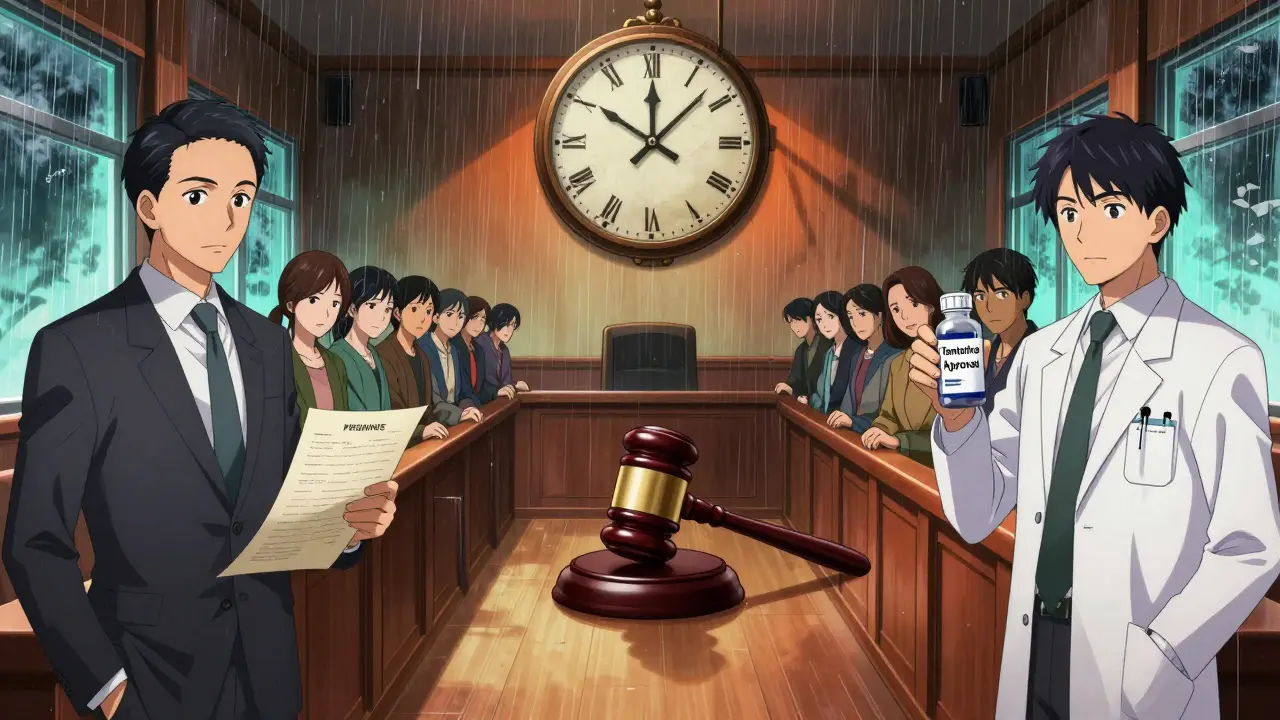
The U.S. generic drug market runs on a delicate balance: bring affordable medicine to patients fast, but don’t let innovators lose their incentive to invent. At the heart of this system is something most people never hear about - the 30-month stay. It’s not a law you’ll find on a billboard or in a TV ad. But it’s one of the biggest reasons why your prescription might cost five times more than it should - and why that cheaper generic version you’re waiting for still isn’t on the shelf.
What Exactly Is the 30-Month Stay?
The 30-month stay isn’t a delay created by bureaucracy. It’s a legal trigger built into the Hatch-Waxman Act a 1984 U.S. law designed to balance drug innovation with generic competition. When a generic drug company files an application to sell a copy of a brand-name drug, they have to say whether they believe the patents on that drug are invalid or won’t be infringed. This is called a Paragraph IV certification. If they do this, the brand-name company has 45 days to sue them for patent infringement. Once that lawsuit is filed, the FDA is legally required to pause final approval of the generic drug - for up to 30 months.
That’s it. No hearing. No vote. Just a clock. And if the lawsuit drags on past 30 months? The stay can extend. If the court rules in favor of the generic maker before then? The stay ends early. The FDA doesn’t decide whether the patent is valid. It doesn’t even get to approve the drug until the legal mess is sorted out.
Why Does This Matter to Patients?
Think about a drug like Enbrel or Humira. These biologics cost over $2,000 a month. Patients wait years for generics to come out. But even when a generic company wins its lawsuit, approval doesn’t mean instant access. The FDA can give what’s called a tentative approval during the 30-month stay - meaning the drug passes all safety and science checks. But it can’t hit shelves until the legal clock runs out.
According to FDA data from 2022, 78% of generic applications received tentative approval while patent cases were still pending. Yet the average time between tentative approval and final launch was 11.3 months. Why? Because companies aren’t always ready. They need manufacturing lines, distribution deals, pricing negotiations. But here’s the catch: the 30-month stay gives brand companies a legal shield to buy time - time they often use to strike deals with generic makers to delay launch even longer.
A 2017 FTC report found that 78% of these patent lawsuits ended in settlements that pushed generic entry past the patent’s official expiration date. That’s not just delay - that’s paid delay. And it’s costing Americans billions.
The Hidden Cost: Billions in Extra Spending
The U.S. spends $127.4 billion a year on generic drugs - 90% of prescriptions, but only 23% of total drug spending. That’s because generics cut prices by 80-85% once they enter the market. But when the 30-month stay is stretched out, those savings get pushed back.
The FTC says patent litigation delays tied to this system add about $13.9 billion annually to U.S. drug costs. That’s not just about one drug. It’s about dozens. For example, a 2023 study from the University of Southern California found that for drugs with Paragraph IV challenges, the median gap between the end of the 30-month stay and the actual generic launch was 3.2 years. That’s not a coincidence. It’s a strategy.
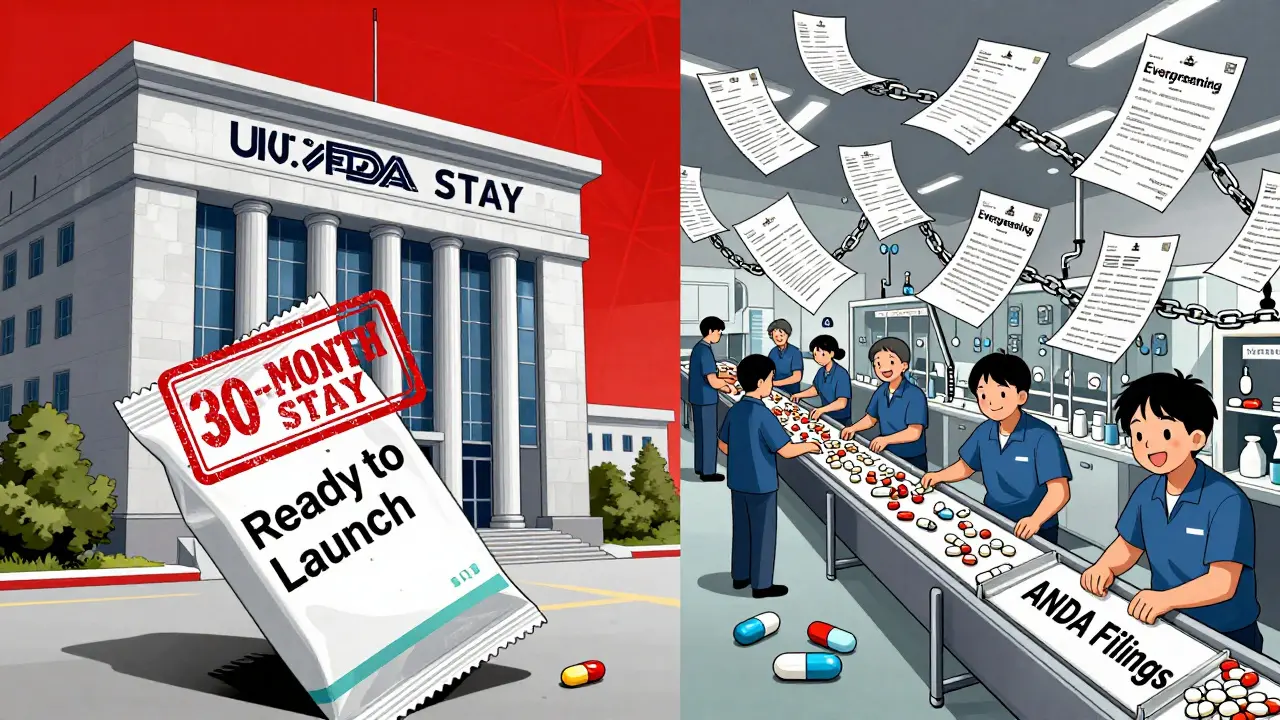
Brand companies pile on patents - not just the original one, but secondary ones covering things like pill coatings, dosing schedules, or delivery methods. A 2019 Brookings study found that 67% of patents listed for top-selling drugs were filed after the drug’s original approval. These are called "patent evergreening" tactics. And each one can trigger a new 30-month stay - if not for the same generic company, then for the next one trying to enter.
How It Compares to the Rest of the World
Other countries don’t do this. In the European Union, there’s no legal pause tied to patent lawsuits. Generic companies can file for approval, and the regulator makes a decision based on science - not court calendars. Canada has a 24-month stay, but it’s less flexible and doesn’t allow multiple triggers. The U.S. system is unique in how tightly it ties regulatory approval to litigation outcomes.
That’s why generic companies from India and China now make up 63% of all ANDA filings. They know how to navigate this maze. They’ve built teams of lawyers, regulatory experts, and patent analysts. One survey found that 89% of U.S.-based generic manufacturers now have dedicated Hatch-Waxman teams, with annual budgets averaging $2.7 million per company. That’s not R&D. That’s legal warfare.
Who Wins? Who Loses?
Brand companies argue the system is fair. They say without it, they’d never invest in new drugs. Former FDA Commissioner Scott Gottlieb claims the Hatch-Waxman Act has saved consumers $2.2 trillion since 1984. And he’s right - without generics, we’d be paying more. But the real question isn’t whether generics help - it’s whether the 30-month stay is the right tool to protect innovation.
Harvard’s Dr. Aaron Kesselheim says the stay has become a tool for systematic delay. His research shows it adds an average of 1.8 years to market exclusivity for blockbuster drugs. Meanwhile, the FTC’s Lina Khan points out that the average drug now has 8.3 patents listed in the Orange Book - up from 1.2 in 1995. That’s not innovation. That’s obstruction.
And patients? They’re stuck in the middle. A senior regulatory affairs specialist at Teva told the Generics Bulletin Board: "We’ve seen cases where the 30-month stay creates false security for brand companies - the litigation drags beyond 30 months, but the generic launch gets delayed by internal commercial readiness issues, not the stay itself." In other words, the system isn’t just slowing down generics - it’s making companies wait for reasons that have nothing to do with patents.

What’s Changing? What’s Coming?
Pressure is building. In February 2023, Congress introduced the Affordable Prescriptions for Patients Act, which would cut the 30-month stay to 18 months and ban stays for secondary patents. The FDA also proposed new rules to force brand companies to list only valid, relevant patents in the Orange Book. Right now, they can list dozens - even if some are weak or expired.
If these changes pass, experts predict generic entry could accelerate by a median of 9.2 months for small-molecule drugs. That’s $28 billion in annual savings, according to USC researchers. But drugmakers warn it could cost $14 billion in lost R&D investment. The truth? Most new drugs are still being developed. The problem is that the system is being abused to protect old ones.
Final Reality Check
The 30-month stay was never meant to be a weapon. It was meant to be a pause button - a way to let courts decide patent disputes without chaos. But today, it’s a delay engine. It’s used to squeeze out extra years of monopoly pricing. It’s used to scare off smaller generic companies who can’t afford $5 million lawsuits. And it’s used to make patients wait - sometimes for years - for medicines they can’t afford.
There’s no magic fix. But if we want real price relief, we need to stop pretending that every patent lawsuit deserves a 30-month clock. The science is ready. The manufacturing is ready. The patients are ready. The law just needs to catch up.
What triggers the 30-month stay?
The 30-month stay is triggered when a generic drug company files an Abbreviated New Drug Application (ANDA) with a Paragraph IV certification - meaning they challenge the validity or infringement of a patent listed in the FDA’s Orange Book. If the brand-name drug manufacturer files a patent infringement lawsuit within 45 days of receiving notice of this certification, the FDA must automatically delay final approval of the generic drug for up to 30 months.
Can the 30-month stay be extended beyond 30 months?
Yes. If the patent litigation isn’t resolved within 30 months, the FDA can extend the stay until the court reaches a final decision. Courts can also shorten the stay if they find the lawsuit was filed in bad faith or without merit. The stay doesn’t automatically end after 30 months - it ends when the litigation ends or is dismissed.
Does the FDA approve the generic drug during the 30-month stay?
Yes - but only tentatively. The FDA can and does complete its scientific review during the stay. If the drug meets all safety and efficacy standards, the agency issues a "tentative approval." This means the generic is ready to go - but legally can’t be sold until the 30-month stay ends or the court rules in favor of the generic manufacturer.
Why do some generic drugs take years to launch even after the 30-month stay ends?
Because the stay is only one part of the puzzle. After approval, companies need to set up manufacturing, negotiate with distributors, price the drug, and sometimes settle with other generic competitors. In some cases, brand companies strike deals with the first generic filer to delay launch - a practice called "pay-for-delay," which is now under regulatory scrutiny.
How does the 30-month stay affect drug prices?
It delays price drops. Generic drugs typically cut prices by 80-85% within a year of launch. The 30-month stay can delay that launch by months or even years. The FTC estimates patent-related delays cost U.S. consumers $13.9 billion annually in extra drug spending. When the stay is extended through litigation or settlements, patients pay more for longer.
Roland Silber
March 5, 2026 AT 16:58The 30-month stay isn't just a legal loophole-it's a profit-maximizing machine disguised as intellectual property protection. I've worked in pharma compliance for 12 years, and I've seen companies file 12 patents on a single drug just to reset the clock. It's not innovation. It's litigation theater.
The FDA's tentative approval system is brilliant-if only it meant anything. Patients think "tentative" means "almost ready." But no, it just means "waiting for the lawyers to finish their coffee."
And don't get me started on pay-for-delay deals. Brand companies pay generics to stay off the market. That's not capitalism. That's collusion with a FDA stamp on it.
Patrick Jackson
March 6, 2026 AT 05:09This is why I cry into my generic ibuprofen at 2 a.m. 😭
My mom’s insulin costs $800/month because the generic got stuck in a 30-month legal quagmire. She’s 68. She doesn’t care about patent law. She just wants to breathe.
I’m not even mad anymore. Just... heartbroken. We built a system that protects corporate balance sheets over human lives. And we call it "fair."
Someone needs to burn this whole thing down. And then rebuild it with empathy, not lawyers.
Adebayo Muhammad
March 8, 2026 AT 03:58Vikas Verma
March 9, 2026 AT 07:09Sean Callahan
March 11, 2026 AT 01:45Ferdinand Aton
March 11, 2026 AT 14:05William Minks
March 12, 2026 AT 14:39As someone who's lived in 5 countries, I can say this: the U.S. is the only place where a drug patent lawsuit can delay a life-saving medicine for years. In Germany? FDA approves. Done. In Japan? Same. Here? We turn healthcare into a courtroom drama with a $5 million budget.
It's not about innovation. It's about branding. And we're all just spectators.
Jeff Mirisola
March 13, 2026 AT 19:47I get it. We need generics. We need lower prices. But let’s not pretend brand companies are villains. They’re just playing the game we gave them. If we want change, we need to fix the rules-not just blame the players.
What if we capped the number of patents per drug? What if we forced transparency on settlement deals? What if we gave the FDA power to approve tentatively-approved drugs immediately?
Solution-oriented thinking > outrage. We can fix this. But we need to build, not burn.
Susan Purney Mark
March 14, 2026 AT 20:02I work in a clinic. I see patients every day who skip doses because they can’t afford the brand. One woman told me last week, "I ration my pills so they last longer."
The 30-month stay isn’t an abstract policy. It’s a woman choosing between insulin and groceries. It’s a veteran choosing between his blood pressure med and his rent.
We need to stop talking about "system efficiency" and start talking about human survival.
Joey Pearson
March 15, 2026 AT 08:16Pranay Roy
March 16, 2026 AT 17:58Joe Prism
March 17, 2026 AT 17:57Bridget Verwey
March 18, 2026 AT 11:12Oh honey. You think the 30-month stay is the problem?
Try telling a single mom in rural Ohio that her asthma inhaler is "coming soon" while she’s on a 14-hour waitlist at the pharmacy.
The real crime? We let this happen and still call ourselves compassionate.
Andrew Poulin
March 18, 2026 AT 22:24Weston Potgieter
March 20, 2026 AT 20:26